


LACONIA — Hassan Sapry showed no emotion as state prosecutors displayed graphic images from inside the Blueberry Lane apartment where they say he killed Wilfred Guzman Sr. in April 2019.
Wednesday marked the second day of the second trial of Sapry, 27. A mistrial was declared during the original prosecution in 2022. Prosecutors say Sapry killed Guzman Sr., then 57, in cold blood in his own apartment, following an argument about race and religion more than six years ago.
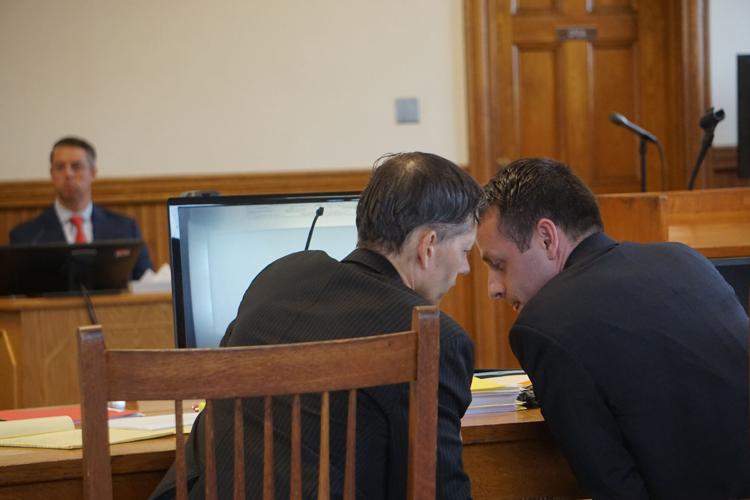
Attorneys Mark Sisti and Amy Ashworth of Sisti Law Offices are defending Sapry, and say he was insane at the time of Guzman Sr.'s death. They’re making an affirmative defense, not guilty by reason of insanity, and the burden — by clear and convincing evidence — is on Sapry to prove it.
“This burden of proof is a lesser burden than beyond a reasonable doubt,” Superior Court Justice Elizabeth Leonard told jurors before proceedings were underway on Tuesday morning.
Sapry’s team has to prove to jurors it was highly likely he was mentally ill or suffering a mental defect at the time of Guzman Sr.’s death, and the alleged crimes were a product of a mental illness or defect.
Leonard told jurors they must balance the facts of the case with New Hampshire State law, basing their eventual verdict on only the evidence presented throughout the trial, which is anticipated to take two to three weeks to conclude.
Prosecutors must prove to the jury, beyond a reasonable doubt, that Sapry committed the nine offenses he’s charged with, including first- and second-degree murder.
“The burden of proof on the matter of guilt is always on the state,” Leonard said.
The jury, which was selected over a one-week period and solidified Monday, heard from law enforcement and expert witnesses Tuesday afternoon and all of Wednesday about the state of Guzman Sr.’s apartment following his death, and about the items and evidence found within the apartment and at Sapry’s residence on Pleasant Street.
On Tuesday, Laconia Police Patrol Sgt. Robert Cameron testified he was on duty on April 19, 2019, and was called to the Guzman apartment after another officer conducted a welfare check there and discovered the body of a man. Upon his arrival, Cameron saw the kitchen was a mess and, looking through a small window there, noticed dried blood on counter tops and elsewhere.
“It appeared that some type of event had taken place,” he said.
Cameron also testified, on cross-examination, there were no signs of forced entry to the apartment, and the upstairs appeared to be in order. Later testimony would note there were reddish-brown stains discovered in the upstairs bathroom.
“It appeared that possibly some type of struggle happened,” Cameron said.
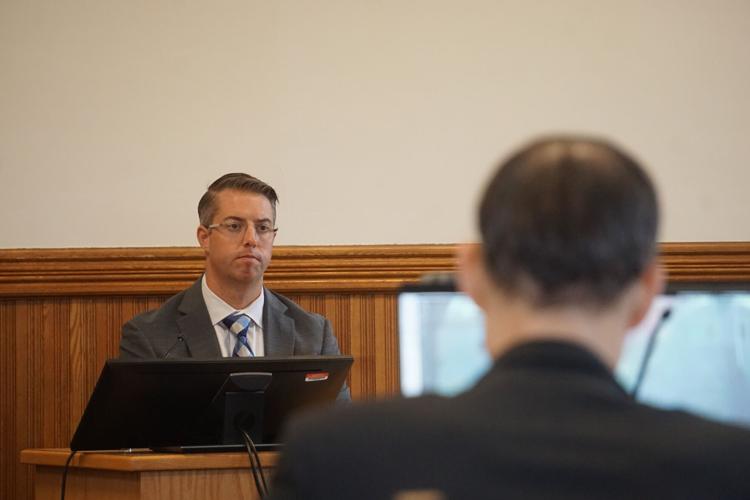
Christopher Martineau, a State Police detective sergeant, was a member of the Major Crime Unit dispatched to Guzman Sr.’s Blueberry Lane apartment, working as an evidence technician.
Martineau testified it took investigators five days to process all of the evidence recovered at the Guzman residence, starting on April 19. He described photos, shown to jurors by prosecutors, of reddish-brown stairs observed on both entryways to the apartment.
While at the scene, Martineau found items scattered around the kitchen, including broken glass, knives, other kitchen utensils and a sword. He also observed a man who was dead on the kitchen floor, which he now knows to be Guzman Sr.
“The range itself has broken glass on the oven door and RBS, as well,” Martineau said in reference to the appliance prosecutors say Sapry smashed Guzman Sr.’s head into during an attack.
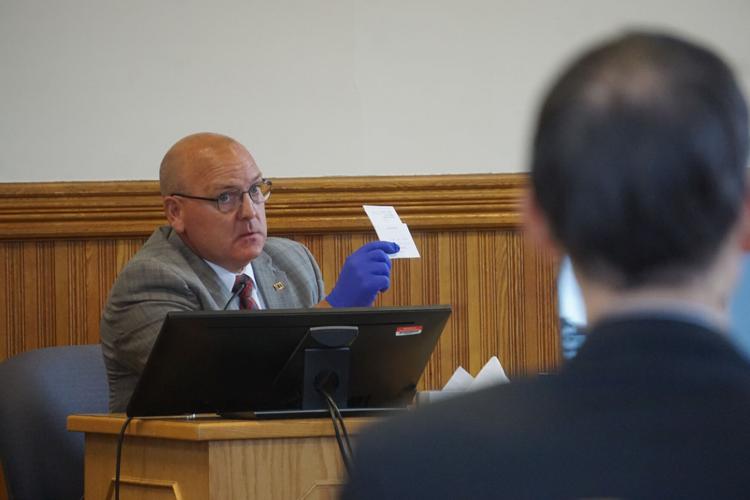
He unpackaged and displayed to the jury state’s Exhibit No. 147, a sword handle, its blade mostly broken, stained with reddish-brown material.
Under cross-examination by Sisti, Martineau said investigators also found a large machete in the Guzman home, on top of a washing machine, that didn’t appear to have been used during the alleged attack. They also found six double-edged knives on the top shelf of a closet, none of which appeared to have been used by Sapry that night, and a second sword, also unused.
Martineau testified he’s never seen a body that had suffered 140 wounds, nor had he seen table forks, kitchen tongs, whisks or a television set used as deadly weapons.
“That scene was quite a mess, wasn’t it?” Sisti asked.
“It was,” Martineau said.
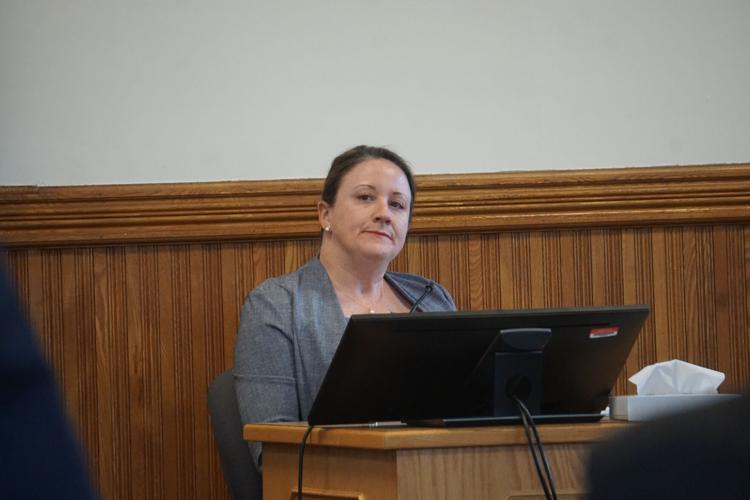
Jill Therriault, forensic scientist with the State Police forensic lab in Concord, testified Wednesday she’d analyzed one of the knives believed to have been used in the attack. It had broken into pieces, and, through her work, she determined the two pieces were originally connected.
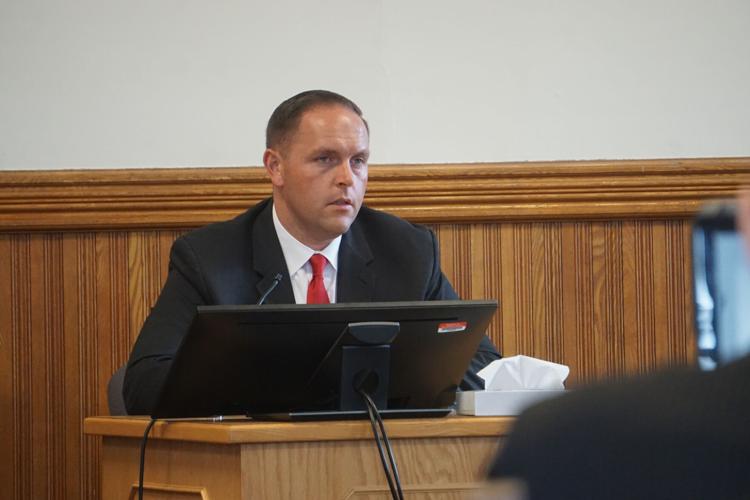
State Police Det. Sgt. Christopher Elphick testified police found personal items belonging to Guzman Sr. in Sapry’s bedroom closet, including a wallet and numerous credit, debit and retail rewards cards, a passport and foreign currency, among other things. They also found a T-shirt, underwear, athletic socks, an athletic jacket and black gloves with visible reddish-brown stains, plus the handle of a broken knife with a portion of the blade still attached, also stained.
Sisti asked Elphick if he knew if Sapry had ever touched many of those items, and Elphick said he didn’t. He also told Sisti none of the stained clothing appeared to have been washed after the fact.
Trial is scheduled to continue Thursday morning.


(0) comments
Welcome to the discussion.
Log In
Keep it Clean. Please avoid obscene, vulgar, lewd, racist or sexually-oriented language.
PLEASE TURN OFF YOUR CAPS LOCK.
Don't Threaten. Threats of harming another person will not be tolerated.
Be Truthful. Don't knowingly lie about anyone or anything.
Be Nice. No racism, sexism or any sort of -ism that is degrading to another person.
Be Proactive. Use the 'Report' link on each comment to let us know of abusive posts.
Share with Us. We'd love to hear eyewitness accounts, the history behind an article.