


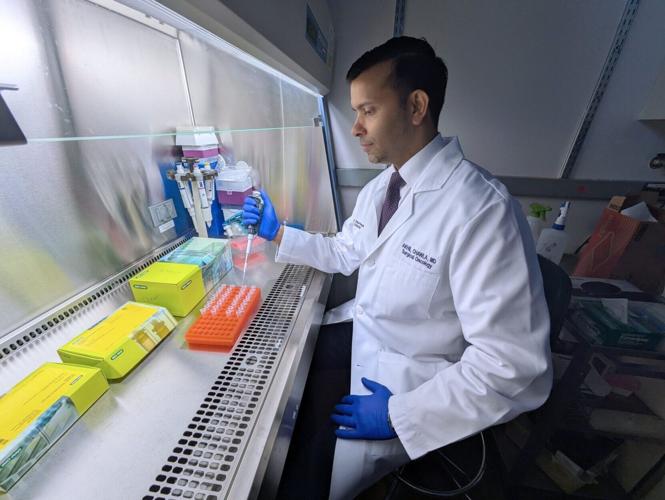
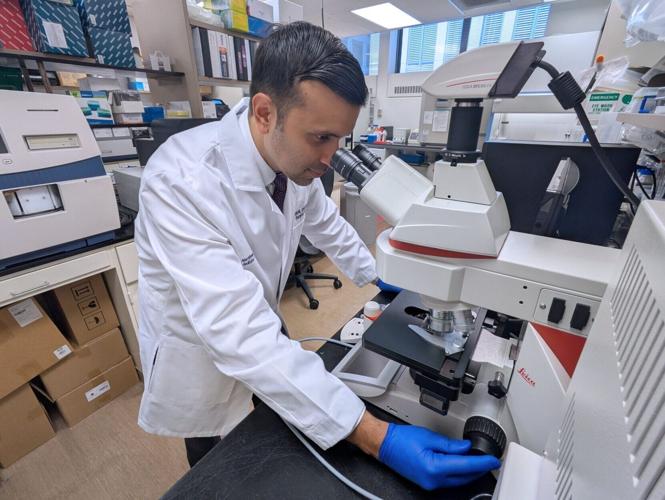

Study senior author Dr. Akhil Chawla, a complex surgical oncologist, working in his lab at Northwestern University Feinberg School of Medicine in Chicago. (Ben Schamisso / Northwestern University via SWNS)
By Stephen Beech
A new blood test can detect even minute traces of one of the deadliest forms of cancer.
The ultra sensitive test can find hidden signs of pancreatic cancer by looking for a key genetic mutation missed by standard testing.
American scientists say it has the potential to extend lives by helping doctors identify patients whose disease is more likely to return - even when scans appear reassuring.
They explained that the new blood test focuses on KRAS - a genetic mutation that drives more than 90% of pancreatic cancers.
The research team, from Northwestern University Feinberg School of Medicine, Chicago, collected blood samples from patients with localized pancreatic cancer throughout treatment.
At diagnosis, the sensitive test detected signs of cancer in 65% of patients, compared to 17% using the standard test.

Study senior author Dr. Akhil Chawla, a complex surgical oncologist, working in his lab at Northwestern University Feinberg School of Medicine in Chicago. (Ben Schamisso / Northwestern University via SWNS)
Following chemotherapy and surgery, the sensitive test continued detecting residual cancer in most patients, while imaging didn't.
The findings, published in the journal Clinical Cancer Research, come as a new revolutionary drug targeting KRAS is showing substantial survival benefits.
Study senior author Akhil Chawla said: "As we enter the era of KRAS-targeted therapies, having a screening tool that tracks the same mutation becomes increasingly important.
"That combination could fundamentally change how we identify high-risk patients, monitor microscopic disease, and potentially intervene earlier before recurrence becomes clinically visible, ultimately getting more patients to cure."
Pancreatic cancer is one of the deadliest malignancies, even when diagnosed before it has visibly spread.
Many patients undergo months of chemotherapy and surgery, yet their cancer often returns.
Chawla said: "In these patients, circulating tumor DNA levels are often extremely low and difficult to detect.


"Many patients and families ask me, 'How do we know if the treatment is working?'

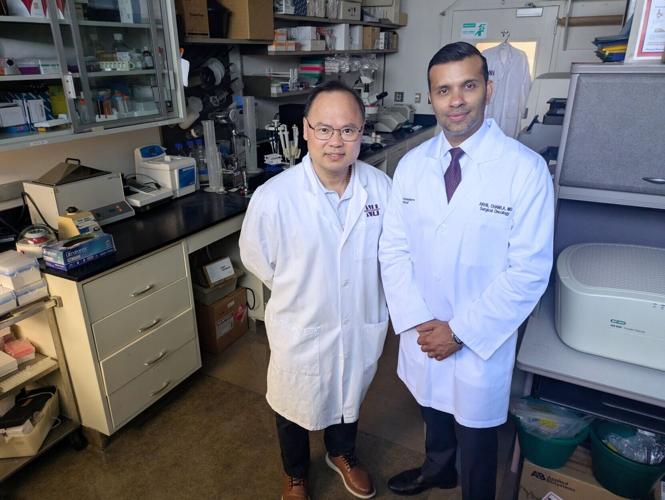
Study authors Drs. Akhil Chawla (right) and Qiang Zhang in their lab at Northwestern University Feinberg School of Medicine in Chicago. (Ben Schamisso / Northwestern University via SWNS)
"This research is part of trying to answer that question more precisely."
The study followed 106 Northwestern Medicine patients with localized pancreatic cancer from diagnosis through chemotherapy and surgery.
The research team collected blood samples from the study participants before treatment, after chemotherapy and after surgery between October 2020 and October 2024.
At diagnosis, the study found that the more sensitive blood test, digital droplet PCR or ddPCR, detected signs of cancer in nearly four times as many patients as conventional next-generation sequencing tests (NGS), which are more commonly used.
Even after chemotherapy and surgery, ddPCR continued detecting cancer in most patients, while NGS and standard testing didn't.
After chemotherapy, ddPCR detected tumor KRAS DNA in 60% of patients, compared with just 5% for NGS.
After surgery, ddPCR detected tumor KRAS DNA in 56% of patients, compared with 9% for NGS.
Chawla said: "This suggests physicians may currently be missing residual disease in most patients using currently available testing approaches."
The findings showed that better detection meant better prediction of survival outcomes.
The clearest example was the discovery of a previously hidden group of high-risk patients whose cancer was missed by standard NGS but detected by ddPCR.
That group survived an average of 27 months after diagnosis, compared with 41 months among patients who tested negative on both tests.
Chawla added: "NGS and ddPCR are blood tests - often called liquid biopsies - that search for traces of DNA shed by cancer cells into the bloodstream.
"Detecting this tumor DNA provides an early sign that cancer is present or may return.
"Because these tests rely on a simple blood draw, they can be repeated over time without requiring invasive procedures."


(0) comments
Welcome to the discussion.
Log In
Keep it Clean. Please avoid obscene, vulgar, lewd, racist or sexually-oriented language.
PLEASE TURN OFF YOUR CAPS LOCK.
Don't Threaten. Threats of harming another person will not be tolerated.
Be Truthful. Don't knowingly lie about anyone or anything.
Be Nice. No racism, sexism or any sort of -ism that is degrading to another person.
Be Proactive. Use the 'Report' link on each comment to let us know of abusive posts.
Share with Us. We'd love to hear eyewitness accounts, the history behind an article.