







(Photo by John Matthew via Pexels)
By Stephen Beech
Loneliness rewires the brain to drive men to drink, suggests a new study.
Feeling lonely escalates boozing in male mice — but suppresses it in females, say scientists.
The first-of-its-kind research discovered a new brain mechanism linking loneliness to drinking alcohol.
Scientists say their findings offer a biological explanation for why loneliness raises the risk of addiction.
American researchers tracked and controlled brain circuits of mice as they chose whether to drink alcohol.

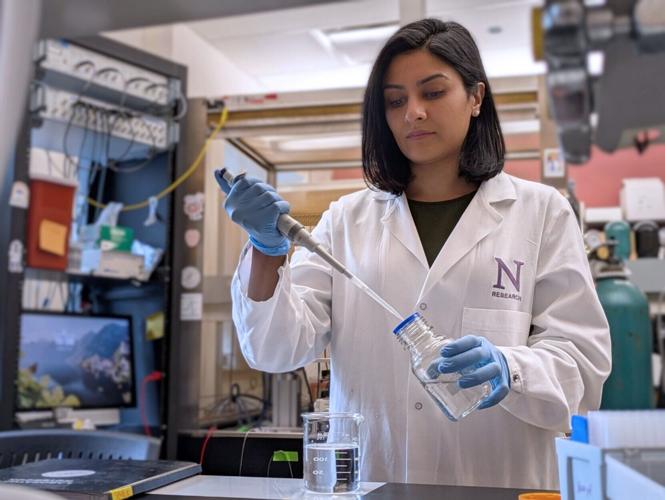
Study first author Dr. Reesha Patel doing research in her lab at Northwestern University Feinberg School of Medicine. (Ben Schamisso / Northwestern University via SWNS)
Scientists from Northwestern University, Illinois, and the Salk Institute for Biological Studies, California, identified a brain mechanism through which isolation escalates alcohol use in male mice — but suppresses it in females.
Social isolation is rising worldwide and is now recognized as a major public health risk, with strong links to substance misuse.
But how feeling isolated rewires the brain in ways that increase vulnerability to alcohol abuse has not been fully understood.
Study first author Reesha Patel, from Northwestern University's Feinberg School of Medicine, said: "This is the first study to identify a specific brain circuit that explains how social isolation can drive increased alcohol use in males, marking a major advance for the field.

"These findings provide a much clearer biological target for understanding and eventually treating alcohol misuse that arises from isolation, a problem that is becoming increasingly common."
She explained that, for the study, adult male and female mice were first housed socially, then some were moved to single housing to model adult social isolation, while others remained socially housed as controls.
The mice were given daily one-hour opportunities to drink from a bottle of water or a bottle filled with a 15% alcohol solution.


Their consumption and choices were tracked for two weeks, during which male mice progressively increased their alcohol intake, while females reduced it.
Using miniature microscopes, the research team recorded activity in specific brain cells while the animals freely moved around and chose whether to drink alcohol.
The cells they monitored form a brain pathway, or circuit, connecting the basolateral amygdala, which processes emotional and stress signals, to the medial prefrontal cortex, which regulates decision-making.

(Photo by MART PRODUCTION via Pexels)
Patel said: "Our work shows that a defined pathway becomes overactive during isolation and directly increases drinking, and that males and females rely on different neural strategies when they're lonely.
"This may help explain long-standing sex differences in neuropsychiatric disorders."
She said she cannot say definitively why isolation increased alcohol consumption in male mice but reduced it in females.
But Patel noted that the sex differences observed in the study mirror patterns reported in some human research.
The team then tested whether the brain pathway merely reflected drinking or caused it.
Using optogenetics — brief pulses of light that turn brain circuits on or off — they artificially activated the circuit in non-isolated male mice.
That caused their brains to respond to alcohol as if they had been socially isolated.

(Photo by cottonbro studio via Pexels)
The findings, published in the journal Nature Neuroscience, showed that when the same circuit was silenced in isolated male mice, alcohol consumption decreased.
The research team now wants to understand what keeps the circuit overactive during social isolation and how downstream brain regions, including the medial prefrontal cortex, contribute to the effect.
They also plan to look at why males and females respond differently to isolation and whether hormones or deeper circuit-level differences play a role.
Patel added: "Another important step is determining how these findings translate to humans."


(0) comments
Welcome to the discussion.
Log In
Keep it Clean. Please avoid obscene, vulgar, lewd, racist or sexually-oriented language.
PLEASE TURN OFF YOUR CAPS LOCK.
Don't Threaten. Threats of harming another person will not be tolerated.
Be Truthful. Don't knowingly lie about anyone or anything.
Be Nice. No racism, sexism or any sort of -ism that is degrading to another person.
Be Proactive. Use the 'Report' link on each comment to let us know of abusive posts.
Share with Us. We'd love to hear eyewitness accounts, the history behind an article.