




Do depression and anxiety treatments work? What new data shows
Depression and anxiety are among the most common mental health conditions, yet many people question whether treatment leads to meaningful improvement. To better understand how care impacts symptoms, LifeStance Health measures and reports treatment outcomes, offering insight into what progress may look like. This article outlines what the data shows about anxiety and depression treatment success.
What the numbers show about depression and anxiety treatment success
LifeStance Health measures treatment improvement using clinically validated questionnaires that are widely used in mental healthcare: the PHQ-9 (Patient Health Questionnaire-9) for depression, and the GAD-7 (Generalized Anxiety Disorder-7) for anxiety.
Based on reporting from patients who received treatment between 2024 and 2025:
- 73% of patients showed clinically significant improvement in depression symptoms, among 150,000 individuals with at least moderate depression.
- 79% of patients showed clinically significant improvement in anxiety symptoms, among 140,000 individuals with at least moderate anxiety.
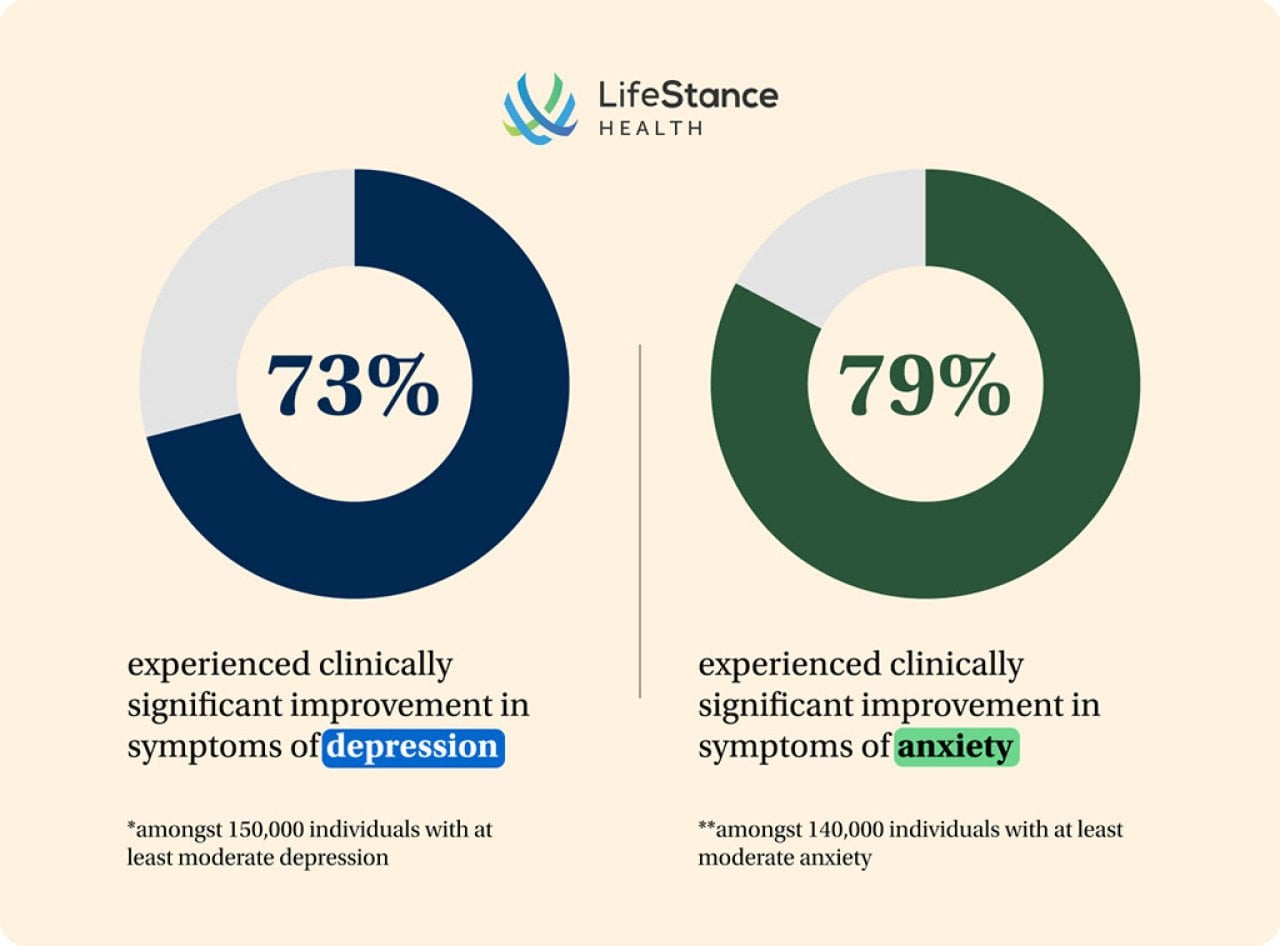
These outcomes reflect changes in patient-reported symptoms over time. Improvement can include feeling less overwhelmed, experiencing fewer symptoms or noticing that symptoms feel more manageable in daily life.
While each person’s experience with mental healthcare is different, these findings indicate that the patients in this research cohort broadly experience meaningful improvement during treatment.
What PHQ-9 and GAD-7 measure
PHQ-9 and GAD-7 are trusted mental health assessments used across healthcare settings. They ask about symptoms commonly associated with depression and anxiety, including mood, energy levels, sleep, concentration, worry and the ability to manage life demands over recent weeks. Their ability to estimate severity of these disorders along with their ease of use has made them a widely adopted way to track progress in mental healthcare.


What progress can look like with depression and anxiety treatment
For individuals considering mental healthcare, it can be reassuring to know whether treatment often leads to improvement.
Outcomes reporting helps provide transparency and set realistic expectations. It can help answer questions such as:
- Do people commonly feel better with treatment?
- Is improvement possible for depression and anxiety?
- What does progress look like for people who seek care?
Not sure what symptoms may mean?
Many people are unsure whether what they are feeling may be depression, anxiety or something else. That uncertainty can make it difficult to know where to start.
Taking a free, confidential online mental health questionnaire can help individuals better understand what they may be experiencing. Taking a questionnaire may help individuals:
- Put language around what they are feeling
- Gain insight into symptom patterns
- Decide whether professional support may be helpful
Healing is possible
Depression and anxiety are common and treatable conditions. The outcomes shared in this article show that patients broadly experience improvement with treatment, which may offer reassurance for those considering mental healthcare.
This story was published by LifeStance Health and reviewed and distributed by Stacker.


(0) comments
Welcome to the discussion.
Log In
Keep it Clean. Please avoid obscene, vulgar, lewd, racist or sexually-oriented language.
PLEASE TURN OFF YOUR CAPS LOCK.
Don't Threaten. Threats of harming another person will not be tolerated.
Be Truthful. Don't knowingly lie about anyone or anything.
Be Nice. No racism, sexism or any sort of -ism that is degrading to another person.
Be Proactive. Use the 'Report' link on each comment to let us know of abusive posts.
Share with Us. We'd love to hear eyewitness accounts, the history behind an article.