




YouTube’s quiet takeover of AI search
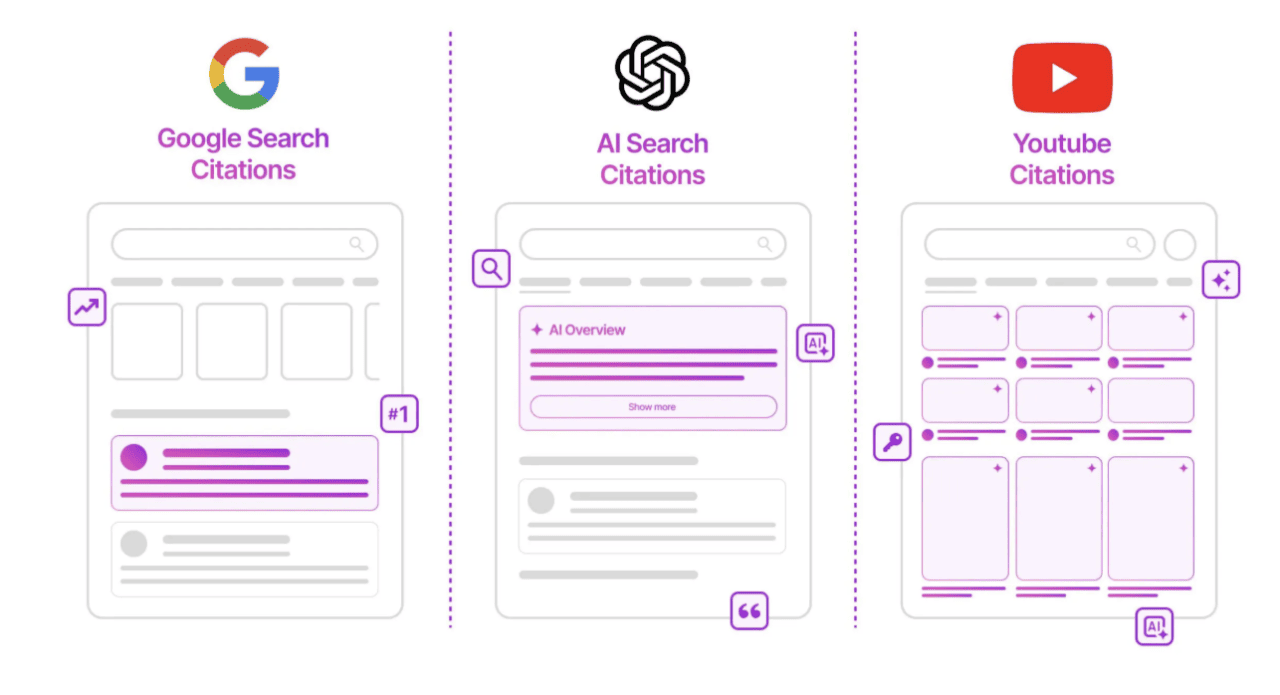
Search is changing faster than most people realize, and the evidence keeps pointing to the same source. Across Google’s AI Overviews, Perplexity, and ChatGPT, one domain consistently surfaces at the top of AI-generated answers: YouTube.
A platform most people associate with tutorials and entertainment is now the most cited source across AI search engines, outranking major news outlets, academic institutions, and legacy web publishers by a significant margin.
As this article from Elk Marketing explains, that pattern is forcing a harder question onto the desks of publishers, marketers, and platform strategists alike: If AI search is quietly reorganizing how authority gets assigned, what does it actually reward, and who gets left behind?
Why is YouTube outperforming traditional publishers in AI search?
YouTube’s lead in AI search is not a result of platform favoritism; it is a direct consequence of how the platform is built. Every video uploaded to YouTube generates a complete package of machine-readable data, including auto-generated transcripts, timestamped captions, and detailed metadata.
Large language models (LLMs) parse these elements with the same ease as they process written text. Effectively turning a 10-minute tutorial into a structured document, providing a clear data layer that models use to verify facts.
Recent BrightEdge data confirms this systemic advantage, showing that YouTube is cited nearly 200 times more frequently than any other video competitor across platforms like ChatGPT and Perplexity.
This utility is amplified by consistent user engagement. High watch time and interaction signals inform AI systems that a video successfully resolved a user’s intent. Particularly in instructional and “how-to” categories, YouTube provides a combination of clear, machine-readable formatting and verified authority that traditional text-based publishers struggle to replicate.
As search evolves, this alignment ensures that AI engines treat the platform not merely as a hub for entertainment but as a trusted, primary source for the technical and visual clarity that modern search experiences demand.
What does citation share reveal about AI search behavior?
That shift in trust has a measurable footprint, and citation share is where it becomes visible. Unlike traditional search rankings, which distribute traffic across dozens of competing pages, AI engines are consolidating around a much smaller pool of sources.
According to BrightEdge, 96.8% of cited domains see zero change week over week, and when shifts do occur, 87% of them are losses. That stability reflects how deliberately AI systems select their sources, and how rarely they expand that circle once it forms.
What those numbers expose is a fundamental change in search architecture. AI engines are now selecting sources rather than ranking pages, and the criteria they apply favor content that demonstrates answers over content that argues for them.
Structured, verifiable information that a model can parse and reproduce with confidence consistently earns citation placement, while authority signals like backlinks and domain strength are evolving to work alongside semantic structure and entity consistency.
Citation visibility has become its own performance metric, one that rewards a different kind of content discipline and sits at the frontier of where search strategy is heading.
Why does performance vary across AI engines?
Visibility within generative search is not uniform because each platform operates on unique retrieval mechanics. Google’s AI products naturally prioritize content from their own ecosystem, reinforcing the dominance of YouTube within their search summaries.
In practice, BrightEdge research shows Google AI Overviews cite YouTube in 29.5% of responses, while Google AI Mode includes the platform in 16.6% of its results.
However, not every AI engine applies that discipline the same way, and the differences are significant. Perplexity operates differently, as its citation patterns move with more speed, with YouTube’s share recently growing by 4.8% week over week, suggesting an engine that updates its source preferences fluidly.


ChatGPT presents a different case, as its video citation volume remains selective at 0.2%, yet that number has doubled week over week, pointing to an engine still calibrating how it weighs external sources, yet moving quickly once it decides on a format.
Each platform is solving the same problem through a different lens, and understanding those incentives is what separates publishers who appear in AI-generated answers from those who do not.
What does this mean for digital publishers?
For publishers, that widening gap signals a need to adapt quickly. As AI engines narrow their focus to a smaller group of reliable sources, the traditional model of building authority through written text alone is reaching its limits.
Text still matters, and it still earns citations, but the data shows that AI-generated answers increasingly rely on sources that communicate across multiple formats. Written content and video now function as a single, combined unit of authority, rather than separate channels competing for the same audience.
That shift carries a deeper implication. The line between a search engine and a content platform is fading, and publishers who treat those two spaces as separate are relying on an outdated playbook.
Distribution format is now part of the authority equation, and the organizations best positioned for AI search visibility are those treating content structure, format diversity, and machine readability as editorial decisions, not technical afterthoughts.
Is AI search accelerating the consolidation of content power?
As AI engines prioritize a select group of established platforms to ensure accuracy and reduce risk, they function as gatekeepers that funnel user attention toward a narrow set of trusted domains. This winner-take-all dynamic naturally favors large, high-authority outlets, often leaving independent publishers struggling to maintain visibility.
Consequently, many sites that once relied on high-volume search traffic now see those visitors diverted directly to AI-generated interfaces, which satisfy the query without requiring a click to the source.
However, video content provides a strategic form of defensibility for those navigating this transition. Because modern AI models use multimodal capabilities to interpret visual evidence and transcripts, high-quality video serves as a verifiable source of truth that is difficult to replicate.
What we’re seeing is the first real example of multimodal optimization. Text alone can describe a process, but video shows it, and when that video is paired with transcripts and structured metadata, AI systems can interpret it as both visual evidence and a structured document.
By treating video as a core asset rather than an optional add-on, independent publishers can secure their place in AI-synthesized answers, ensuring their expertise remains central to the digital narrative.
The Structural Shift Already in Motion
AI search is not dismantling the content economy; it is reorganizing it around a different set of rules that are already in effect. Those rules are compressing the traditional search results page into a single synthesized answer, making citation visibility a more decisive measure of reach than click-through traffic ever was.
That compression is fundamentally reshaping how informational authority gets assigned, pushing AI systems to prioritize content that is structured, verifiable, and multimodal by design.
YouTube’s dominance across every major AI platform reflects that reality directly, confirming that format carries as much weight as expertise in determining what gets surfaced. This is what forces the definition of search engine optimization to evolve, shifting away from ranking individual pages toward earning selection as a trusted source.
For publishers, brands, and strategists navigating this transition, the most valuable content moving forward will be the kind that AI systems can interpret with confidence, cite with authority, and deliver to audiences at scale.
This story was produced by Elk Marketing and reviewed and distributed by Stacker.


(0) comments
Welcome to the discussion.
Log In
Keep it Clean. Please avoid obscene, vulgar, lewd, racist or sexually-oriented language.
PLEASE TURN OFF YOUR CAPS LOCK.
Don't Threaten. Threats of harming another person will not be tolerated.
Be Truthful. Don't knowingly lie about anyone or anything.
Be Nice. No racism, sexism or any sort of -ism that is degrading to another person.
Be Proactive. Use the 'Report' link on each comment to let us know of abusive posts.
Share with Us. We'd love to hear eyewitness accounts, the history behind an article.