


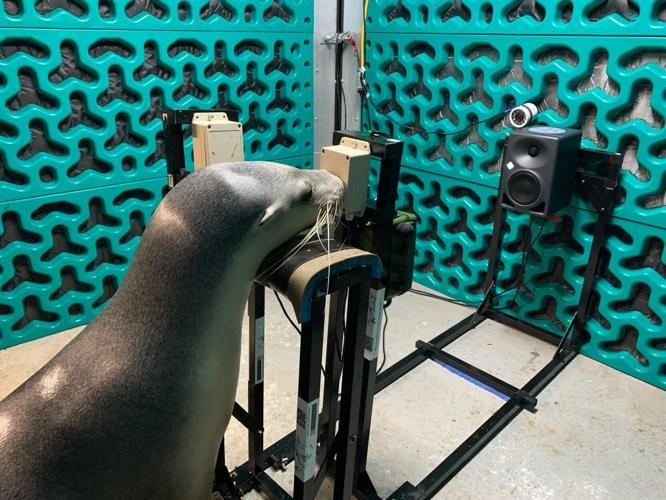
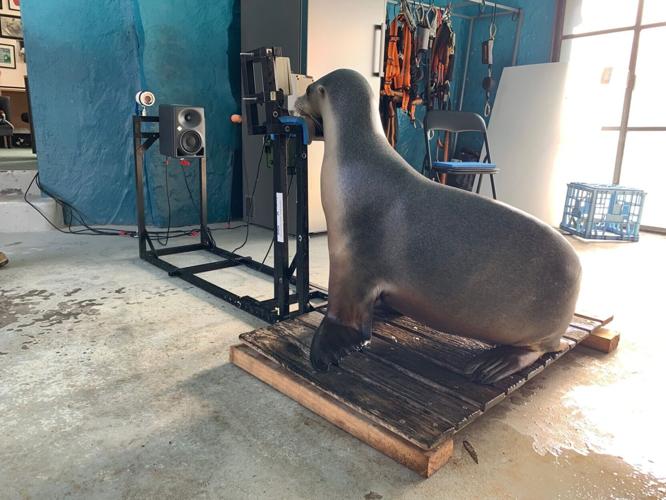
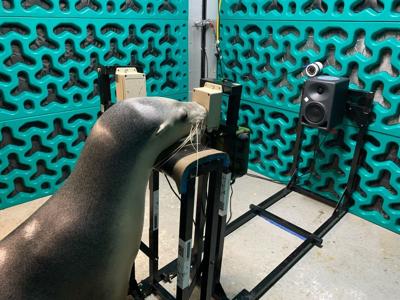

Eve the sea lion doing a hearing test. (Christine Erbe/Curtin University via SWNS)
By Dean Murray
Seals and sea lions have been trained to take hearing tests to begin to understand how much human noise bothers them.
Researchers from Curtin University and Taronga Conservation Society Australia have used the study to reveal what sounds these marine mammals can hear and help assess how human-made noise could affect them.
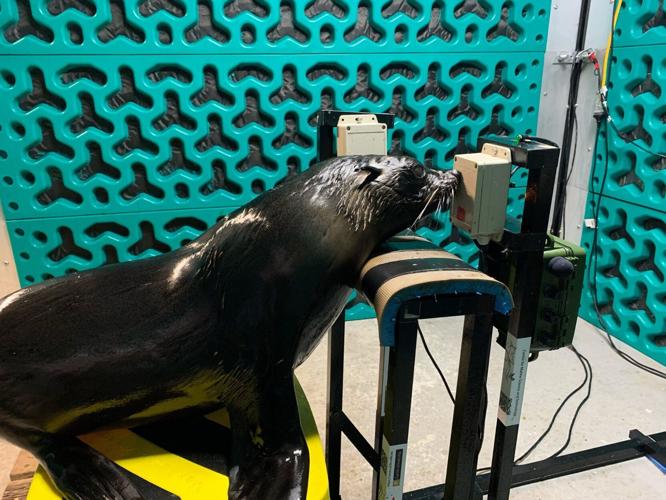
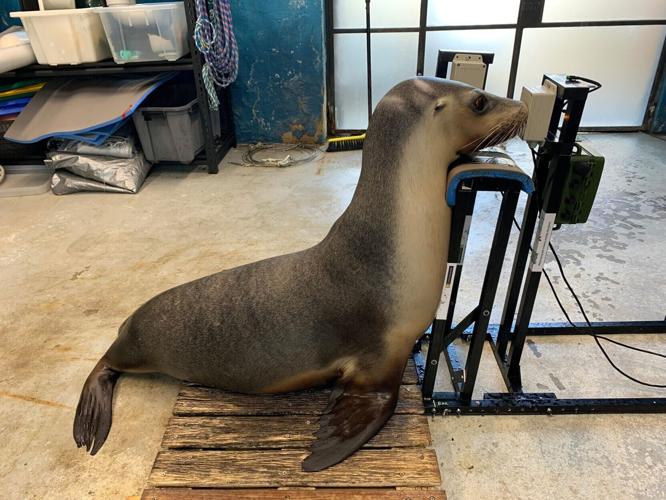
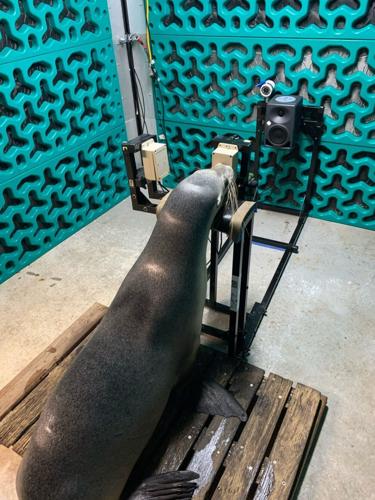
Marine keepers trained two Australian sea lions and two long-nosed fur seals at Taronga Zoo Sydney to respond to sounds by pressing a paddle when they heard a tone, with the mammals rewarded with fish for correct responses.

Nala the sea lion doing a hearing test. (Christine Erbe/Curtin University via SWNS)
Both species were most sensitive to sounds around 3.2 kilohertz, providing the first detailed baseline of hearing sensitivity for the two Australian species.
Lead researcher Christine Erbe, from Curtin’s Centre for Marine Science and Technology, said understanding what the animals could hear was an important first step in assessing the potential impacts of noise from human activity.
“Before we can understand whether a noise is affecting an animal, we need to know whether it can hear that noise in the first place,” Erbe said.
“These hearing tests give us that baseline and allow us to start asking how noises from ships, boats, aircraft and coastal construction might affect seals and sea lions.


Nala the sea lion doing a hearing test. (Christine Erbe/Curtin University via SWNS)
“The research is particularly important for the endangered Australian sea lion, which has an estimated population of only about 12,000 animals and relies on hearing for communication, finding food, navigation and detecting threats.”
The researchers also compared the long-nosed fur seals’ hearing with noise from boats, ships, aircraft, trains and construction, finding many of these sounds would be audible to the animals when on land.
Taronga Conservation Society Australia behavioral biologist Benjamin Pitcher said training the animals to voluntarily participate in the tests provided a valuable way to investigate their sensory abilities.

Nala the sea lion doing a hearing test. (Christine Erbe/Curtin University via SWNS)
“The seals and sea lions were given voluntary choice to participate in the hearing tests using positive reinforcement, allowing us to measure what they could actually perceive while keeping the animals engaged in the process,” Pitcher said.
“The findings could help inform environmental impact assessments and noise management as shipping, coastal development and offshore industries expand.
“We now know what these animals can hear in air. The next step is to understand how noise affects them under water, and when it begins to interfere with their behavior or hearing.”
The studies, “Aerial Audiograms of Two Long-Nosed Fur Seals (Arctocephalus forsteri)” and “In-Air Behavioral Audiograms of Two Australian Sea Lions (Neophoca cinerea),” were published in Conservation and Animals, respectively.


(0) comments
Welcome to the discussion.
Log In
Keep it Clean. Please avoid obscene, vulgar, lewd, racist or sexually-oriented language.
PLEASE TURN OFF YOUR CAPS LOCK.
Don't Threaten. Threats of harming another person will not be tolerated.
Be Truthful. Don't knowingly lie about anyone or anything.
Be Nice. No racism, sexism or any sort of -ism that is degrading to another person.
Be Proactive. Use the 'Report' link on each comment to let us know of abusive posts.
Share with Us. We'd love to hear eyewitness accounts, the history behind an article.