


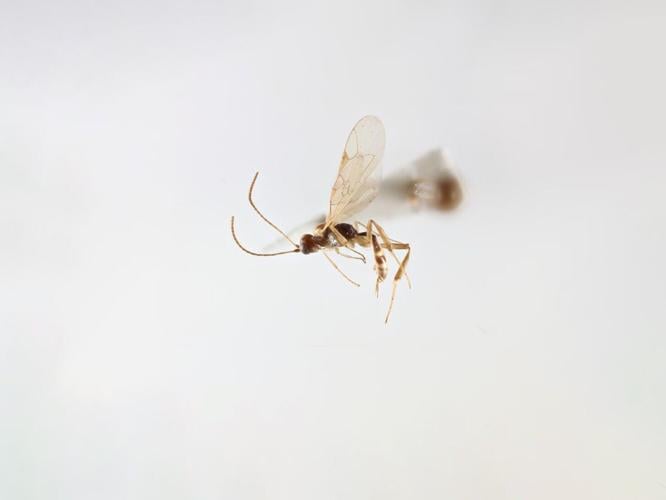



Mikedixson via Wikimedia Commons
By Stephen Beech
A new species of wasp has been named in honor of Sir David Attenborough's 100th birthday.
The insect, originally from Chile, was identified from a specimen housed at London's Natural History Museum.
Scientists from the Museum, who described the new genus and species of parasitic wasp, named it Attenboroughnculus tau as a birthday present for TV naturalist Sir David who turns 100 on Friday, May 8.
The researchers say Attenborough's work has inspired generations, including many of those working at the Museum, to appreciate and protect the natural world.
They explained that the species name "tau" refers to a striking "T" shaped marking on the insect's abdomen.
The study, published in the Journal of Natural History, gives new insights into one of the least understood groups of wasps.
Attenborough has highlighted parasitoid wasps in his documentaries, including memorable sequences in The Trials of Life, where he described them as "body snatcher wasps."
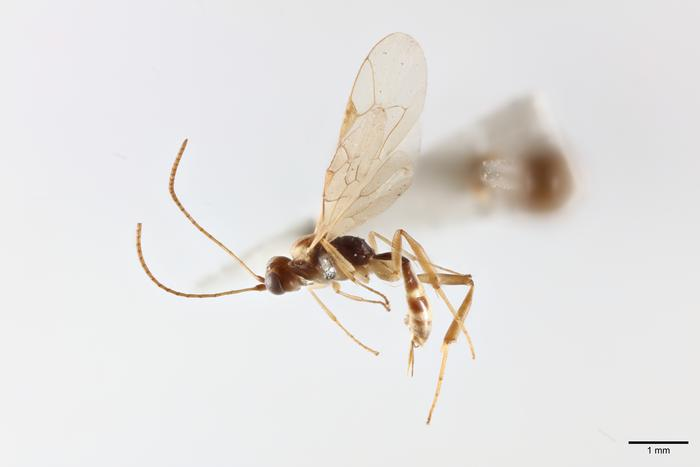
Trustees of the Natural History Museum / Journal of Natural History
Study leader Gavin Broad says Attenborough's storytelling has brought attention to organisms that are often overlooked due to their small size or unusual life histories.
Broad, the Natural History Museum's principal curator of insects, said: "When I was far too young, I learned about taxonomy from David Attenborough's Life on Earth series and resolved to be a taxonomist.


"Amazingly, I ended up a taxonomist, so I have Sir David to thank for that."
He says the newly described insect is both a new species and a new genus because it is so distinct from its closest relatives that it can't logically fit into any established genus.
It measures just 3.5 millimeters in body length and was originally collected in 1983 in the Valdivia Province of Chile, a country Sir David has visited in several of his documentaries.
Despite being collected over 40 years ago, the wasp's unusual characteristics were only recently spotted by volunteer Augustijn De Ketelaere while undertaking a detailed examination of the ichneumonid collections.
Researchers then identified a unique combination of anatomical traits that separate it from previously known genera including a strongly curved abdominal segment, subtle toothlike structures on the ovipositor, which is used to deposit eggs, and unique wing and leg morphology.

(Photo by Mingyang LIU via Pexels)
Its discovery increases the number of known genera in the rare subfamily to four.
Broad says the discovery of Attenboroughnculus tau serves to highlight the value of museum collections.
It is hoped that efforts to revisit and reexamine items could reveal countless new species, particularly among insects and other small organisms.
Fans of Sir David visiting the Museum can enjoy Our Story with David Attenborough, its first ever immersive experience until August.
They can also see a quote from Sir David installed in bronze lettering: "The future of the natural world, on which we all depend, is in our hands."
Study co-author Jennifer Pullar, the Museum's science communications manager, added: "We hope to inspire global scientists to take another look in their collections to see if there is something small that could contribute to our collective understanding and therefore the future of our natural world."


(0) comments
Welcome to the discussion.
Log In
Keep it Clean. Please avoid obscene, vulgar, lewd, racist or sexually-oriented language.
PLEASE TURN OFF YOUR CAPS LOCK.
Don't Threaten. Threats of harming another person will not be tolerated.
Be Truthful. Don't knowingly lie about anyone or anything.
Be Nice. No racism, sexism or any sort of -ism that is degrading to another person.
Be Proactive. Use the 'Report' link on each comment to let us know of abusive posts.
Share with Us. We'd love to hear eyewitness accounts, the history behind an article.