


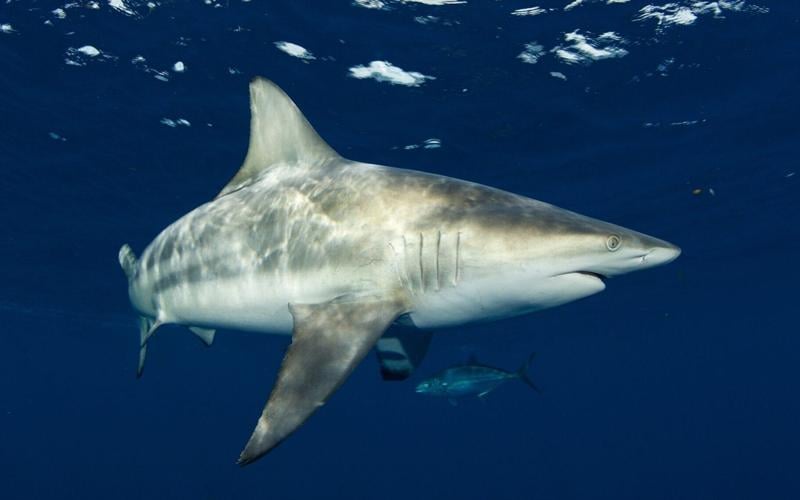




Blacktip sharks provided researchers with a rare opportunity to observe free-swimming sharks in clear, shallow water off Southeast Florida. (Stephen Kajiura / Florida Atlantic University via SWNS)
By Stephen Beech
Sharks' super-sensitive hearing can detect tiny sounds hundreds of feet away, reveals new research.
Scientists used an underwater speaker and an aerial drone to work out just how good the apex predators of the ocean are at detecting potential prey they can't yet see.
Exactly how far a free-swimming shark can hear a sound — and whether it can determine where that sound is coming from — had remained largely unknown until now.
But a study by scientists from Florida Atlantic University (FAU) in the U.S. of blacktip sharks has helped establish the details.
The research team discovered that the species can detect sounds from considerable distances and respond by dramatically changing direction away from the source — even when the sound source is nearly 250 feet away.

(Photo by Karam Alani via Pexels)
Their findings, published in the journal Integrative Organismal Biology, provide the first quantified evidence that free-swimming sharks can detect and orient away from sound in the acoustic far field.
The FAU team chose blacktip sharks because their predictable seasonal aggregations off Florida provided a rare opportunity to observe free-swimming sharks in clear, shallow water.
Large numbers of blacktip sharks gather each winter along the Palm Beach County coast, while smaller groups remain in the area year-round.
Study senior author FAU professor Stephen Kajiura said: "Their abundance and accessibility made it possible for us to observe them from above without disturbing their natural behavior, while also presenting controlled underwater sounds."
The study was conducted in shallow nearshore waters throughout Palm Beach County.
Researchers anchored a boat and deployed an underwater speaker which drifted with the current up to 19 meters (62 feet) away, which minimized the boat's influence on the sharks.

(Photo by Airam Dato-on via Pexels)
The team tested three ranges of low-frequency sounds — 100 to 200 hertz, 200 to 400 hertz and 400 to 800 hertz — along with a 10-kilohertz control sound outside the known hearing range of sharks.
Kajiura said the sounds were played at a high intensity to startle the sharks rather than try to attract them.
The research team used calibrated hydrophones to map sound levels at different distances so they could calculate exactly what the sharks heard when they responded.


An aerial drone tracked free-swimming sharks from 40 to 50 meters above the water as researchers presented control and experimental sounds.
Frame-by-frame video analysis was used to measure the sharks' response distance and changes in swimming direction.
The sharks responded to all three experimental sound ranges but not to the 10-kilohertz control.
They detected low-frequency sounds from up to 74 meters (243 feet) away, considerably farther away than previously found under free-swimming conditions.
Kajiura said the sharks rapidly changed course away from the source, indicating they could determine the direction of the sound.

(Photo by Public Domain Pictures via Pexels)
More than 70% of responses occurred in the acoustic far field, and the sharks were more sensitive to lower frequencies, detecting them from farther away and at lower sound levels.
Kajiura said: "What makes this finding particularly interesting is that the sharks were responding to sounds beyond the acoustic near field, where the sound behaves differently than it does close to the source.
"This suggests that they are detecting the particle motion associated with sound even at considerable distances from the source — something we have not previously been able to demonstrate in free-swimming sharks."
He says the finding is intriguing because sharks don't have the gas-filled swim bladder found in many bony fish, an organ that can help detect sound pressure.
Sharks are instead thought to rely on their inner ears — including a specialized structure called the macula neglecta — to detect movement and vibrations produced by sound traveling through the water.
The researchers say their findings also highlight the value of studying shark hearing in the wild, where researchers can observe responses to sound without the reflections and other limitations of laboratory tanks.
Study lead author Caroline Sullivan, who conducted the research as part of her master's degree in biological sciences, said: "Trying to do hearing experiments in a tank results in the sound bouncing off the walls which causes complex and confusing signals — it is like being in a house of mirrors.
"This is why it is so important to do these types of experiments in the ocean with wild sharks to get a natural response."
Kajiura added: "The ocean is an acoustic environment, and sharks are clearly tuned into it in ways we are only beginning to understand.
"Being able to detect and respond to sounds from hundreds of feet away gives these predators an important source of information about their surroundings.
"The next question is how their sensory system allows them to pick up and interpret these distant sounds."


(0) comments
Welcome to the discussion.
Log In
Keep it Clean. Please avoid obscene, vulgar, lewd, racist or sexually-oriented language.
PLEASE TURN OFF YOUR CAPS LOCK.
Don't Threaten. Threats of harming another person will not be tolerated.
Be Truthful. Don't knowingly lie about anyone or anything.
Be Nice. No racism, sexism or any sort of -ism that is degrading to another person.
Be Proactive. Use the 'Report' link on each comment to let us know of abusive posts.
Share with Us. We'd love to hear eyewitness accounts, the history behind an article.