


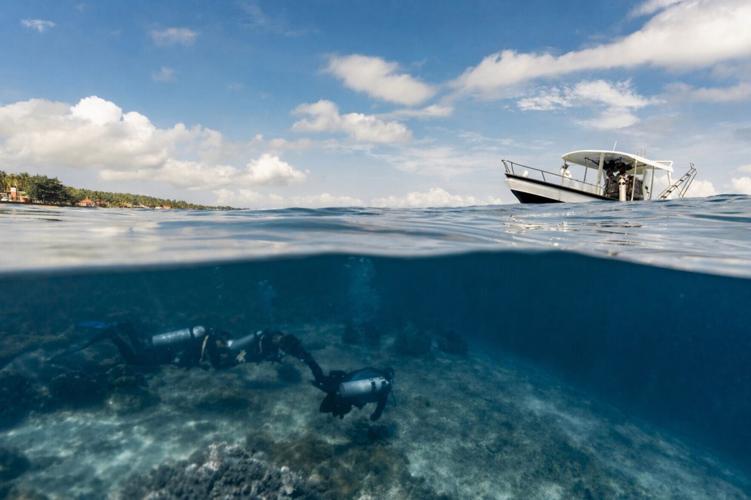


Scuba divers departing for a dive in Nusa Penida, Indonesia. (Dr. Bing Lin via SWNS)
By Stephen Beech
Scuba-diving tourists are destroying coral reefs they want to conserve, warns a new study.
The study reveals how well-intentioned divers are actually contributing to reef damage at tourism hotspots.
Australian researchers found that scuba-diving tourism — widely promoted as a "sustainable" way to experience coral reefs — is causing "frequent and often hidden damage" to fragile marine ecosystems.
The team analyzed the behavior of more than 700 scuba divers across tourism hotspots in the Philippines and Indonesia, including Bali.
Drawing on data from more than 300 hours of underwater observation, the researchers recorded 4,981 reef "contact events" among 411 divers.
Around 41% of those contacts caused observable damage to coral — from direct breakage to the stirring of sediment that can smother reef life, according to the findings.

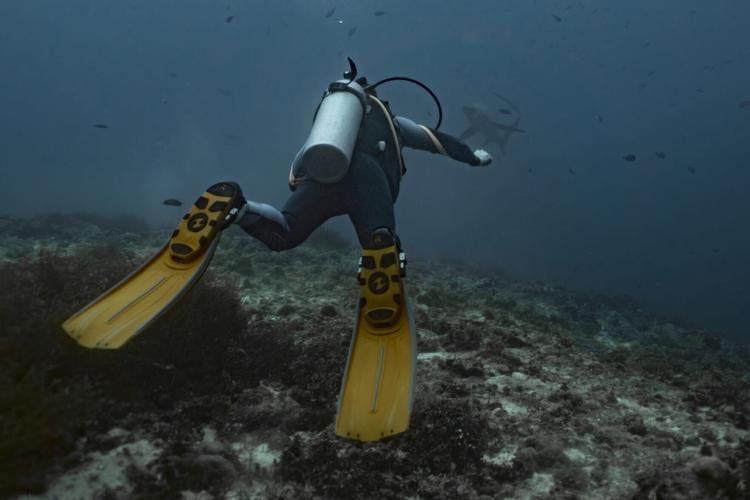
A scuba diver touches the reef in the presence of a thresher shark in Leyte, Philippines. (Dr. Bing Lin via SWNS)
On average, divers made 0.26 reef contacts a minute — around one every four minutes — and spent nearly two seconds of every minute in direct contact with the reef.
Study leader Bing Lin said: "This work documents the unsustainable underwater footprint of scuba diving tourism on coral reefs."
He says a central finding of the study, published in the journal Conservation Letters, is that most damage is not deliberate.
More than 80% of damaging contacts were unintentional or unnoticed by the diver, revealing how routine tourism activity can quietly degrade reef systems over time.
Most divers in the study self-reported very high pro-environmental attitudes, suggesting that they by and large care about reef conservation.
Lin said the study also uncovered several "striking" psychological patterns.
Around three-quarters of divers rated themselves as "above average" in their ability to avoid reef contact compared to their peers — an example of the "illusory superiority" effect, where people systematically overestimate their abilities relative to others.
The study also documented the Dunning-Kruger effect in divers — where people with lower skill levels disproportionately overestimated their competence.

Dr. Bing Lin, postdoctoral research fellow in the Thriving Oceans Research Hub in the School of Geosciences at the University of Sydney. (University of Sydney via SWNS)


Lin said that overconfidence translated into a major gap between perception and reality.
In matched observations, divers underestimated how often they contacted the reef by nearly five-fold.
Lin said: "Many divers believe they are careful and low impact, but our data shows a consistent mismatch between perception and behaviour behavior."
The study identified several factors that were associated with increases in reef damage.
Divers using underwater cameras, gloves or pointer sticks had higher contact rates, while peer behavior also played a "significant" role — when one diver touched the reef, others were much more likely to follow suit.
Wildlife encounters — often the highlight of dive tourism — were found to significantly amplify damage.
The presence of marine animals increased intentional reef contacts by 220%, unintentional contacts by 85%, and damaging contacts by 106%, often as divers approached or adjusted position to observe the wildlife.
The study also found that a small minority of divers accounted for a disproportionate share of total reef damage, suggesting targeted interventions could have considerable benefits.

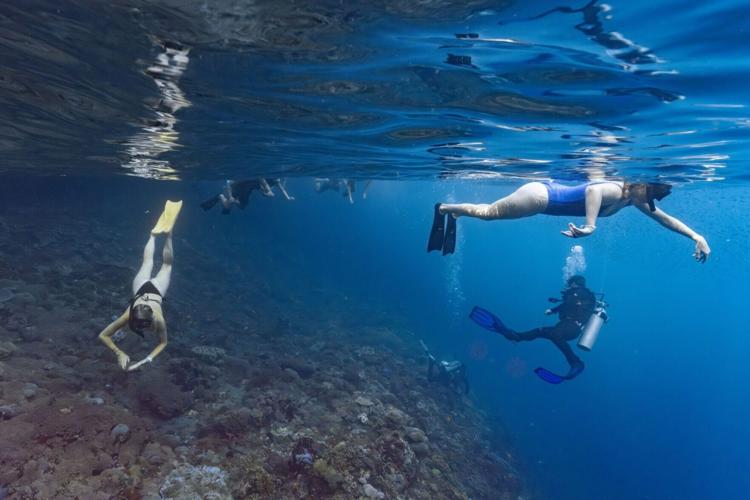
Snorkelers and scuba divers enjoying a coral reef in Nusa Penida, Indonesia. (Dr. Bing Lin via SWNS)
Lin, from the University of Sydney's Thriving Oceans Research Hub, said: "It's difficult to quantify the true scale of the reef contact problem.
"But what is clear is that unregulated underwater tourism is an overlooked local driver of damage that adds to, and amplifies, other acute and chronic reef stressors."
Lin's previous research, published in Nature Sustainability, has shown the regionally detectable effects of coastal tourism, including scuba diving, on coral reefs across an entire archipelago.
With coral reefs already under pressure from climate change, pollution and overfishing, he says the findings highlight the need to better manage tourism impacts in heavily visited regions.
Lin said: "Tourism is critical to many coastal economies, including those closely linked to Australia.
"But without changes to diver behavior, training and industry standards, it risks undermining the very ecosystems it depends on."
The researchers point to practical solutions — including improved buoyancy training, stricter controls on equipment use, stronger environmental briefings and higher standards in diver and dive-operator certification — to reduce cumulative damage.
Lin added: "First and foremost, divers need to understand that they are a part of the problem before we can convince them to become a part of the solution."


(0) comments
Welcome to the discussion.
Log In
Keep it Clean. Please avoid obscene, vulgar, lewd, racist or sexually-oriented language.
PLEASE TURN OFF YOUR CAPS LOCK.
Don't Threaten. Threats of harming another person will not be tolerated.
Be Truthful. Don't knowingly lie about anyone or anything.
Be Nice. No racism, sexism or any sort of -ism that is degrading to another person.
Be Proactive. Use the 'Report' link on each comment to let us know of abusive posts.
Share with Us. We'd love to hear eyewitness accounts, the history behind an article.