



(NASA/ESA/STScI/W. Blair (JHU) via SWNS)
By Dean Murray
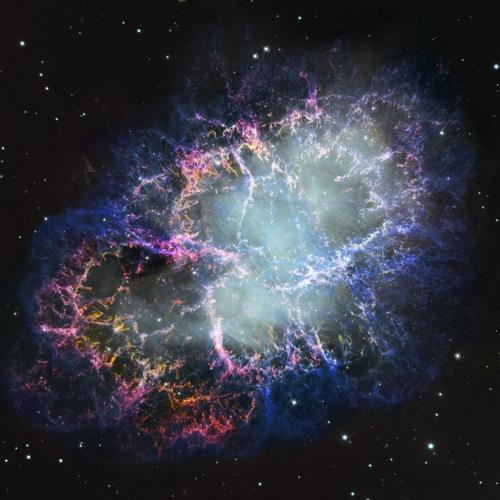
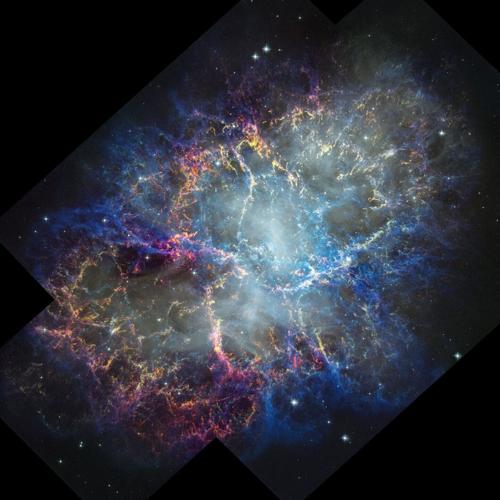
A quarter-century after first observing the full Crab Nebula, NASA’s Hubble Space Telescope has taken a fresh look at the expanding remains of the long-dead star.
The new image, published in The Astrophysical Journal, reveals in unprecedented detail how the supernova remnant has changed over 25 years.
The nebula lies 6,500 light-years away in Taurus and was first seen in 1054, when its explosion created a “new star’’ visible even in daylight.
It takes its name from the crab-like filaments drawn by 19th-century astronomer William Parsons.


(NASA/ESA/STScI/W. Blair (JHU) via SWNS)
“We tend to think of the sky as being unchanging, immutable,” said William Blair of Johns Hopkins University, who led the new observations. “However, with the longevity of the Hubble Space Telescope, even an object like the Crab Nebula is revealed to be in motion, still expanding from the explosion nearly a millennium ago.”
By comparing new and reprocessed 1999 images, Hubble shows the nebula’s filaments racing outward at 3.4 million miles per hour.
William Blair said filaments on the edge have moved more than those at the centre, evidence of its nature as a pulsar wind nebula driven by radiation from a spinning neutron star.
The data will be combined with other telescope observations, including infrared images from NASA’s James Webb Space Telescope released in 2024, to build a more complete picture of the centuries-old stellar remnant.




(0) comments
Welcome to the discussion.
Log In
Keep it Clean. Please avoid obscene, vulgar, lewd, racist or sexually-oriented language.
PLEASE TURN OFF YOUR CAPS LOCK.
Don't Threaten. Threats of harming another person will not be tolerated.
Be Truthful. Don't knowingly lie about anyone or anything.
Be Nice. No racism, sexism or any sort of -ism that is degrading to another person.
Be Proactive. Use the 'Report' link on each comment to let us know of abusive posts.
Share with Us. We'd love to hear eyewitness accounts, the history behind an article.