


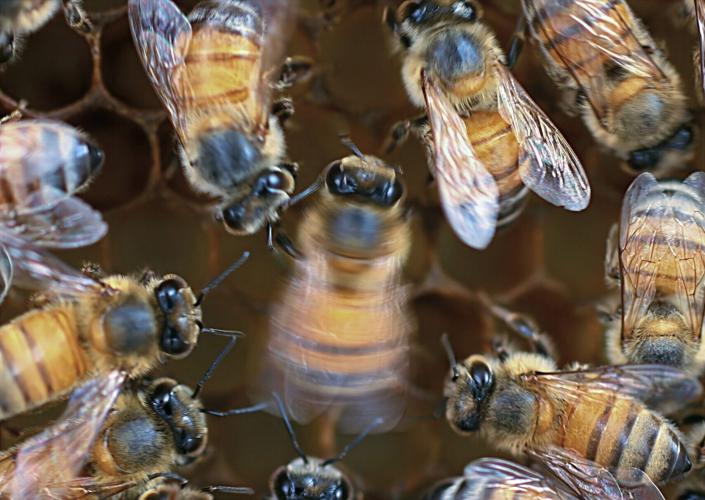

A dancing honey bee (center) is surrounded by an audience of followers that carefully interpret the movements of the ultra-fast waggle dance. (Heather Broccard Bell via SWNS)
By Stephen Beech
Honey bees dance better for bigger audiences, reveals new research.
The precision of their "waggle dance" fluctuates depending on audience size and who’s in attendance, according to the findings.
Scientists have in recent years carefully deciphered details of the dance - an advanced form of social communication in the animal kingdom.
Biologists at the University of California San Diego and their colleagues unravelled how the waggle dance conveys critical information about food sources for the benefit of fellow hive inhabitants.
Now a new study of the dynamics of the dance has shown that it’s not just the dance performer that matters - it’s also who’s in the audience.
The experiments showed that the performing forager is not simply broadcasting a predetermined message.
Instead, the precision of the performer’s directions to the food source depends on its audience.
Once a foraging bee returns to the hive after discovering a promising food source, the research team explained that it communicates the location information to hive mates by performing a "blazing-fast, complex" dance.

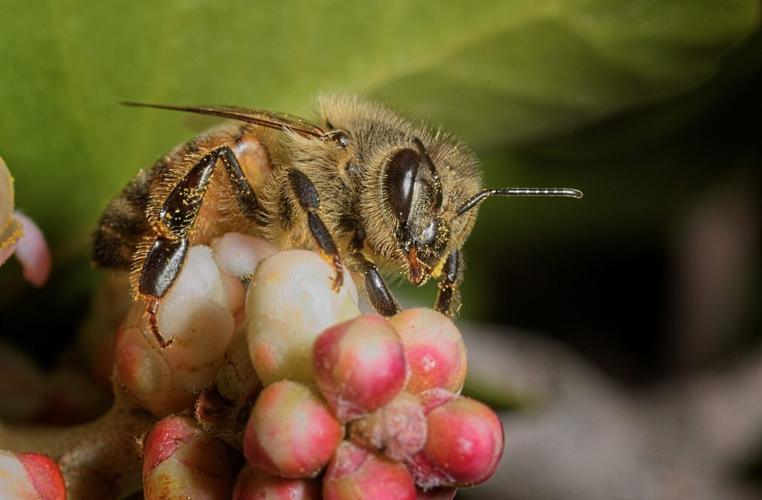
When honey bee foragers locate a food source, such as this lemonade berry sumac shrub (Rhus integrifolia), they return to the hive and communicate the source through the intricate details of the waggle dance. (Heather Broccard Bell via SWNS)
While other bees pay attention, the dancing forager runs forward while “waggling” its abdomen, then loops back and repeats the performance in a matter of seconds.
The angle of the waggle dance conveys the direction of the food relative to the sun, and the duration of the performance encodes the distance to the source.
Professor James Nieh, of the UC San Diego School of Biological Sciences, likened the new findings to a street performance.
With a good-sized audience, he says street musicians focus on the performance itself.
But when the crowd thins out, the performer scans faces, moves position and puts more effort into finding and keeping an audience.
Nieh says the search for a receptive audience essentially changes the bee's performance because it is difficult to maintain the precision of a fast, repeated movement pattern while simultaneously moving around to locate and engage an audience.
He said: “Everyone has seen a street musician or a performer adjust to a changing crowd.
“In the hive, we see a comparable trade-off.
"When fewer bees follow, dancers move more as they search for their audience, and the dance becomes less precise.”


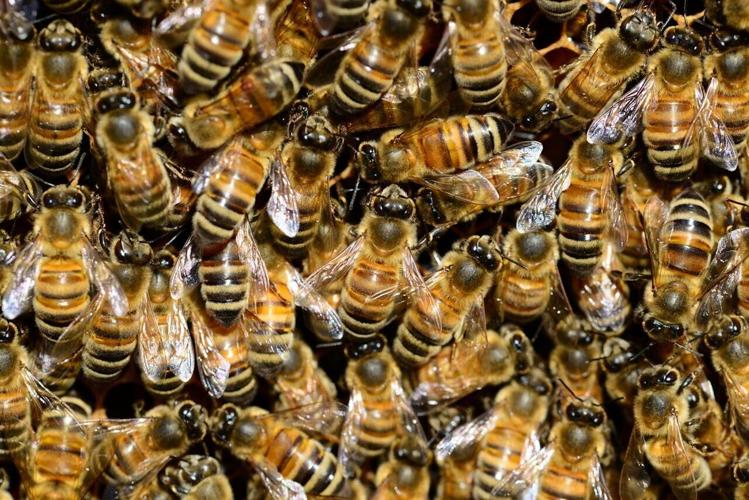
(Photo by Pixabay via Pexels)
Working with scientists from Queen Mary University of London and the Chinese Academy of Sciences, Nieh studied experimental hives and monitored the honey bee “dance floor,” which replicated the crowded, dynamic social space found in real hives.
In the first part of the experiment, the team evaluated fluctuating numbers of bees in the primary dancing area to test the changes caused by different audience sizes.
In a second set of experiments, the researchers kept the number of bees constant, but changed the age of the audience members by introducing young worker bees, which are not interested in following dances.
In both experimental scenarios, dancers were less precise when performing for a smaller audience.
Study senior author Professor Ken Tan, from the Chinese Academy of Sciences, said: “The waggle dance is often presented as a one-way information transfer.
"Our data show that feedback from the audience shapes the signal itself.
"In that sense, the dancer is not only sending information, but also responding to social conditions on the dance floor.”
The new study, published in the journal Proceedings of the National Academy of Sciences (PNAS), also provided clues to how dancers sense audience size and composition.

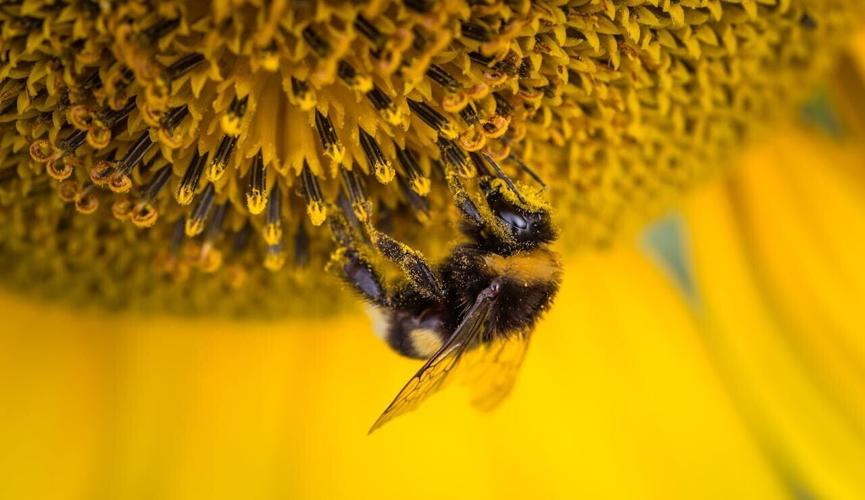
(Photo by Anton Atanasov via Pexels)
The research team found that audience members make frequent antennal and body contact with dancers.
The researchers say such tactile cues likely provide information about audience composition.
Professor Lars Chittka, from Queen Mary University of London, said the study shows that “humans aren’t the only ones who perform differently depending on their audience."
He added: "Our study shows that honey bees quite literally dance better when they know someone is watching.
"When followers are scarce, dancers wander around searching for listeners - and in doing so, their signals become fuzzier.
"It’s a lovely reminder that even in the miniature world of insects, communication is a deeply social affair.”
The researcher said that the findings also offer a window into how animal groups manage information.
Nieh said: "The new findings show that the accuracy of a signal can depend on the availability of receivers, not only on the motivation of the sender."
He added: “That kind of feedback may be important in animal societies, engineered swarms and other distributed systems where the quality of information can rise or fall with audience dynamics.”


(0) comments
Welcome to the discussion.
Log In
Keep it Clean. Please avoid obscene, vulgar, lewd, racist or sexually-oriented language.
PLEASE TURN OFF YOUR CAPS LOCK.
Don't Threaten. Threats of harming another person will not be tolerated.
Be Truthful. Don't knowingly lie about anyone or anything.
Be Nice. No racism, sexism or any sort of -ism that is degrading to another person.
Be Proactive. Use the 'Report' link on each comment to let us know of abusive posts.
Share with Us. We'd love to hear eyewitness accounts, the history behind an article.