




Unbelievably, the average business uses 897 different applications to run its day-to-day operations. But only 29% of businesses have these tools connected in some way, according to Salesforce’s 2025 State of Data and Analytics Report.
The most valuable apps to connect are the ones teams use daily. For sales and marketing teams working with Microsoft tools, a CRM Office 365 integration is one of the most important software connections. It supports sales reps working in Outlook, ops teams working in Excel, and others using Teams for calls and meetings.
But sometimes integrations break, and when a CRM connection to Office 365 breaks, it typically comes down to one of three things, each with its underlying cause and documented fix. This Nutshell guide details where these breakdowns occur and how you can prevent them.
Key takeaways
- The most common Office 365 CRM integration problems surface in three places: Outlook sync errors, Excel-related duplicate records, and Teams/SharePoint permission mismatches.
- Detailed documentation from Microsoft offers comprehensive preventative steps to mitigate these failures.
- At the heart of the solution is identifying a single system of record and implementing scheduled sync and permission checks.
Where does a CRM Office 365 integration usually break down?
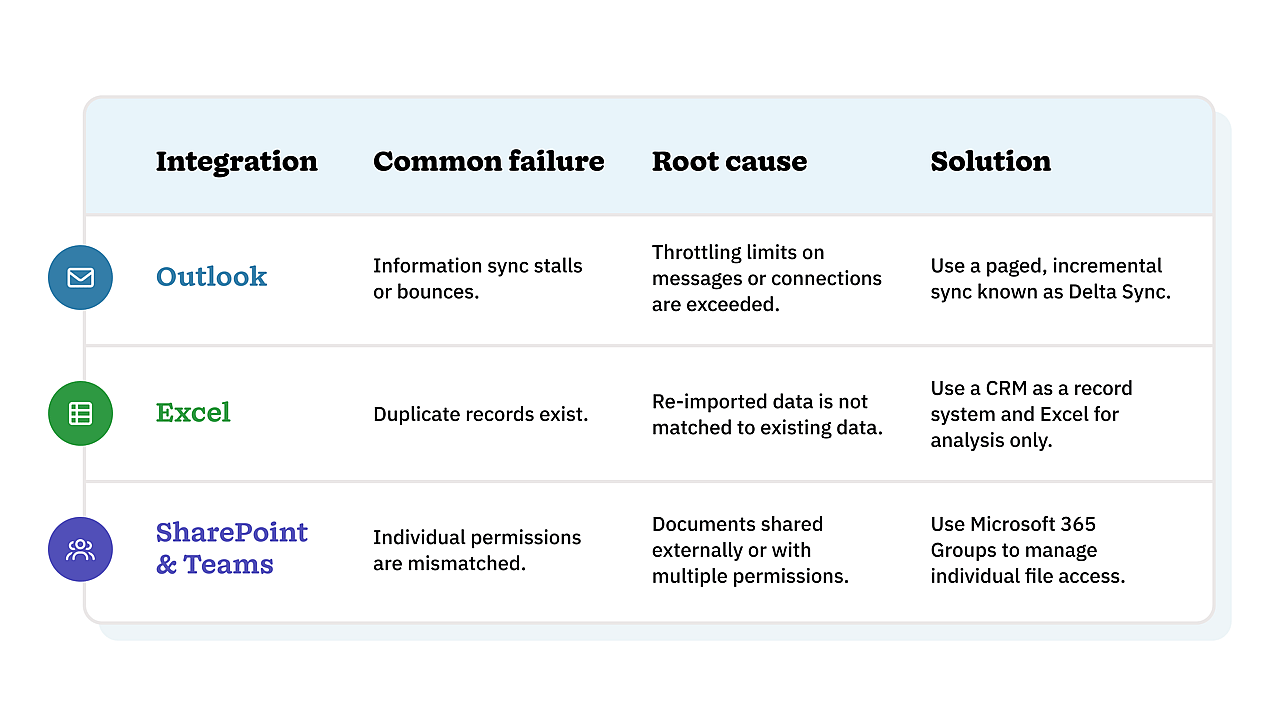
Nine times out of ten, you can expect a Microsoft Office 365 CRM integration to break down in one of these three areas:
1. Outlook sync connection: The inability to sync data between the CRM and a connected Microsoft tool, most noticeable in Outlook, where team members are likely to pick up missing emails quickly.
2. Excel-based data exports: Most teams export data to Excel at some point, and duplicate records are usually the most common issue that surfaces.
3. Teams or SharePoint permission settings: Misalignment on the permissions side is not as easy to spot, and usually comes to light when someone realizes they’ve lost or gained deal access.
Outlook sync errors
Exchange Online is the cloud-based platform that houses Microsoft’s email, shared calendar, and contact management services. However, many Outlook users are unaware of Exchange Online’s cap of 3,600 messages per hour per mailbox and its ActiveSync connection limit of 100 devices per mailbox.
As a result, users may see an Outlook sync error when their CRM pushes or pulls more mailbox data than Exchange Online allows. When you overshoot these limits, Microsoft delivers an automatic bounce, which blocks the incoming email.
This doesn’t necessarily mean your CRM or Outlook software is broken, but it likely indicates that the integration has requested too much data too many times. The throttle applied limits how much data one connection can send over a specific period.
Microsoft’s development documentation provides clear recommendations to avoid the throttle, including setting up integrations to run in line with Exchange Online’s default throttling policies. To prevent Exchange from re-pulling the entire mailbox with each update, teams should employ an incremental sync approach.
Excel data export and duplicate records
Teams connecting data from Excel to their CRM are likely to come across duplicates. A duplicate record is contact, deal, or account data that appears in your CRM system more than once. Duplicates usually occur when team members input or import data separately, and not within the original data store.
Ledge’s 2025 study surveyed 100 finance professionals and discovered that 94% use Excel for their financial close processes. But half of those said that one reason each financial close takes longer than it should is that they spend too much time matching Excel data with data from other systems.


All it takes to create a duplicate is for one team member to export data into Excel, make changes, and import it back into the CRM without matching it to existing data. Making the CRM the sole system of record is the best fix for this issue.
Microsoft Teams and SharePoint permission mismatches
Admins can control Microsoft Teams channel file permissions through SharePoint’s permission inheritance feature, where permissions applied to a channel are applicable to all users invited to the channel. That means team members in the channel all have the same level of file and subfolder access within their shared workspace.
If a team member shares a file or folder from that channel externally, it may result in a permission mismatch. Because they’ve changed the permission settings for that specific file or folder, permission updates made in SharePoint will apply to all other files and folders in the workspace, but not that one.
If someone with access to that file or folder leaves the company, they may still be able to access its contents, despite the admin updating who can access it from SharePoint.
Varonis analyzed roughly 10 billion files across 1,000 IT environments for its 2025 State of Data Security report. The study discovered that cloud data from 66% of the companies examined is exposed to anonymous users. It also found that 88% of companies have active ghost accounts, giving former employees access to confidential information.
Admins can manage user access through Microsoft 365 Groups instead of via per-person permissions to eliminate the potential for a permission mismatch.
How do you set up an Office 365 CRM sync that stays reliable?
Proper planning is at the heart of a clean CRM Office 365 integration sync and prevents teams from having to apply fixes when something goes wrong. These steps will help ensure that teams set up their integration for sync success:
- Choose one system of record: Canonical records related to deals and contacts should be stored in your CRM, and your Office 365 tools should read from that data.
- Consider Exchange Online limits: To avoid Exchange Online’s throttling threshold, it’s best to implement frequent, smaller sync updates rather than occasional updates when the mailbox is full.
- Test with real data: Before initiating the sync across your team, test using your actual contact records.
- Assign an owner: Reduce the risk of anything breaking by appointing a dedicated owner to regularly monitor sync error logs, instead of only checking when a team member complains.
Keeping data consistent across Outlook, Excel, and Teams
The key to consistent data across these Office 365 applications is building a solid maintenance habit. That includes scheduling regular checks of Microsoft Teams and SharePoint permissions, because permission drift can happen without anyone noticing until it’s too late.
When it comes to Excel, team members should consider data exports from their CRM to Excel as temporary data sources. And when importing data from Excel back into their CRM, they should follow a planned process to ensure data is matched correctly.
A few good habits keep the breakdowns at bay
Yes, CRM Office 365 integration failures happen, but they are almost always preventable. Teams just need to understand where Office 365 CRM sync breakdowns could occur and monitor the integration accordingly.
Ensuring that everyone knows the CRM is the sole source of truth and that your Office 365 tools sync to it is the first step to integration success. Developing and maintaining good integration maintenance habits is the second.
This story was produced by Nutshell and reviewed and distributed by Stacker.


(0) comments
Welcome to the discussion.
Log In
Keep it Clean. Please avoid obscene, vulgar, lewd, racist or sexually-oriented language.
PLEASE TURN OFF YOUR CAPS LOCK.
Don't Threaten. Threats of harming another person will not be tolerated.
Be Truthful. Don't knowingly lie about anyone or anything.
Be Nice. No racism, sexism or any sort of -ism that is degrading to another person.
Be Proactive. Use the 'Report' link on each comment to let us know of abusive posts.
Share with Us. We'd love to hear eyewitness accounts, the history behind an article.