




How to use artificial intelligence to enhance the retail experience
The AI retail market is projected to reach $24.1 billion by 2028, a significant rise from $15.4 billion in 2023. This growth underscores the urgency for retailers to move from experimentation to strategic implementation.
For retailers, the challenge is not simply acknowledging AI’s potential but navigating its complexities to unlock real, measurable value. With new tools emerging constantly, knowing where to invest can be a significant hurdle. This article from Driveline Retail Merchandising provides a roadmap for understanding and implementing AI to enhance the retail experience, improve efficiency, and boost profitability.
Key Takeaways
- AI enhances customer experience through personalization, 24/7 support, and improved in-store environments.
- AI optimizes retail operations by improving demand forecasting, inventory management, and supply chain efficiency.
- A successful AI strategy requires clear business objectives, data readiness, and the right AI tools and partners.
- The future of AI in retail includes agentic AI, which is expected to further revolutionize the industry.
Understanding the AI Revolution in Retail
To effectively use AI, it’s essential to understand its current impact and the core technologies driving its adoption. It’s about separating the hype from the tangible applications that can drive your business forward today.
AI has moved from a competitive advantage to an essential part of retail infrastructure for many companies. The modern consumer expects personalized experiences, instant support, and a frictionless shopping journey across all channels. AI is now required to manage this complexity and meet heightened consumer expectations. The cost of inaction is high, potentially leading to decreased customer loyalty and a loss of market share to more agile, data-driven competitors.
The data speaks for itself. According to an NVIDIA survey, in 2024, 69% of AI adopters report increased annual revenue, and 72% experience reduced operating costs. Furthermore, 42% of retailers claimed to be using AI, with another 34% piloting initiatives, indicating a clear industry-wide shift.
Understanding the Core AI Technologies Transforming Retail
Several key AI technologies are at the forefront of the retail revolution. Understanding their functions is the first step to harnessing their power:
- Machine learning and predictive analytics: By analyzing vast datasets, algorithms identify patterns to inform strategic decisions. These patterns range from demand forecasting to dynamic pricing, where prices are adjusted in real time based on demand, competition, and other variables. Supervised learning models can be trained on historical data to predict future outcomes, while unsupervised learning can uncover hidden patterns in customer behavior.
- Natural language processing (NLP): NLP powers advanced chatbots and virtual assistants, enabling them to understand customer queries and provide helpful, contextually relevant responses. NLP technology can be the difference between a frustrating, dead-end bot interaction and a helpful, humanlike conversation that can resolve complex issues and even offer personalized advice.
- Computer vision: This technology enables AI to interpret the physical world. In retail, computer vision is used for inventory management through shelf-scanning robots, loss prevention by detecting unusual behavior, and in-store analytics that track customer traffic patterns. It provides a rich source of data on how customers interact with the physical store environment.
- Generative AI: The technology behind tools like ChatGPT, generative AI can create new content, such as marketing copy, product descriptions, and even personalized email campaigns. It powers innovative customer experiences like AI-driven styling suggestions and virtual try-ons. Beyond content creation, it can also generate synthetic data to train other AI models, helping retail companies overcome challenges of data scarcity.
Elevating the Customer Experience with Artificial Intelligence
AI’s most visible impact is on the customer experience. AI can improve customer engagement and enable a new level of personalization.
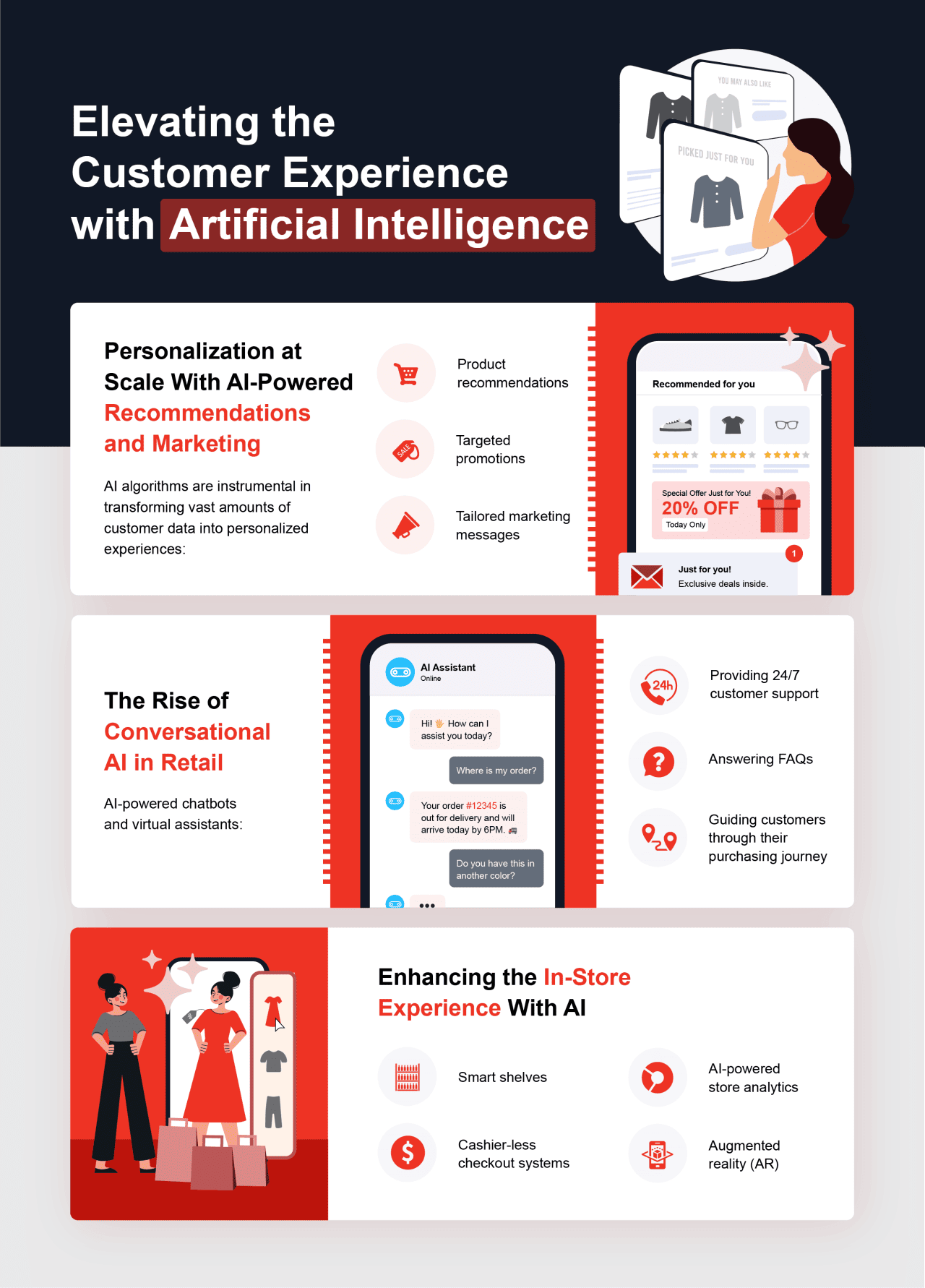
Personalization at Scale With AI-Powered Recommendations and Marketing
AI algorithms are instrumental in transforming vast amounts of customer data into personalized experiences.
- Data collection and processing: AI systems gather data from multiple touchpoints, including e-commerce interactions, in-store purchase history, and loyalty program activity. The systems then use this data to create a holistic, 360-degree view of each customer.
- Predictive analytics: By analyzing consumer data, AI can predict future customer behavior and preferences with a high degree of accuracy, anticipating their needs before they even arise.
- Behavioral tracking and modeling: AI creates individual customer profiles that evolve in real time. This capability allows for highly relevant customer interactions, such as sending a push notification with a special offer on a product a customer has been browsing.
A deep understanding of the customer enables a range of powerful applications:
- Product recommendations: AI systems suggest products a customer is likely to be interested in, based on their past behavior and similar user profiles. The personalized approach improves the customer experience and increases average order value.
- Targeted promotions: With the help of AI, retailers can deliver personalized offers and discounts that are most relevant to each customer, increasing the likelihood of conversion and building customer loyalty.
- Tailored marketing messages: Customizing the content, timing, and channel of marketing communications helps maximize consumer engagement and increase conversion rates.
Retailers must be transparent with customers about how their data is being used and provide them with control over their data. Building trust is essential for the long-term success of any personalization strategy.
The Rise of Conversational AI in Retail
AI-powered chatbots and virtual assistants have evolved into sophisticated conversational agents that can handle a wide range of customer interactions, offering significant benefits:
- Providing 24/7 customer support: This always-on technology handles customer inquiries around the clock, reducing the need for after-hours staffing and minimizing wait times — a critical factor in customer satisfaction.
- Answering FAQs: Chatbots provide instant, accurate answers to frequently asked questions about delivery, returns, and store policies, freeing up human agents to handle more complex, high-value interactions.
- Guiding customers through their purchasing journey: By providing tailored product suggestions and proactive engagement, conversational AI helps customers find what they need and complete their purchase with ease and confidence.
The integration of voice-activated AI assistants, such as Alexa and Google Assistant, is another growing trend. Customers can now use voice commands to create shopping lists, search for products, and even make purchases, creating a truly hands-free and convenient shopping experience.
Enhancing the In-Store Experience With AI
The impact of AI is not limited to the digital realm. In physical stores, AI is being used to create a more efficient, engaging, and personalized shopping environment.
- Smart shelves: Shelves automatically track inventory and detect out-of-stock items.
- Physical AI: Robotics-assisted scanning system in store to track inventory, predict OSA and phantom inventory.
- Cashier-less checkout systems: Eliminate wait times and create a truly frictionless experience.
- AI-powered store analytics: Provide insights into customer behavior through space mapping systems, heat mapping, and queue management.
- Augmented reality (AR): Another technology that is enhancing the in-store experience. For example, some retailers are using AR apps that allow customers to visualize how a piece of furniture would look in their own home before they make a purchase.


Optimizing Retail Operations Through AI
Beyond customer-facing applications, AI is a powerful tool for optimizing back-end operations, improving efficiency, and driving profitability.
One of the most powerful applications of AI in retail is its ability to dramatically improve demand forecasting and inventory management. Accurate forecasting is critical for profitability. AI-powered predictive analytics offers a level of precision that traditional methods cannot match.
Advanced Demand Forecasting
AI goes beyond simple historical sales data to create a more nuanced and accurate picture of future demand, through:
- Diverse data integration: AI models can simultaneously analyze a wide range of variables, including historical sales figures, current market trends, upcoming holidays, and even local events or weather patterns that could impact purchasing behavior.
- Identifying hidden patterns: Machine learning algorithms can identify subtle correlations and patterns that would be harder for a human analyst to spot. For example, AI might find a link between a local sporting event and an increase in sales of specific snack items, allowing for proactive inventory adjustments.
- Social media sentiment analysis: AI can monitor social media and other online platforms to gauge public sentiment and identify emerging trends. A sudden spike in online conversations about a particular product can be an early indicator of a future surge in demand.
Intelligent Inventory Optimization
More accurate forecasting directly leads to more efficient inventory management, which has a significant impact on the bottom line. AI helps retailers achieve this through:
- Reduced overstocking: By having a clearer picture of future demand, retailers can avoid ordering excess inventory that leads to costly markdowns, storage fees, and waste, particularly for perishable goods.
- Minimized stockouts: Conversely, AI helps prevent stockouts of popular items, which can lead to lost sales and frustrated customers. The system can automatically trigger reorder points to ensure shelves remain stocked.
- Automated replenishment: AI-driven systems can automate the entire replenishment process, from identifying the need to placing an order with the supplier, reducing the manual workload on employees and minimizing the risk of human error.
Effective Returns Management
AI can also bring a new level of intelligence to product returns, a significant challenge for many retailers. AI can help with:
- Predicting return rates: By analyzing historical return data, AI can predict the likely return rate for different products. This information can be used to adjust inventory levels and inform product descriptions and marketing strategies to reduce the likelihood of returns.
- Identifying fraudulent returns: AI can analyze patterns in return data to identify and flag potentially fraudulent activity, such as organized return fraud rings or individuals who consistently abuse return policies. This capability can significantly reduce losses associated with return fraud.
The Role of AI in Logistics and Warehouse Automation
AI is also transforming retail supply chain optimization. Here’s how:
- Optimizing delivery routes: AI can analyze real-time traffic data, weather conditions, and delivery schedules to determine the most efficient routes, reducing fuel costs and delivery times.
- Automating warehouse processes: Autonomous mobile robots and other AI-powered automation solutions can streamline warehouse operations, from picking and packing to inventory control, leading to faster order fulfillment and fewer errors. The rise of “dark stores,” which are dedicated to fulfilling online orders, is a testament to the power of warehouse automation.
- Improving overall supply chain efficiency: AI provides end-to-end visibility into the supply chain, enabling more accurate demand planning and a more agile response to disruptions. This focus on supply chain efficiency is a key area where AI can deliver significant ROI.
A Step-by-Step Guide to Building Your AI Strategy
Developing a successful AI strategy requires a thoughtful, systematic approach. Here is a five-step guide to help you get started.
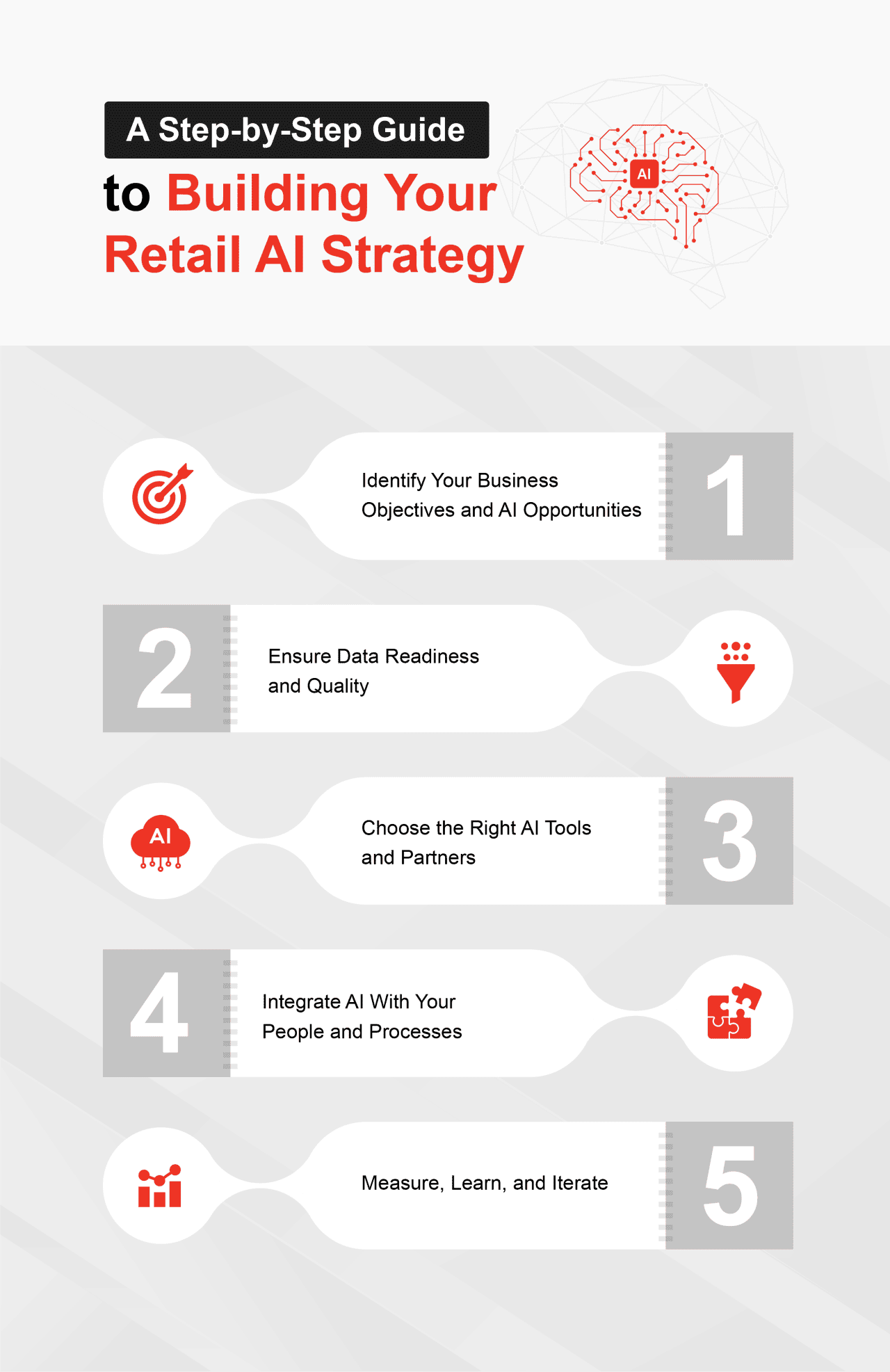
Step 1: Identify Your Business Objectives and AI Opportunities
The first step is to clearly define what you want to achieve with AI. Rather than chasing the latest technology, start by identifying your key business challenges and opportunities. Whether it’s improving customer satisfaction, reducing operational costs, or increasing sales, your AI strategy should be directly aligned with your business goals.
Step 2: Ensure Data Readiness and Quality
Data is the lifeblood of AI. To get the most out of your AI initiatives, you need to have high-quality, accessible data. Invest in robust data governance and preparation processes to ensure your data is accurate, complete, and unbiased. Creating a single source of truth for your customer and operational data is a critical first step. Effective data collection is a crucial part of this process.
Step 3: Choose the Right AI Tools and Partners
There are a vast number of AI tools and platforms on the market. When evaluating vendors, look for partners with a deep understanding of the retail industry who can provide a comprehensive solution that meets your specific needs.
Step 4: Integrate AI With Your People and Processes
To be successful, you need to integrate AI with your existing workflows and support your employees with new tools and insights. This process requires a focus on change management and employee training. The right partner will help you integrate AI into your existing workflows and support your team through the process.
Step 5: Measure, Learn, and Iterate
AI implementation is an ongoing process of improvement. It’s essential to establish a framework for monitoring AI model performance and using the insights to make continuous improvements. This iterative approach will allow you to adapt to changing market conditions and customer behaviors and ensure your AI initiatives continue to deliver value over the long term.
This story was produced by Driveline Retail Merchandising and reviewed and distributed by Stacker.


(0) comments
Welcome to the discussion.
Log In
Keep it Clean. Please avoid obscene, vulgar, lewd, racist or sexually-oriented language.
PLEASE TURN OFF YOUR CAPS LOCK.
Don't Threaten. Threats of harming another person will not be tolerated.
Be Truthful. Don't knowingly lie about anyone or anything.
Be Nice. No racism, sexism or any sort of -ism that is degrading to another person.
Be Proactive. Use the 'Report' link on each comment to let us know of abusive posts.
Share with Us. We'd love to hear eyewitness accounts, the history behind an article.