



AI prompts that work: Mastering prompt engineering (with examples)
When ChatGPT first launched and went viral, some common sentiments around the tool were that it was a shortcut to doing real work. Anybody could type in a few sentences and get text back that they could use for anything under the sun. In fact, ChatGPT reached 100 million users just two months after launch — the fastest adoption rate of any consumer application in history — with users generating over 10 billion prompts per day by mid-2024.
As ChatGPT and other LLMs have evolved, they’ve certainly created shortcuts, but one thing we’ve all learned is that prompting is an art form in itself. The output you get isn’t perfect … sometimes it isn’t even usable. We’ve all experienced the frustration of typing something like “give me blog ideas” only to receive generic suggestions, while watching others get brilliant, tailored content with seemingly effective prompts.
There are good ways and bad ways to chat with these tools. There are heavy users who get valuable output from LLMs with a snap of their fingers and others who seem to struggle to save any time. It’s clear that AI prompt engineering is a skill that needs to be developed, WebFX reports.
What is AI prompting?
AI prompting is the art of crafting clear, specific instructions that effectively communicate with AI systems to produce desired outputs. It involves strategically combining creativity, context, constraints, and clarity to guide the AI toward generating the most useful, relevant, and high-quality responses.
Anecdotally, people who receive weak responses from LLMs tend to be delivering poor prompts. They’ll ask for a report on a particular company but only type “Give me a report about Boeing” into their chat interface. Much like many who have grown up learning how to “speak” search engine, AI prompts require you to think about how you ask a certain question to generate the best response.
LLMs are much better at natural language, but you still need to be able to properly think through a few things when prompting to receive truly high-quality responses. Here are four keys to effective AI prompts.
The 4 C’s: AI prompting effective practices
- Creativity: Starting with a strong, well-defined idea. The stronger and more unique the idea, the better the output. This is the human magic needed to really utilize AI to its fullest potential.
- Context: Providing relevant background information — explain the why in as much detail as you can.
- Constraints: Setting clear boundaries and requirements. How should the LLM surface information?
- Clarity: Using precise, unambiguous language and specific instructions about the format you want the response to be in and how it’s structured.
If you’re looking to convert from metric to imperial, do you need to get this detailed? Of course not. But for more heavy-duty prompts, adding this level of detail is a big separator.
Here’s an example prompt with each of the 4 C’s highlighted:
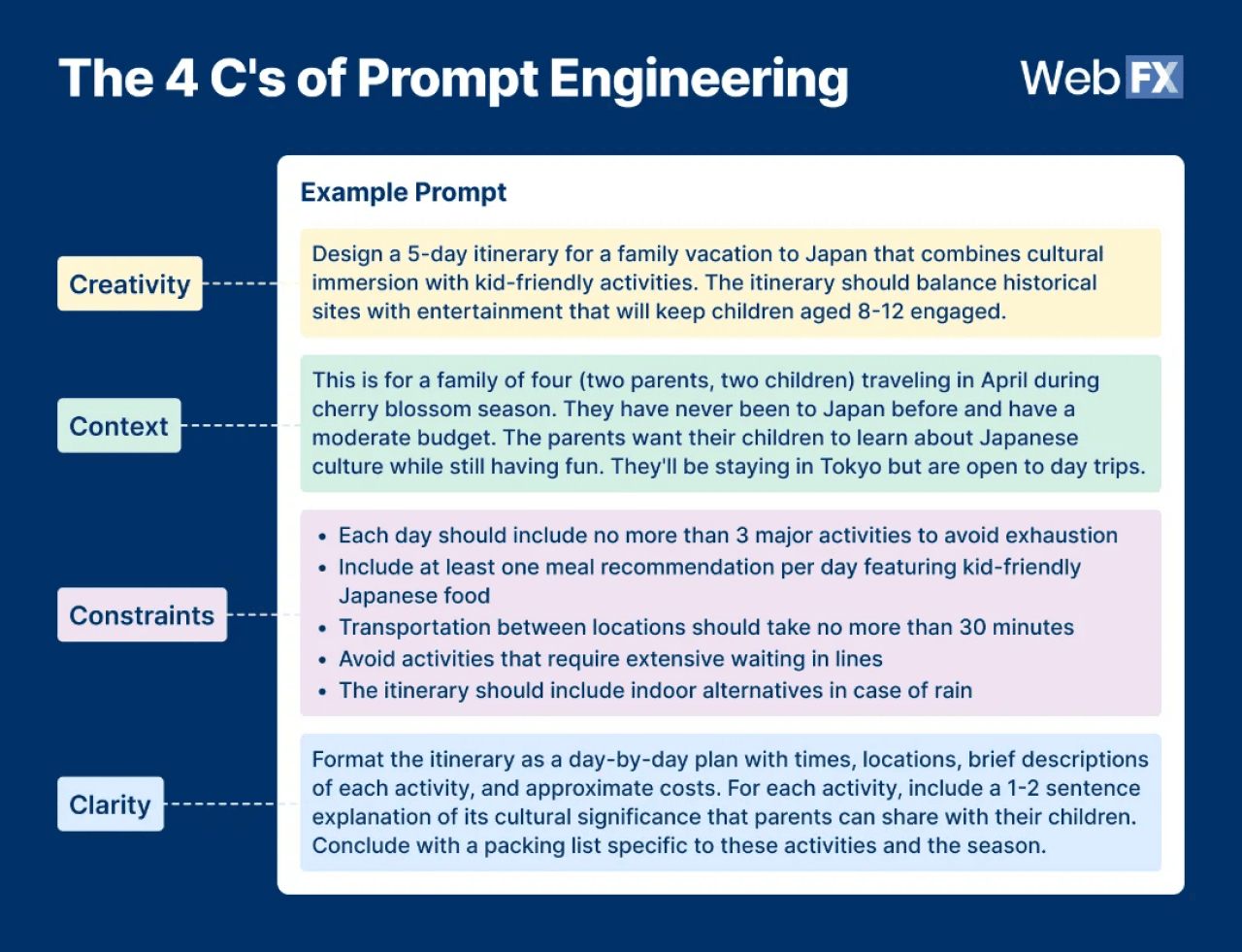
The four C’s approach will get you much more helpful answers to your queries and tailor the approach to your precise needs.
Good vs. bad AI prompts: Traits and examples
Let’s take a deeper look at how not to prompt and some bad habits you should aim to break if you want to get the most out of LLMs.
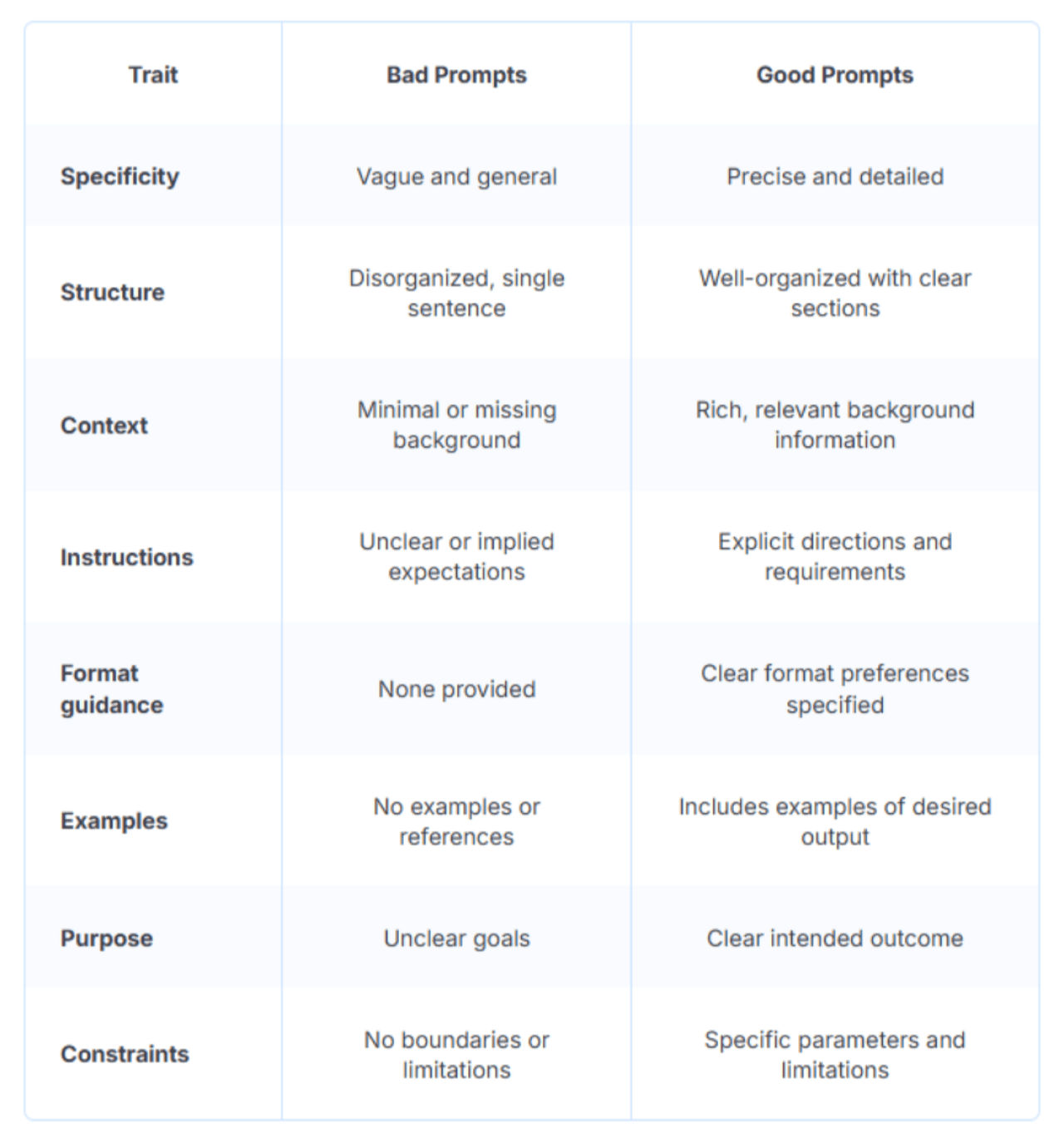
Example transformation
Bad Prompt: “Tell me how to use Instagram Reels.”
Good Prompt Using the 4 C’s Framework:
Creativity: Create an actionable guide on using Instagram Reels to increase engagement for small e-commerce businesses selling handmade products. The guide should focus on organic growth strategies rather than paid advertising.
Context: This is for a community of artisans who have basic social media knowledge but limited time and marketing budgets. Most have fewer than 1,000 followers and sell products in the $30-100 range. They’re competing against mass-produced items and need to showcase their craftsmanship effectively.
Constraints:
- Keep strategies feasible for someone spending 3-5 hours per week on social media
- Focus only on Instagram Reels, not other platforms or features
- Avoid strategies requiring expensive equipment beyond a smartphone
- Include only tactics that have proven effective since Instagram’s 2023 algorithm updates
- Must be appropriate for businesses in various creative niches (jewelry, ceramics, textiles, etc.)
Clarity: Structure the guide with an introduction explaining why Reels are valuable for artisans, followed by 5-7 specific strategies with step-by-step instructions. For each strategy, include a specific example, estimated time investment, and expected outcomes. Conclude with a weekly content planning template and 3-5 content ideas tailored to handmade businesses. Use straightforward language, bullet points for actionable steps, and highlight any technical terms that beginners might not understand.
The Overlooked Prompting Mistakes Costing You Hours
Mistake #1: The Kitchen Sink Prompt
Trying to get everything in one massive prompt. “Create a complete marketing strategy including SEO, PPC, social media, content calendar, budget allocation, competitive analysis, and KPI tracking for my B2B SaaS company targeting enterprise customers in the healthcare sector with a $50K monthly budget…”
A better approach: Break complex tasks into steps. Start with competitive analysis, then use those insights to inform strategy, then develop the tactical plan.
Mistake #2: Copy-Paste Syndrome


Finding a “perfect prompt” online and using it without customization. That viral LinkedIn prompt for blog posts? It was probably created for a completely different industry, audience, and goal than yours.
Mistake #3: One-and-Done Prompting
Accepting the first output without iteration. AI responses are starting points, not final products. The magic happens in rounds 2-5 of refinement.
Mistake #4: Ignoring Model Limits
Asking ChatGPT for real-time data or expecting Claude to analyze a 500-row spreadsheet without proper formatting. Each model has strengths and limitations so work with them, not against them.
Mistake #5: Forgetting the Human Review
Treating AI output as publish-ready. Even perfect prompts need human expertise to validate accuracy, add nuance, and ensure brand alignment.
Don’t be afraid to ask AI for help with prompting
One of the most overlooked resources for improving your prompting skills is right in front of you: the AI itself. Think of it like asking a local for directions in a new city … they know the terrain better than any map.
When first using AI tools, users may spend hours crafting a prompt only to receive mediocre results. One effective strategy is to ask the AI how it prefers to be prompted. It’s like asking a chef how they’d like ingredients prepared before cooking them.
“How would you recommend I prompt you about website redesign strategies so you can provide me with a 3-page action plan?”
The AI will often provide format suggestions, key elements to include, and even example prompts that you can modify for your specific needs.
Daisy chain prompts across models
Different AI models have different strengths. Google Gemini might excel at research-heavy tasks across a ton of websites, gathering comprehensive information on a topic. You can then take that research and feed it to ChatGPT or Claude to synthesize and structure it into actionable insights.
This approach is like a relay race, where each runner (AI) handles the leg they’re best at. This technique can be used to analyze data in large CSV files. For example, one model can handle the heavy analysis while another runs a research report to add broader context to the findings. The result is a comprehensive analysis of the data and its surrounding context.
Upload your own data for precision
Generic prompts produce generic results. Providing your own data is like giving the AI a custom map instead of general directions.
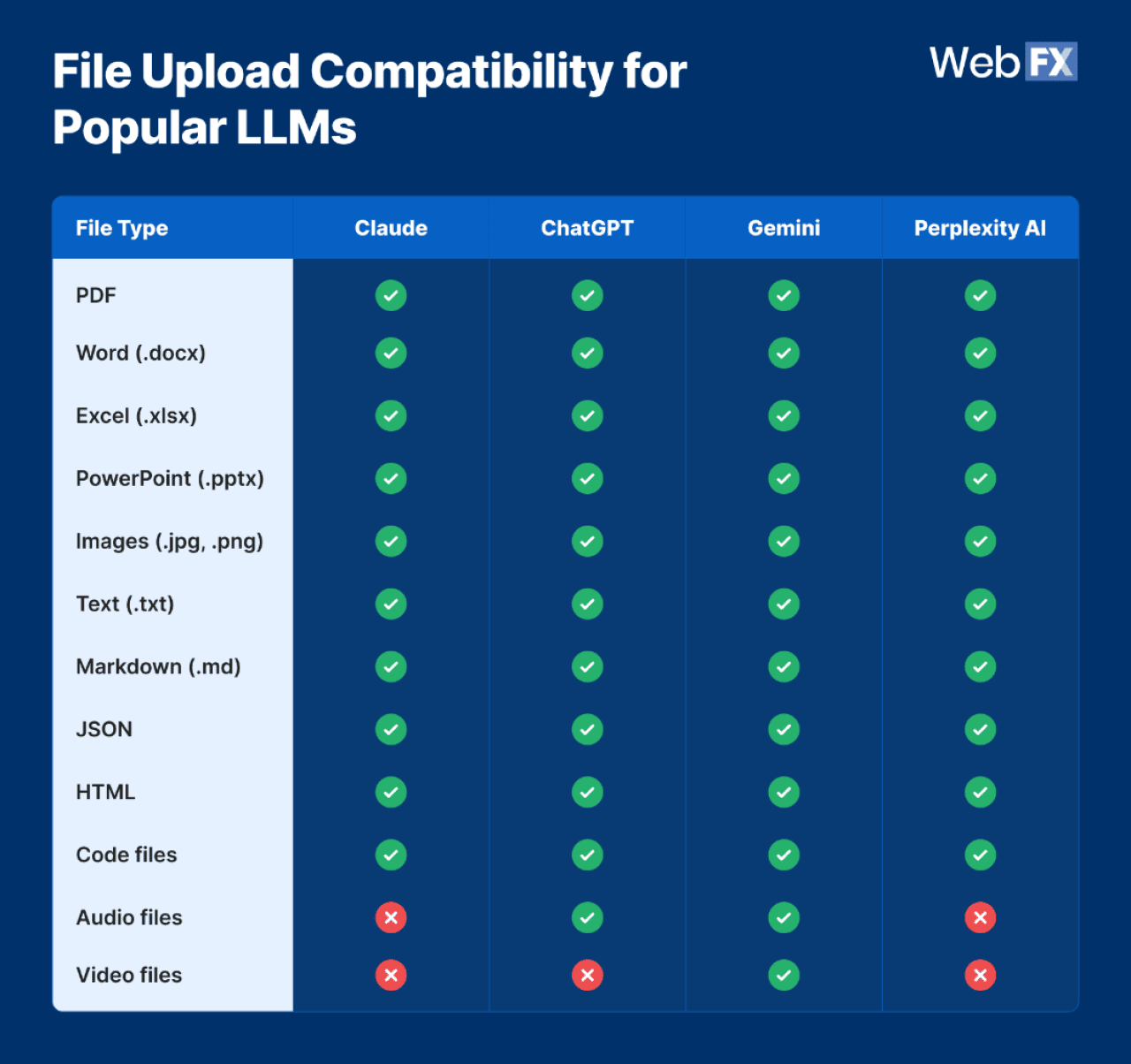
LLMs are able to process a big variety of file types nowadays, in addition to being able to read specific URLs in a lot of cases. A lot of times when prompting, users are referencing something specific, and simply adding that file or information works wonders.
File upload compatibility for popular LLMs
Treat AI conversations as ongoing dialogues
Effective prompting isn’t a one-shot effort, it’s an iterative process. Your first attempt might give you a rough shape, but each subsequent refinement brings you closer to your vision.
This approach is valuable when brainstorming creative projects. Rather than expecting perfection immediately, each AI response can be viewed as a stepping stone. “That’s interesting, but can we explore the second point more deeply?” This conversational approach allows the AI to build on previous context rather than starting fresh each time.
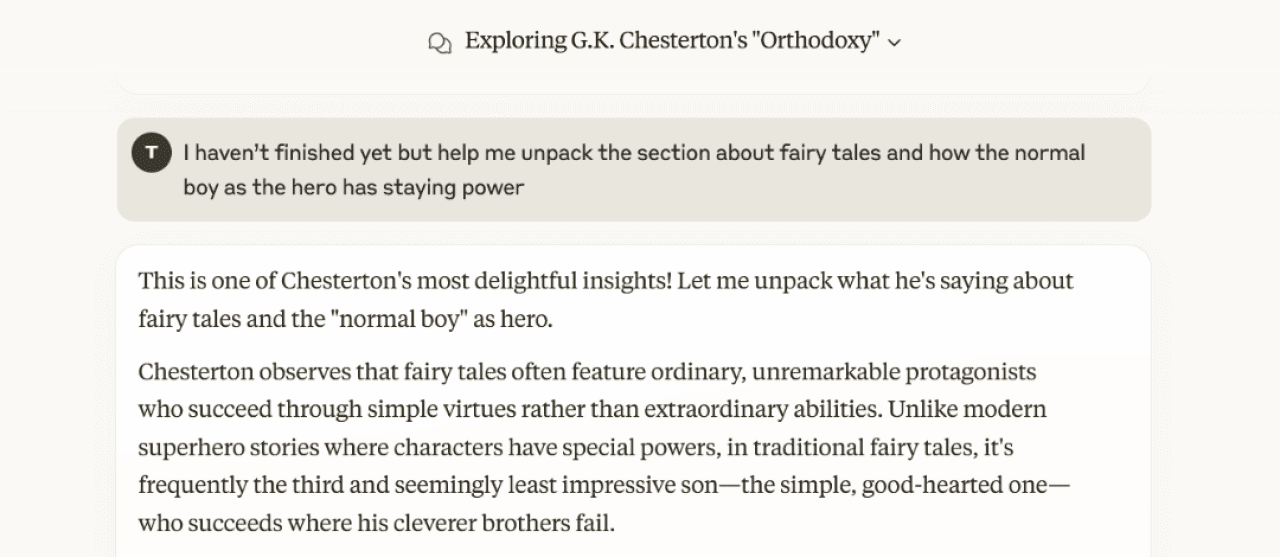
One application is using AI as a reading companion for non-fiction books. After finishing a chapter on behavioral economics, users can discuss key concepts with the AI as if in a book club. “What did you think about the author’s perspective on loss aversion? I found it interesting how it contradicted…” The AI helps highlight connections that might be missed and suggests related concepts to explore because the conversation maintains a continuous conversation rather than exchanging isolated prompts.
By approaching AI prompting as a collaborative, iterative process rather than a one-time command, you’ll unlock much richer possibilities from these increasingly sophisticated tools.
By mastering the 4 C’s framework — Creativity, Context, Constraints, and Clarity — you can transform your AI interactions from frustrating exchanges into productive partnerships. The difference between someone who struggles with AI tools and someone who leverages them effectively often comes down to how thoughtfully they craft their prompts.
Remember that effective AI prompting isn’t about finding a perfect formula or magic words — it’s about clear communication, specific details, and an iterative approach. Start with strong ideas, provide rich context, set appropriate boundaries, and be precise in your instructions. As you practice these principles, you’ll develop an intuitive sense for what works, making each interaction more valuable than the last. A key AI tool isn’t the latest model or feature — it’s your ability to ask the right questions in the right way.
This story was produced by WebFX and reviewed and distributed by Stacker.


(0) comments
Welcome to the discussion.
Log In
Keep it Clean. Please avoid obscene, vulgar, lewd, racist or sexually-oriented language.
PLEASE TURN OFF YOUR CAPS LOCK.
Don't Threaten. Threats of harming another person will not be tolerated.
Be Truthful. Don't knowingly lie about anyone or anything.
Be Nice. No racism, sexism or any sort of -ism that is degrading to another person.
Be Proactive. Use the 'Report' link on each comment to let us know of abusive posts.
Share with Us. We'd love to hear eyewitness accounts, the history behind an article.