


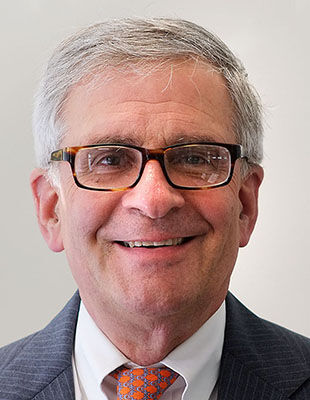
BOSTON — As he lies dying, the man who once snarled from the floor of the House of Representatives — whose rhetorical rockets' red blare mercilessly exposed the logistical flaws in the arguments of his overmatched opponents, whose piercing, pitiless wit stung his rivals, whose caustic asides roiled his political caucus — can barely muster a whisper.
Barney Frank is on the line, breathing his words — among his last — rather than barking them, his message coming as a murmur more than as mortar fire.
"It gives me comfort," he muttered, in hospice at age 86, "to have done something."
For a half-century — from his pilgrimage in Freedom Summer, the 1964 voter-registration drive in segregated Mississippi, to his backbench and backroom bargaining on Capitol Hill — Frank did something. Not something or other, but the things other people didn't do, but should have.
He is a gay man who, unlike other gays in the House at the time, was forthright about his sexuality and vigorous in support of gay rights. He worked for the rights of the powerless. He spoke truth to power. He used power to make gentle the life of the world.
Though he never did any of that gently.
"He had an amazing connection between brain and mouth," recalled former Democratic Rep. John Tierney of Massachusetts. "Republicans froze when he was at the mike. They knew they were going to get scorched."
I've known him for 57 years, witnessing 57 varieties of a man whose name is an aptronym, the phenomenon occurring when a name matches a person's identity. Margaret Court played tennis, Cecil Fielder played first base, Larry Speakes was a White House spokesman, Barney Frank is frank.
He wasn't always Barney. He was born Barnett Frank of Bayonne, New Jersey, but as a born agent of change, he — in the one act in which he actually was formal — formally changed his name to Barney. It made him (only slightly) more approachable.
Even with that, he doesn't remotely resemble the huggable "Barney" of children's television — the dinosaur and his friends met "to play and sing with happy faces," not an accurate description of a Frank floor speech — and he surely isn't purple, in prose or politics. The Barney of American politics was blue: cobalt congressional Democratic blue.
The remarkable thing about Frank — even more remarkable when you think of how our politics have been poisoned by a different strain of partisanship, far more searing and divisive than anything even contemplated by the gentleman from the fourth district of Massachusetts — is how much he accomplished working with people for whom he had contempt.
"He compromised ... some," said former Democratic Rep. Michael Harrington of Massachusetts, an early mentor. "He was transactional, with a real talent to make things happen."
And to make things change.
"He made it clear to every public official that sexual orientation was nothing to apologize for," said Charles Wolfe, former president of the Gay and Lesbian Victory Fund. "That was unheard of. He showed that being honest about who you are wasn't a roadblock to success."
Frank became a subject of scandal after hiring a prostitute as his driver. He later received a mortifying reprimand from his House colleagues.
He was — this has disappeared from the capital — simultaneously ideological and pragmatic.
"He had all the qualities that make for an influential member of the House," said former Rep. James Shannon of Massachusetts. "That included the art of compromise and dealing with people who disagreed with everything he believed."
The rare political figure whose mastery of legislation is matched by his mastery of language, he was, like Sen. Edward M. Kennedy, a political figure who raised money from his allies and whose name (and the specter of him in power) helped his rivals raise even more.
Like Kennedy, he had a special gift for finding an otherwise unidentified wrinkle in politics that allowed him to use comedy to win comity in Washington. Kennedy did it on education with George W. Bush and health care with Orrin Hatch. Frank did it with the House Financial Services Committee.
The notion of Frank, whose interests generally are in matters of social justice, sitting as chairman of a congressional banking panel, or helping to bail out automobile companies, would have astonished anyone who saw him, at age 29, organize and terrorize the youthful crusaders who, like he, saw the insurgent congressional campaign of Harrington as a heat-seeking missile directed at Richard Nixon's Vietnam policies.
(He scared me, a campaign volunteer at age 15, and scared me later, in my 40s, when he dutifully and regularly called me, then the Washington bureau chief of The Boston Globe, to offer not particularly praiseworthy critiques of the shortcomings of our coverage.)
The 2010 Dodd-Frank Wall Street Reform and Consumer Protection Act bears his name, which, after the monumental masons complete their work, also will be chiseled on his tombstone.
Here's a representative story about a congressional representative: Years ago, I was tasked to write advance Globe obituaries of people neither near death nor even ill. I called Frank about a perfectly healthy Supreme Court justice.
"When are you going to write my obit?" he asked.
"I already have."
"You missed the best part — what's going to be on my tombstone: 'The time of the gentleman has expired.'"
Long before the time of the gentleman grew limited, he performed several refined minuets in the dance of legislation. One example among many:
One of his great enemies was Rep. Don Young, chairman of the House Resources Committee and one of Frank's few rivals in irascibility. Frank was reluctant to approach the Alaska Republican when he set out to create a Whaling National Historical Park in New Bedford, Massachusetts.
So he dispatched GOP Rep. Peter Blute, who shared the old whaling area in his district, to approach Young in his office, where dozens of animal heads hung on the wall.
"I was a conservative but learned that Barney knew how to move legislation and that I had to learn from him," Blute said. "He had the best strategic thinking — the best understanding of how people interacted — of anyone whom I worked with in the time I was in the House."
In our last conversation, as the gentleman was nearing the end, I asked him what was his greatest achievement. "Learning to be smart enough," he said, "to not answer questions like that."
•••
David M. Shribman is the former executive editor of the Pittsburgh Post-Gazette.


(0) comments
Welcome to the discussion.
Log In
Keep it Clean. Please avoid obscene, vulgar, lewd, racist or sexually-oriented language.
PLEASE TURN OFF YOUR CAPS LOCK.
Don't Threaten. Threats of harming another person will not be tolerated.
Be Truthful. Don't knowingly lie about anyone or anything.
Be Nice. No racism, sexism or any sort of -ism that is degrading to another person.
Be Proactive. Use the 'Report' link on each comment to let us know of abusive posts.
Share with Us. We'd love to hear eyewitness accounts, the history behind an article.