


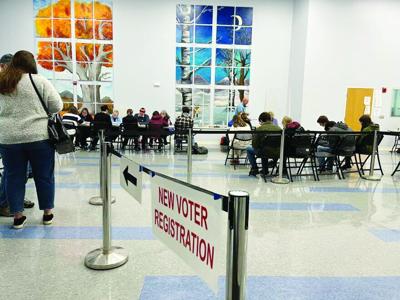
A federal judge heard opening arguments Monday in a lawsuit challenging the constitutionality of a 2024 state law that requires first-time voters in New Hampshire to show proof of U.S. citizenship when they register.
The trial over House Bill 1569, which was backed by Republicans and signed into law by then-Gov. Chris Sununu, is expected to last two weeks. A ruling by Judge Samantha Elliott is expected before this year’s primary elections.
The law is considered one of the strictest in the nation, requiring all first-time registrants in the state to bring a passport, birth certificate or naturalization papers to the polls. Previously, would-be voters who didn’t have certain documents with them could sign a legally binding affidavit confirming their qualifications before casting a ballot.
Catherine Denny, an attorney with the New Hampshire Department of Justice, defended the law as “common sense” during opening arguments Monday. She said the state has a significant interest in “promoting election integrity” and encouraging confidence in New Hampshire elections. While there is no evidence of widespread voter fraud in the state, polling from the University of New Hampshire has found that about a quarter of residents believe voter fraud is a problem in the state.
The law is being challenged by a range of groups and individual citizens, including the ACLU, New Hampshire Youth Movement, and the League of Women Voters. Henry Klementowicz, an attorney with the state chapter of the ACLU, said the law creates “significant and unnecessary burdens” for voters, including residents who have recently turned 18 and are registering for the first time. He also highlighted an alleged disproportionate impact on women, who may have changed their surnames because of marriage and need to show additional paperwork beyond a birth certificate when they register to vote.
Klementowicz told the judge that in the past 26 years of elections, there have been just eight instances of non-citizens found to have improperly cast ballots in the state, with the bulk of those cases involving inaccurate information provided by local officials about eligibility.
The so-called documentary proof of citizenship law remains in effect in New Hampshire and, according to the plaintiffs, has already led to hundreds of potential voters being turned away during recent municipal elections.
A federal court struck down a similar citizenship law in 2016 in Kansas, where experts alleged as many as 30,000 otherwise qualified voters were unable to participate in an election because they lacked access to a passport or birth certificate.
During the first day of the trial, Olivia Zink, executive director of the Coalition for Open Democracy, said that her group had observed voters in New Hampshire turned away from polling places during municipal elections last year due to a lack of documentation. She also testified that voter registration drives for high school seniors were resulting in far fewer successful registrations than in previous years, because many students did not have the necessary documents.
Experts in voting laws are expected to testify in the days ahead, including New Hampshire Secretary of State David Scanlan, who backed the law.
Last year, Republicans adopted a new law, known as House Bill 464, that gives local election officials the ability to access certain vital records, including state-issued drivers licenses or birth certificates, from the polling place while registering new voters. While accessing those records could assist some people to register, opponents note that many people who are qualified to vote may not have been born in New Hampshire, or may lack a New Hampshire drivers license.
•••
These articles are being shared by partners in the Granite State News Collaborative. Don’t just read this. Share it with one person who doesn’t usually follow local news — that’s how we make an impact. For more information, visit collaborativenh.org.


(0) comments
Welcome to the discussion.
Log In
Keep it Clean. Please avoid obscene, vulgar, lewd, racist or sexually-oriented language.
PLEASE TURN OFF YOUR CAPS LOCK.
Don't Threaten. Threats of harming another person will not be tolerated.
Be Truthful. Don't knowingly lie about anyone or anything.
Be Nice. No racism, sexism or any sort of -ism that is degrading to another person.
Be Proactive. Use the 'Report' link on each comment to let us know of abusive posts.
Share with Us. We'd love to hear eyewitness accounts, the history behind an article.