


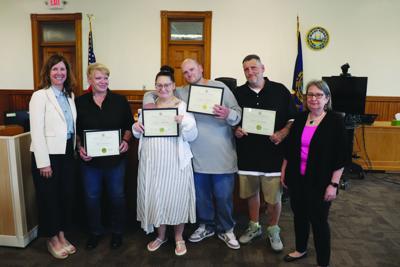
LACONIA — Scott Beaumont, Stacie Gentile, Alicia Mclean, and James Morin graduated from Belknap County Recovery Court Tuesday afternoon, completing a program that lasts about a year-and-a-half for most participants.
Jacqui Abikoff, executive director of Horizons Counseling Center, opened the commencement ceremony, in Superior Court, with a question, and promptly provided the answer.
“Why would we take in felons who have been unsuccessful with traditional parole and been arrested multiple times?
"This saves them from years in New Hampshire State Prison. They’re all getting out one day — sending them to prison doesn’t treat disease.”
Morin has been part of the program since March 3, 2025. He was given the choice to take a three-month jail sentence, or volunteer for a program where most participants spend 18 to 24 months working to recover, 6-10 of those spent in daily counseling and educational sessions.
“He grabbed the concept of recovery, and ran with it,” Abikoff said.
Morin is one of few participants who made it from beginning to end with no slip-ups. Abikoff said he had a “stick with the winners” mentality, and migrated to participants who were doing well.
Morin said, at first, the idea of the program terrified him, because “nothing was working.” When he chose this route, his best friend told him he would regret it. Morin described himself as hardheaded, and said after hearing this, he leaned into the program to prove her wrong, and graduated in just 16 months. Morin, or “Jimbo” to his friends, said he is “forever grateful to have a good recovery system. I made friends, and a foundation.”
Superior Court Justice Elizabeth Leonard spoke Tuesday afternoon. Before the four graduates were introduced, she said although it is a five-step process, their work is not done yet.
“Commence means beginning. This is not the end of your journey. Now, you move on to the sixth phase, as you continue to transform into sober, productive members of the community.”
Belknap Sheriff Bill Wright planned to attend with Chief Deputy James McIntire, but their duties got in the way. Wright left a note on the Belknap County Recovery Court’s Facebook page.
“On behalf of the men and women of the Belknap County Sheriff’s Office, congratulations to all of the graduates and to everyone who helped make this journey a success. Your hard work, dedication, and commitment are something to be proud of. We wish you all the best as you begin the next chapter.”
Three alumni were in attendance. Among them was guest speaker Cierra Gonyea. After her graduation, Gonyea worked for New Hampshire Public Defender, where she still does today. During her recovery, she said it was difficult to push herself to do simple things, like going to the dentist, or “putting fruits and vegetables into my cart and actually buying them.” Program participants chuckled and nodded in understanding.
“Slow and steady wins this race. We are all worthy of a beautiful, peaceful life. It doesn’t feel real. It will be different than anything you’ve ever known.”
Beaumont entered the recovery program on Feb. 11, 2025.
“He came determined he would be the fastest, because he had all the answers, and would argue every point. Then he told me he just thought it was fun to argue,” Abikoff said, earning laughter from the audience. “I said, 'If you have all the answers, you don’t know all the questions.'”
“I tried writing a speech 15 times. On my first day, I told myself, ‘Just show up and don’t lie,'" Beaumont said. Although it was a hard journey, he said this program gave him “a chance to make a right.”
Abikoff said Beaumont’s journey was not a straight line, but progress is always good enough. Through his determination to be the quickest graduate, Beaumont was able to complete this phase of the program in 17 months.
To reach commencement, participants must complete a five-step program, receiving additional recovery support in a more hands-off manner. Along the five-steps are random drug tests, meetings with case managers, check-ins with a parole officer, court appearances, as well as group and one-on-one counseling, typically daily for the first half of the program. After graduation, participants stay from six to 12 months in post-treatment, to monitor progress and emphasize long-term support and recovery.
Paul H. Dean, the governor’s adviser for addiction and behavioral health, made an unexpected appearance. He came with four letters in hand, for each of the graduates, from Gov. Kelly Ayotte (R-NH).
Dean read Ayotte's remarks aloud.
“This is a significant achievement and reflects countless days of hard work. It demonstrates your ability to overcome and focus on your goals. Today marks a new chapter. Your success serves as an example that meaningful change is possible.”
Mclean started the program on Oct. 23, 2022.
“It’s been a long, bumpy road, but this woman is a fighter. Her fighting spirit brought her here today,” Abikoff said.
Abikoff has known Mclean for many years. The two embraced at the ceremony. “She ran from everything, including herself. But she took the reins back.”
After almost four years in the program, Mclean stood before her peers, family, and friends. She turned to the recovery program counselors, and said, “Thank you to everyone here for me today. It’s been a long road, and I appreciate everyone.”
Gentile reached her commencement Tuesday afternoon, after only 11 months.
“Now Stacie was a more private person. She doesn’t wear her heart, or her mind, on her sleeve, but she shared more over time,” Abikoff said.
Unlike most participants, Gentile was working part-time, then eventually full-time, throughout the program. Abikoff commended her for this achievement, and said her “priorities changed” during her time there.
“She had bumps in the road, and beat herself up. She saw mistakes as a failure, but despite this, she learned about herself and recovery,” Abikoff said.
Gentile received her certificate, and turned to the staff, teary-eyed, thanking them.
After forming in 2012, the Belknap County Recovery Court has helped over 60 people complete the program and begin their long-term recovery journey.
Abikoff said these graduates have “walked through fire” to get there. It is not an easy task, and it truly changes their lives. “It’s the family they make. Our job is to help them find that family and recovery, so they’re not alone.”
Abikoff expressed her pride in the graduates, and well-wishes on their sixth step in the program. She urged them to come back for their peers’ commencement, as they will serve as role models, like Gonyea.
“We don’t give up on them, if they don’t give up on themselves.”


(0) comments
Welcome to the discussion.
Log In
Keep it Clean. Please avoid obscene, vulgar, lewd, racist or sexually-oriented language.
PLEASE TURN OFF YOUR CAPS LOCK.
Don't Threaten. Threats of harming another person will not be tolerated.
Be Truthful. Don't knowingly lie about anyone or anything.
Be Nice. No racism, sexism or any sort of -ism that is degrading to another person.
Be Proactive. Use the 'Report' link on each comment to let us know of abusive posts.
Share with Us. We'd love to hear eyewitness accounts, the history behind an article.