


Electricians are becoming increasingly important to the U.S. economy as electricity demand accelerates and the country expands its energy infrastructure.
Electricians can enter the field without four-year degrees and can instead opt for a less expensive trade school education or an apprenticeship that allows them to earn while they hone their skills. Demand for electricians’ services is already strong, but the field also has bright prospects given recent technology and policy shifts.
The U.S. is experiencing a rapid surge in electricity demand, driven in large part by the explosive growth of artificial intelligence, cloud computing, and energy-intensive data centers. This increase in consumption is placing new strain on an aging power grid that was not built for such high and fluctuating loads. To keep up, utilities and governments are racing to modernize grid infrastructure and integrate more renewable energy sources like solar and wind. These sweeping changes—both in the technologies we use and how we power them—are expected to significantly expand the need for skilled electricians to install, maintain, and upgrade electrical systems across the country.
However, as the nation increasingly embraces electrification, a crucial challenge has emerged: the existing workforce of electricians may not be sufficient to meet the rising demand.
Projected Job Growth for Electricians: A Leader Among the Trades
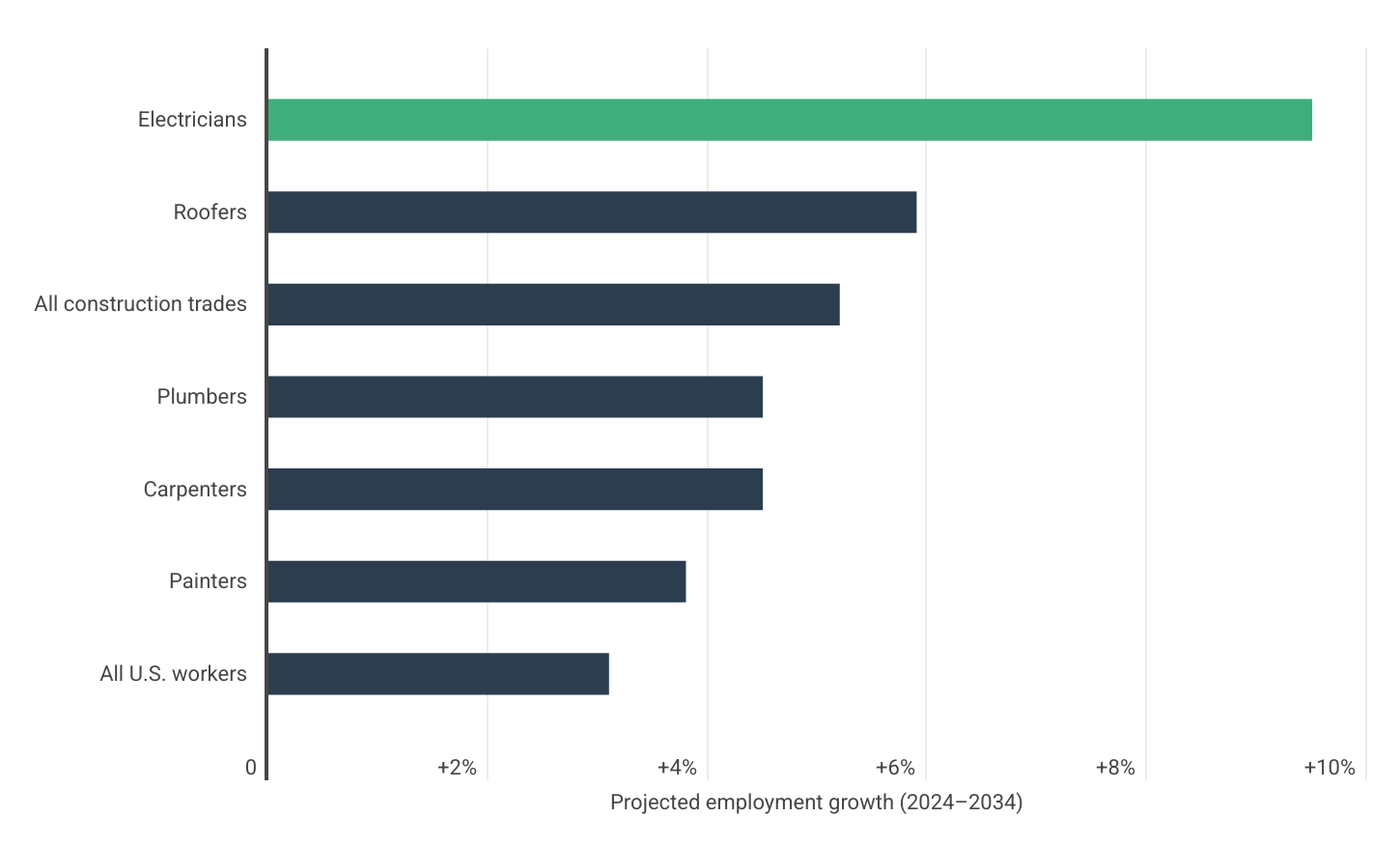
The BLS projects that electrician jobs will grow 3X faster than the U.S. average
Source: Construction Coverage analysis of U.S. Bureau of Labor Statistics data | Image Credit: Construction Coverage
According to the Bureau of Labor Statistics, job opportunities for electricians are projected to grow at a pace that’s three times faster than the national average in the coming decade. Electrician employment is expected to rise by 9.5% from 2024 to 2034, far exceeding the 3.1% growth rate projected for all U.S. jobs.
Electricians are also set to outpace their peers in related construction trades. While the overall construction trades sector is anticipated to grow by 5.2% by 2034, roofers are projected to see slightly higher gains of 5.9%, while carpenters (+4.5%), plumbers (+4.5%), and painters (+3.8%) are expected to experience slower growth. Despite muted projections for some of these popular construction occupations, they are still above the national average for all U.S. workers, an indication of the continued demand for skilled trades workers.
How Much Do Electricians Make Per Year?
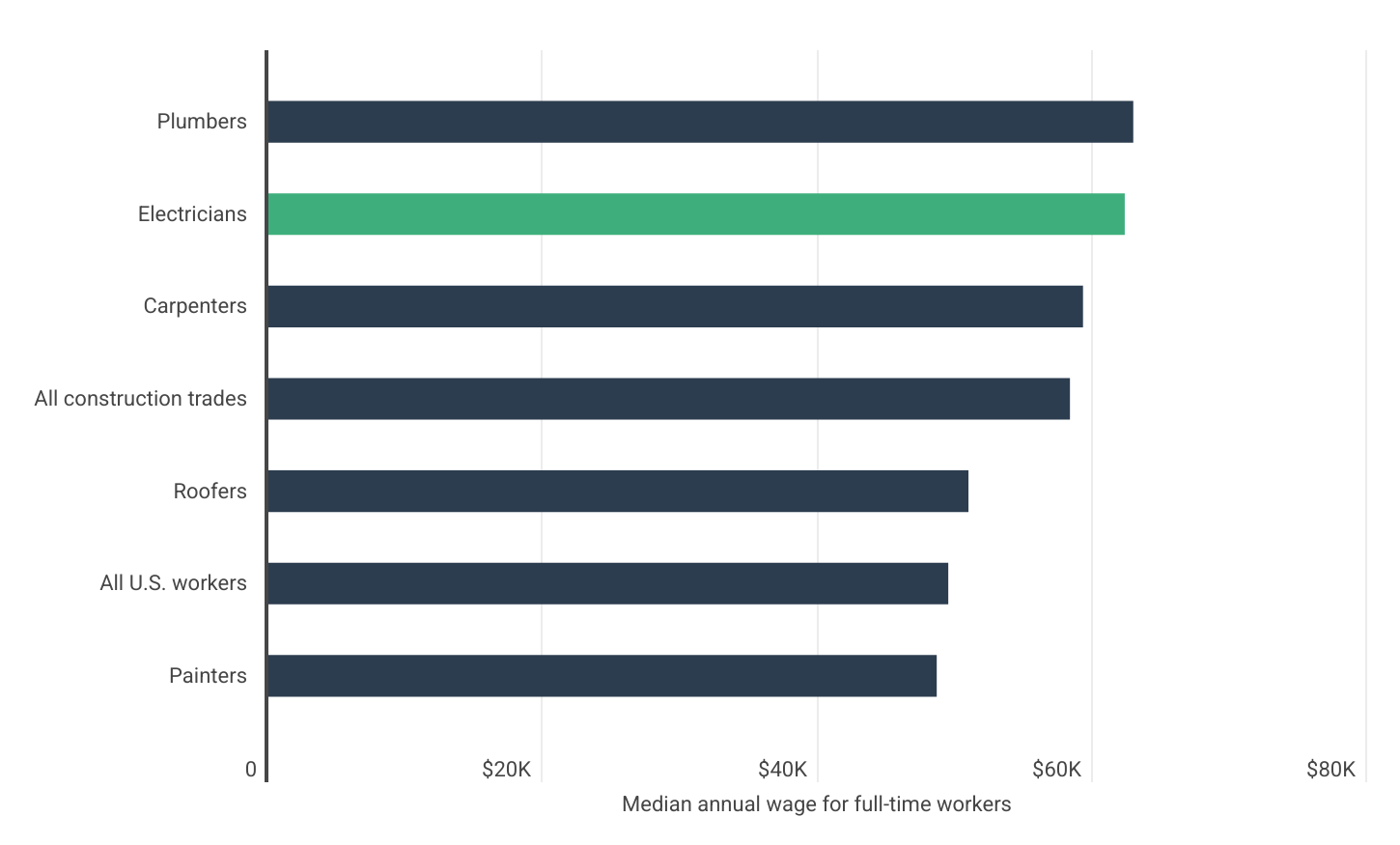
Electricians earn a median $62,350 per year, or $30 per hour, which is 26% more than the typical American worker
Source: Construction Coverage analysis of U.S. Bureau of Labor Statistics data | Image Credit: Construction Coverage
In large part due to strong demand, electricians are well compensated compared to other skilled trade workers and to those with similar levels of required training. In 2024, the median annual wage for electricians was $62,350, approximately 26% higher than the median wage of $49,500 across all U.S. occupations.
Even within the skilled trades, electricians stand out for their pay. On average, electricians earn about 6.8% more than the broader group of construction trades workers. While plumbers have a similar median salary as electricians, other trades such as roofers and painters earn significantly less, with median wages of $50,970 and $48,660, respectively. Carpenters fall somewhere in between, with a median wage of $59,310.
Cost-of-Living-Adjusted Pay: Real Electrician Wages by State
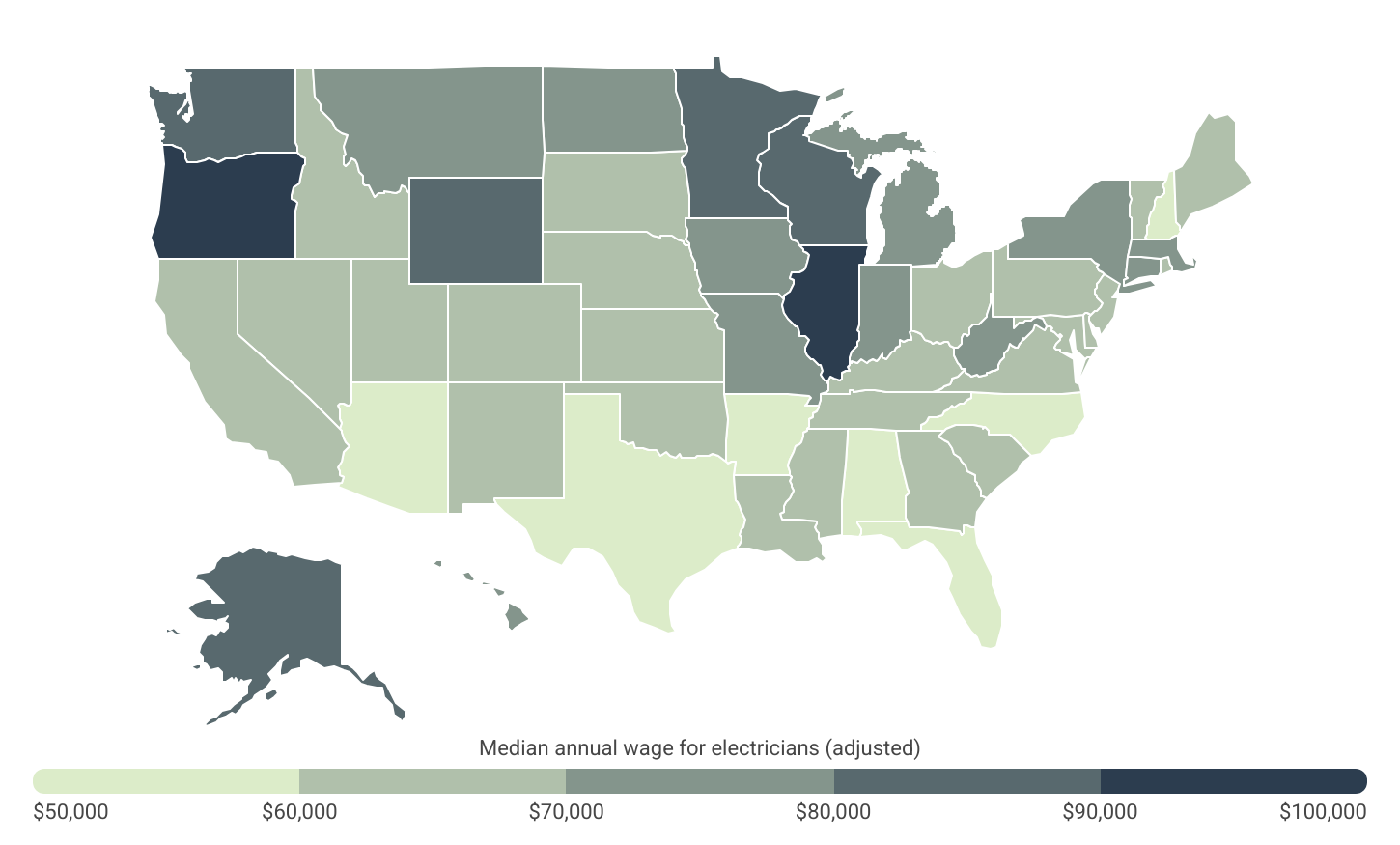
Illinois, Oregon, and Washington offer the best compensation for electricians—all over $88K per year
Source: Construction Coverage analysis of U.S. Bureau of Labor Statistics and U.S. Bureau of Economic Analysis data | Image Credit: Construction Coverage
Location plays a key role in the earning potential for electricians, with Midwestern and Western states offering some of the highest wages when adjusted for cost of living. Illinois leads the nation at an adjusted median annual wage of $97,476, followed by Oregon at $92,933 and Washington at $88,917. In the Midwest, lower living costs help boost the relative value of wages in states like Wisconsin ($80,658), Missouri ($77,320), and Michigan ($77,168). In contrast, electricians in Oregon and Washington benefit from higher nominal wages that more than offset the region’s higher costs, keeping their adjusted earnings strong.
Alaska ($80,480) and Hawaii ($76,605) are two more examples of high-cost Western states that offer strong wages to electricians even after accounting for the cost of living. Despite being the third most expensive state in the country, Hawaii ranks tenth nationwide for adjusted electrician pay. In general, Western states benefit from relatively high unionization rates, which help drive up nominal wages. Alaska, in particular, also sees strong demand for skilled electricians due to its sizable oil and gas industry.
In contrast, Southern states generally pay lower wages to electricians—and to construction workers overall—reflecting weaker unions and economies less dependent on industries that require skilled electrical work. Seven of the 10 lowest-paying states for electricians are in the South.
The same factors are at play at the metro level, and accordingly, locations in Florida and Texas are overrepresented among the lowest-paying metropolitan areas for electricians, even when factoring in the states’ relatively lower living costs compared to other large states like California. On the other hand, locations in Illinois—like Chicago, Decatur, and Champaign—stand out as offering some of the best compensation for the nation’s electricians.
Here is a summary of the data for New Hampshire:
- Median annual wage for electricians (adjusted): $58,845
- Median annual wage for electricians (actual): $61,990
- Median annual wage for all workers (actual): $52,610
- Relative concentration of electricians (compared to average): +6%
- Relative cost of living (compared to average): +5.3%
For reference, here are the statistics for the entire United States:
- Median annual wage for electricians (adjusted): $62,350
- Median annual wage for electricians (actual): $62,350
- Median annual wage for all workers (actual): $49,500
- Relative concentration of electricians (compared to average): N/A
- Relative cost of living (compared to average): N/A
For more information, a detailed methodology, and complete results, see The Best-Paying U.S. Cities for Electricians on Construction Coverage.


(0) comments
Welcome to the discussion.
Log In
Keep it Clean. Please avoid obscene, vulgar, lewd, racist or sexually-oriented language.
PLEASE TURN OFF YOUR CAPS LOCK.
Don't Threaten. Threats of harming another person will not be tolerated.
Be Truthful. Don't knowingly lie about anyone or anything.
Be Nice. No racism, sexism or any sort of -ism that is degrading to another person.
Be Proactive. Use the 'Report' link on each comment to let us know of abusive posts.
Share with Us. We'd love to hear eyewitness accounts, the history behind an article.