


As artificial intelligence reshapes the job market and the U.S. unemployment rate reaches a four-year high, plumbers and other skilled tradesworkers are seeing growing demand. While many office-based jobs face slowing growth, plumbing continues to offer steady employment and long-term job security.
Plumbing may not be considered a high-profile career, but it remains essential. Plumbers are needed for new construction, routine maintenance, and emergency repairs—services that are always in demand. At the same time, the industry is facing a labor shortage as older plumbers retire and fewer younger workers enter the field.
This report uses the latest data from the Bureau of Labor Statistics and the Bureau of Economic Analysis to examine how plumbing jobs are expected to grow, how wages compare to other jobs nationally, and which U.S. cities offer the best and worst pay for plumbers after adjusting for local cost of living.
Here are the key takeaways from the analysis:
- Plumbers are in demand. Plumbing jobs are projected to grow about 50% faster than the U.S. job market overall.
- Plumbing pays well. The typical plumber earns $62,970 per year or $30.27 per hour, making it one of the top-paid skilled trades.
- Big pay gap by state. After adjusting for cost of living, plumbers in Illinois earn roughly twice as much as plumbers in Florida—$97,314 vs. $48,854.
Plumber Job Growth: Are Plumbers Currently in High Demand?
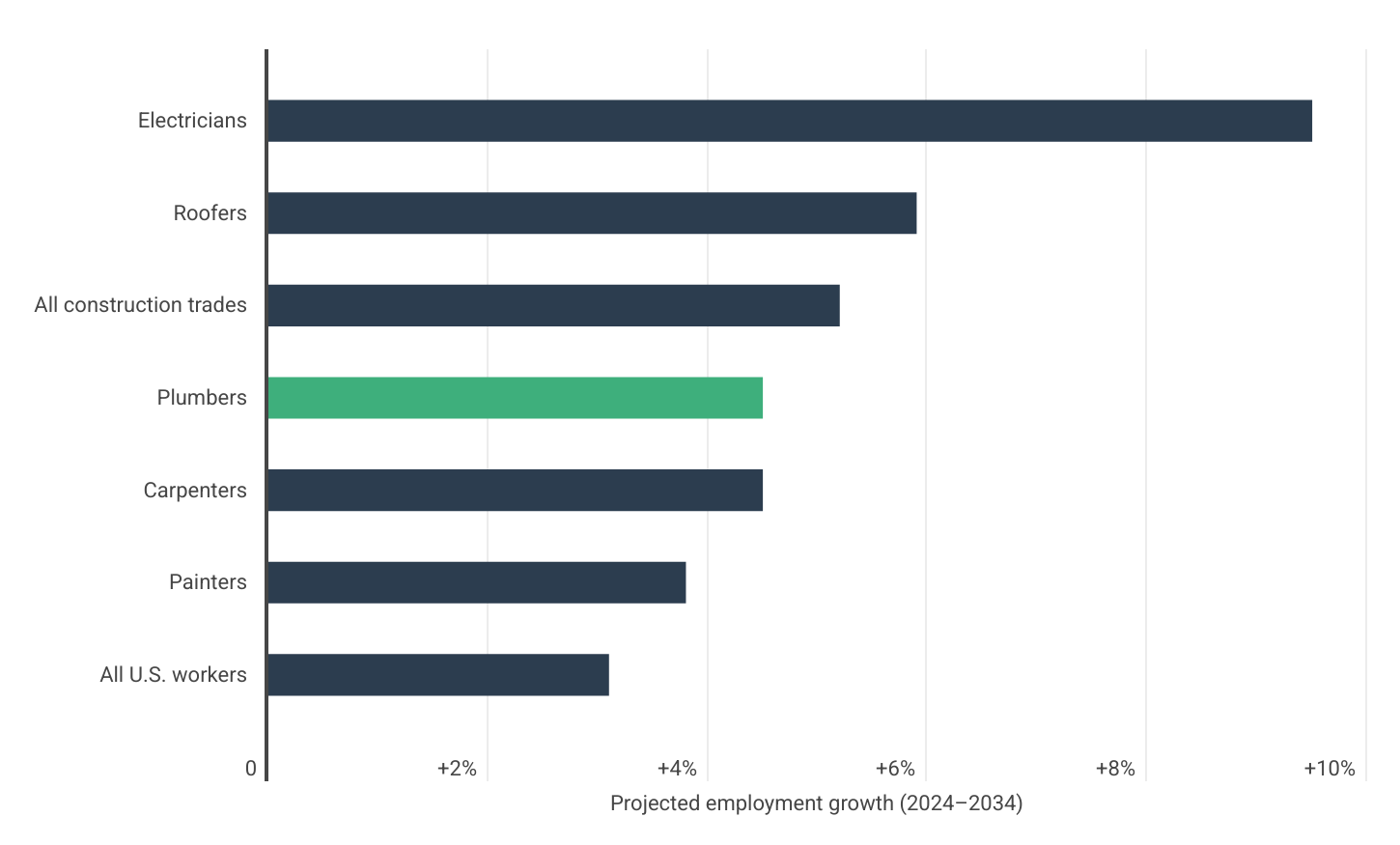
According to the BLS, plumbing jobs are projected to grow about 50% faster than the average across all U.S. jobs.
Source: Construction Coverage analysis of U.S. Bureau of Labor Statistics data | Image Credit: Construction Coverage
Plumbing jobs are expected to grow faster than the national average over the next decade, underscoring the continued demand for this skilled trade. According to the U.S. Bureau of Labor Statistics, employment for plumbers is projected to increase by 4.5% between 2024 and 2034—outpacing the 3.1% growth rate forecast for all occupations across the U.S. labor market.
While the projected growth rate for plumbers lags behind that of the broader construction sector (+5.2%), this slower pace reflects a more stable and steady stream of demand. Unlike some trades that are experiencing rapid expansion driven by specific sectors—such as electricians (9.5% projected growth) benefiting from the growth of data centers, EV infrastructure, and solar energy installations—plumbing tends to see more consistent need across both residential and commercial settings.
Rather than depending on emerging industries or policy-driven investments, plumbing demand is tied to everyday needs. This steadier growth reflects a lower level of volatility, offering job seekers a more predictable employment outlook.
Plumber Salaries: Are Plumbers Paid Well Compared to Other Trades?
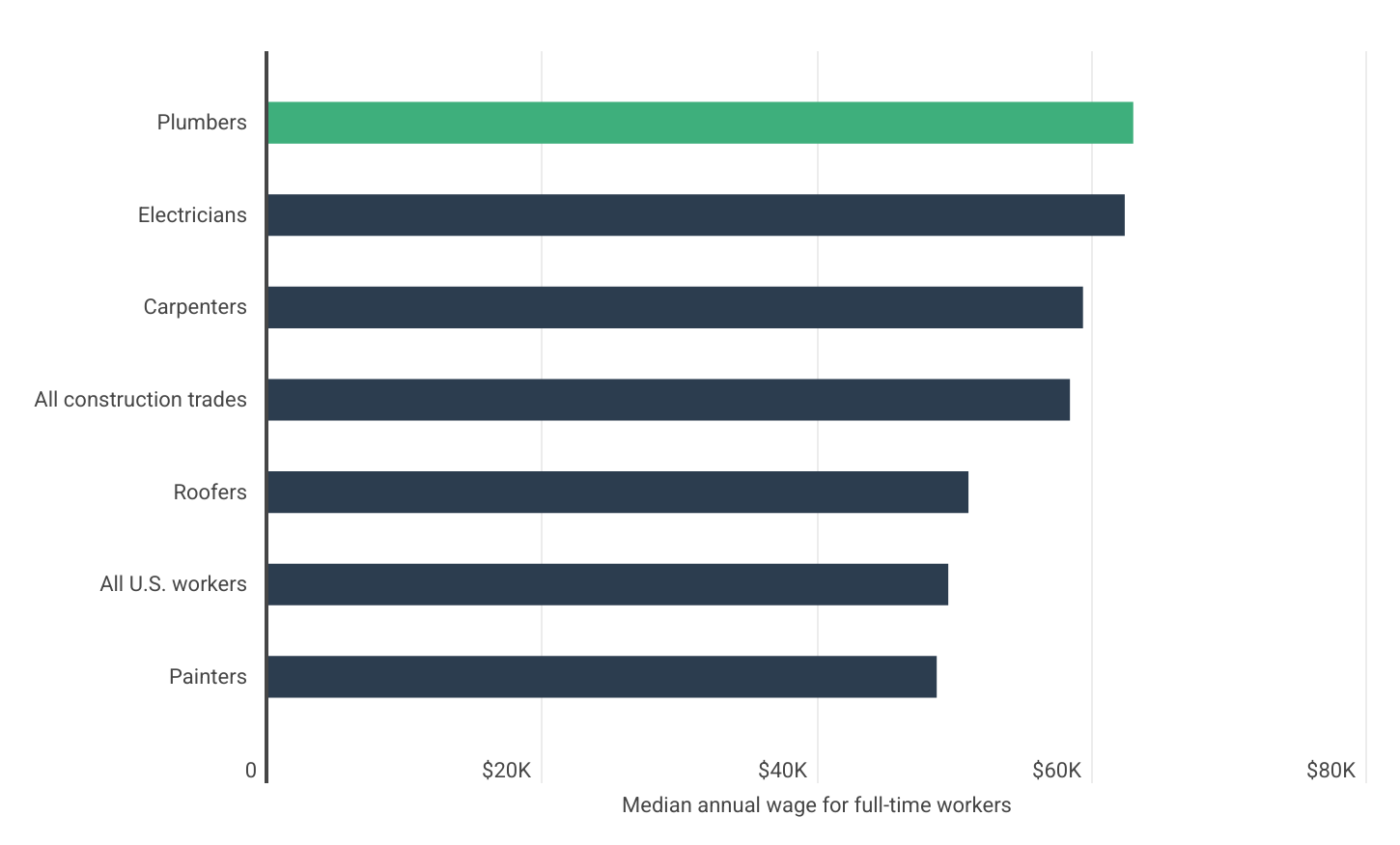
Plumbers earn a median annual wage of $62,970—about 8% more than the average construction worker
Source: Construction Coverage analysis of U.S. Bureau of Labor Statistics data | Image Credit: Construction Coverage


Plumbers earn a median annual wage of $62,970, placing them among the better-paid workers in the construction trades. That figure is about 8% higher than the median wage across all construction occupations ($58,360), and nearly 27% higher than the median wage for all U.S. workers, which stands at $49,500.
Compared to related trades, plumbers earn slightly more than electricians ($62,350) and significantly more than carpenters ($59,310), roofers ($50,970), and painters ($48,660). While wage differences across trades can reflect varying levels of specialization and risk, these figures highlight plumbing as one of the more financially rewarding paths within the skilled labor sector.
Importantly, becoming a plumber does not require a four-year college degree. Instead, aspiring plumbers can pursue training through affordable trade schools or apprenticeship programs that offer hands-on experience while earning a wage. This combination of relatively high pay and accessible training makes plumbing an appealing option for those looking to avoid student debt while entering a high-demand field.
Regional Differences: Plumber Salaries by State
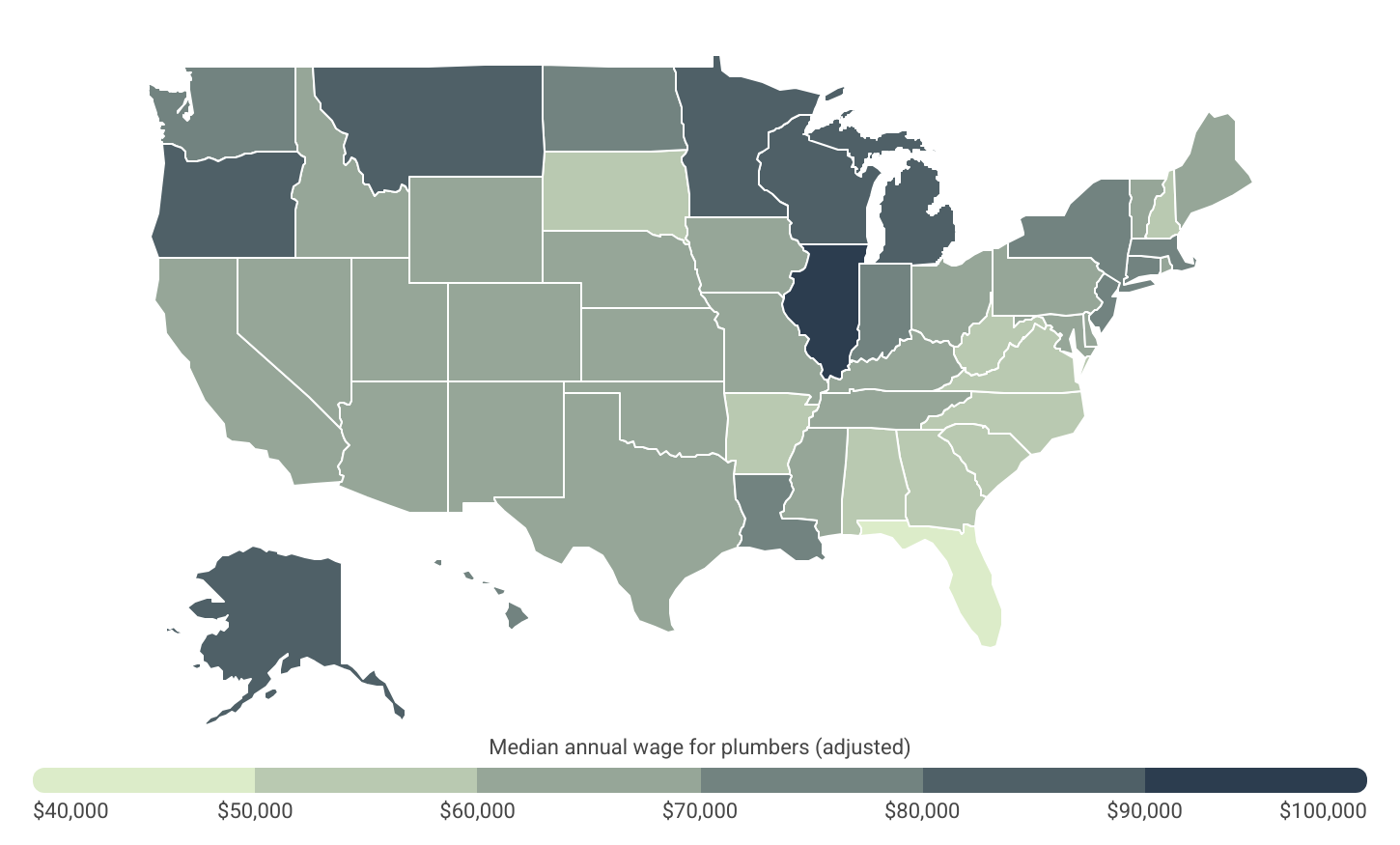
Real plumber wages range from a high of $97,314 in Illinois to a low of $48,854 in Florida
Source: Construction Coverage analysis of U.S. Bureau of Labor Statistics and U.S. Bureau of Economic Analysis data | Image Credit: Construction Coverage
After adjusting for cost of living, plumber salaries vary widely across the United States. At the top of the list is Illinois, where plumbers earn an adjusted median wage of $97,314—nearly double the adjusted wage at the bottom of the rankings in Florida ($48,854). Illinois and Florida are also the top- and bottom-paying states for construction workers overall.
Most of the top-earning states are located in the northern half of the country, including Midwestern states like Illinois ($97,314), Minnesota ($84,620), Wisconsin ($84,331), and Michigan ($81,787). Colder climates in these regions may contribute to higher demand for plumbing services, particularly for winterization, repairs, and emergency work, which can drive up wages. Western states like Oregon ($88,912), Montana ($86,355), and Alaska ($81,689) also rank highly, possibly due to a combination of labor shortages, strong union representation, and higher baseline wages in rural or remote areas.
By contrast, Southern states tend to offer the lowest adjusted wages for plumbers. Florida ($48,854), North Carolina ($54,165), West Virginia ($55,284), and Arkansas ($57,451) all fall in the bottom five. This may reflect lower union density, lower prevailing wage standards, and generally lower labor costs in the region. Still, growing populations and ongoing construction activity may create steady work opportunities, even in lower-wage markets.
Similar trends hold at the local level, with many metropolitan areas in the Midwest and West ranking highly for plumbers’ wages. In the top metros, including Rochester, MN ($106,751), Madison, WI ($103,825), and Kennewick-Richland, WA ($102,012), the typical plumber can expect to earn well over $100,000 per year after adjusting for living costs. These high-paying areas often share two characteristics: relatively high unionization rates and moderate to low costs of living—factors that together contribute to stronger real wages for skilled trades.
Here is a summary of the data for New Hampshire:
- Median annual wage for plumbers (adjusted): $58,883
- Median annual wage for plumbers (actual): $62,030
- Median annual wage for all workers (actual): $52,610
- Relative concentration of plumbers (compared to average): +25%
- Relative cost of living (compared to average): +5.3%
For reference, here are the statistics for the entire United States:
- Median annual wage for plumbers (adjusted): $62,970
- Median annual wage for plumbers (actual): $62,970
- Median annual wage for all workers (actual): $49,500
- Relative concentration of plumbers (compared to average): N/A
- Relative cost of living (compared to average): N/A
For more information, a detailed methodology, and complete results, see The Best-Paying Cities for Plumbers on Construction Coverage.


(0) comments
Welcome to the discussion.
Log In
Keep it Clean. Please avoid obscene, vulgar, lewd, racist or sexually-oriented language.
PLEASE TURN OFF YOUR CAPS LOCK.
Don't Threaten. Threats of harming another person will not be tolerated.
Be Truthful. Don't knowingly lie about anyone or anything.
Be Nice. No racism, sexism or any sort of -ism that is degrading to another person.
Be Proactive. Use the 'Report' link on each comment to let us know of abusive posts.
Share with Us. We'd love to hear eyewitness accounts, the history behind an article.