


The construction and real estate industries continue to undergo significant shifts moving into 2026. The residential sector experienced rapid growth during the COVID-19 pandemic—driven by low interest rates and high demand for suburban housing. However, new home construction has since declined from its 2022 peak. Meanwhile, public construction spending, which had seen steady growth due to federal investments through the Infrastructure Investment and Jobs Act (IIJA) and the Inflation Reduction Act, appears to be leveling off, signaling a potential industry-wide slowdown.
For carpenters and other skilled tradespeople, these shifting conditions are reshaping job opportunities and earnings potential across the country. Against this backdrop, this report from Construction Coverage—a site helping builders and tradespeople make informed business and career decisions—analyzes the most recent data from the U.S. Bureau of Labor Statistics and the U.S. Bureau of Economic Analysis to assess how carpenters are faring economically. The analysis focuses on projected job growth within the occupation, how carpenter wages compare to those of other skilled trade workers, and which U.S. cities offer the highest and lowest pay after adjusting for cost of living differences.
Here are the key takeaways from the analysis:
- Job prospects remain strong despite headwinds. The BLS projects total carpenter employment to grow 4.5% in the coming decade, ahead of the 3.1% average across all occupations.
- Carpenter wages outpace the broader construction sector. The median annual wage for carpenters is $59,310, which is about $1,000 more than what’s typical for the construction industry overall.
- Low wages in the South. Real wages for carpenters are consistently low in the South, even after adjusting for lower living costs. Carpenters in Hawaii and Illinois can make about $30,000 more per year than those in Florida and Texas.
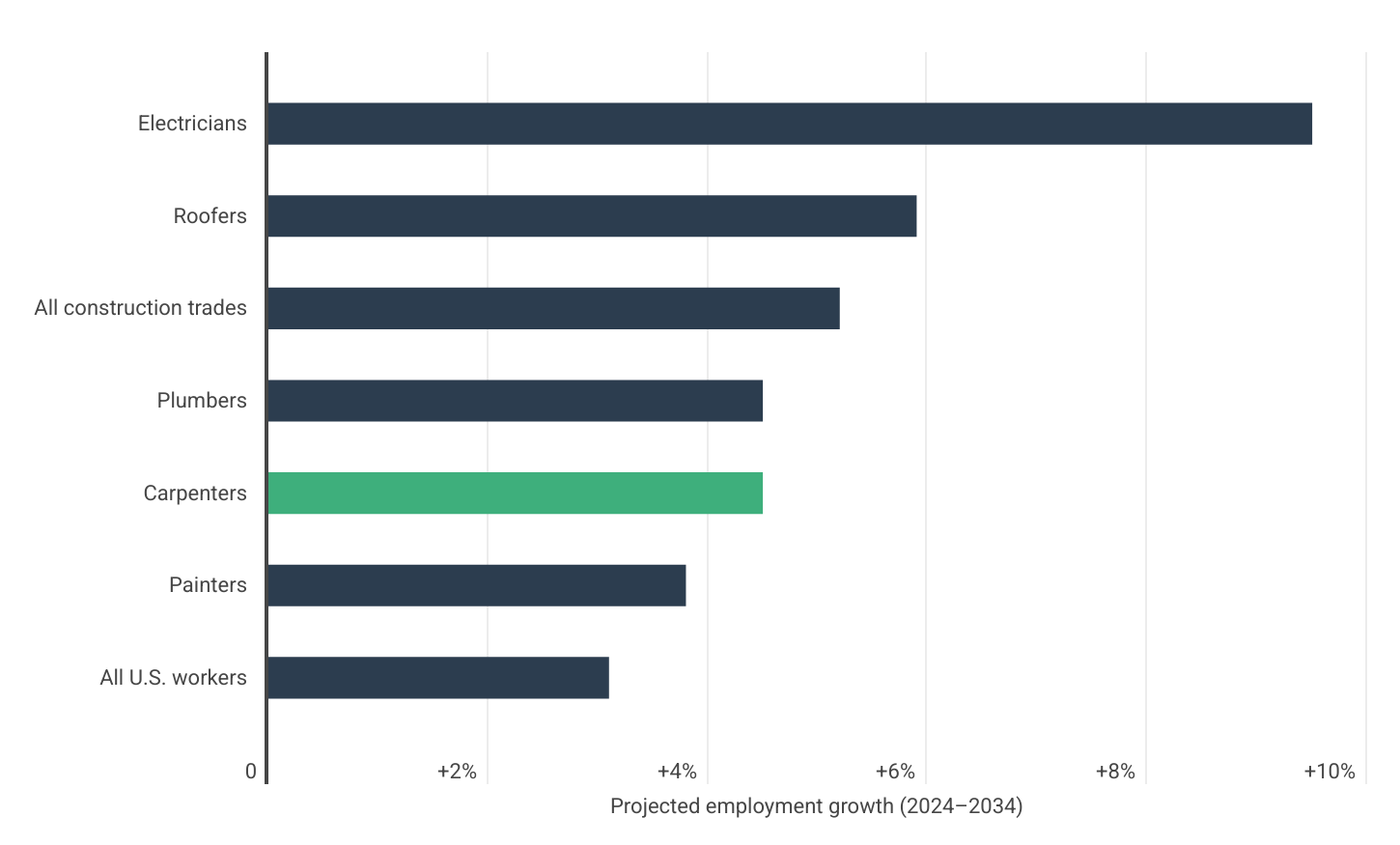
Carpenter Jobs to Grow 4.5% by 2034
BLS projects carpenter job growth will beat the national average (+3.1%) but trail the broader construction sector (+5.2%)
Source: Construction Coverage analysis of U.S. Bureau of Labor Statistics data | Image Credit: Construction Coverage
While overall job growth in the U.S. is projected to remain modest over the next decade, the demand for skilled tradespeople continues to outpace the national average. According to projections from the U.S. Bureau of Labor Statistics, employment for carpenters is expected to grow by 4.5% between 2024 and 2034—surpassing the 3.1% growth rate forecasted for all U.S. workers.
However, this growth trails the broader construction trades category, which is projected to grow by 5.2%. Electricians (+9.5%) and roofers (+5.9%) are expected to see especially strong job gains, due in part to the ongoing investment in electrification and residential solar installations. Plumbers, whose employment is projected to grow at the same rate as carpenters (+4.5%), tend to see more stable demand because their work often involves essential and routine maintenance services.
Carpenters, by contrast, are more vulnerable to economic slowdowns. Their work is closely tied to new construction and remodeling activity—segments that are often delayed or scaled back during periods of rising interest rates or broader economic uncertainty. While the long-term outlook remains positive, carpenter employment tends to be more cyclical and sensitive to shifts in the housing market.
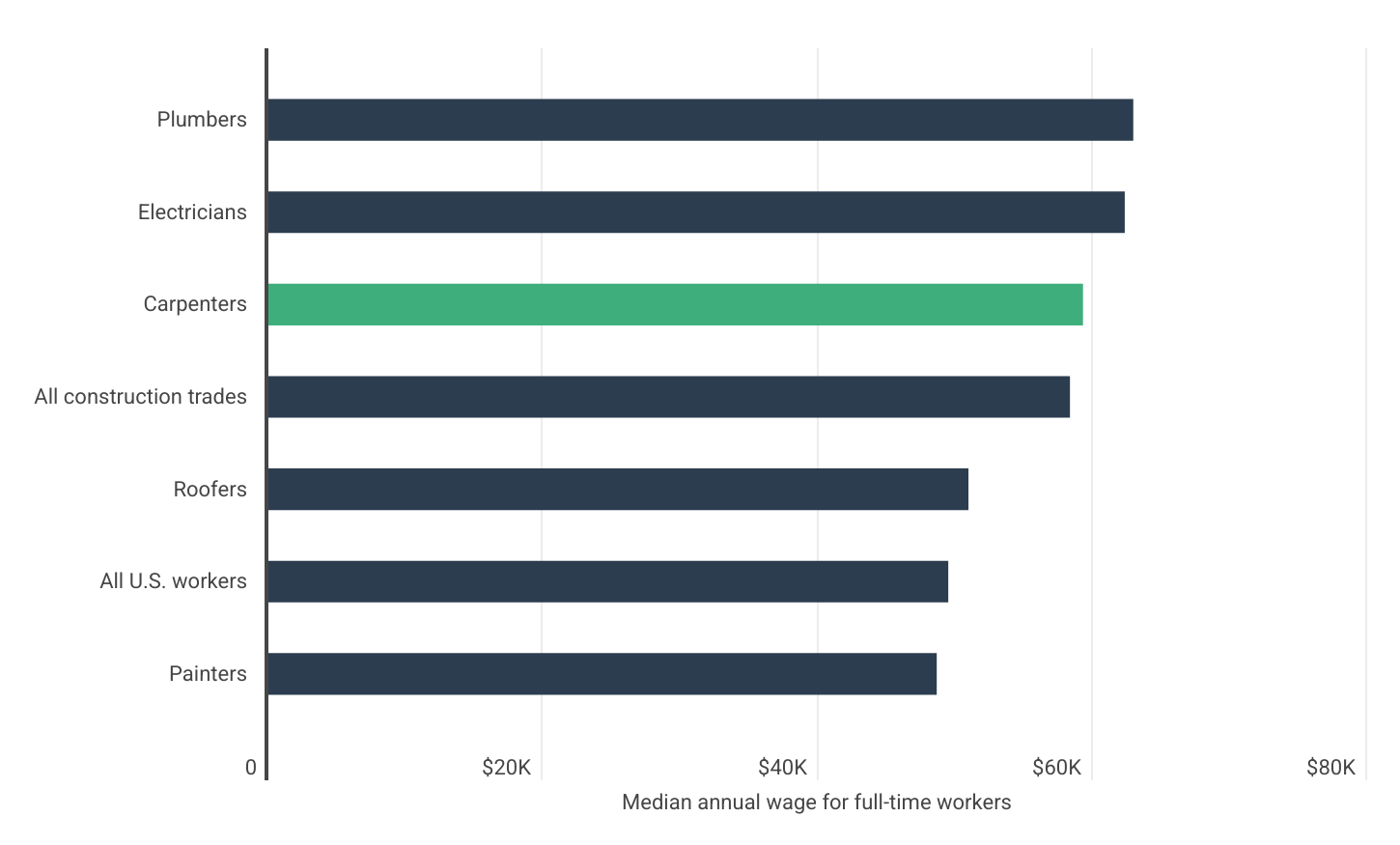
How Much Do U.S. Carpenters Make Per Year?
Carpenters earn a median $59,310 per year ($28.51 per hour), which is 20% more than the typical U.S. worker
Source: Construction Coverage analysis of U.S. Bureau of Labor Statistics data | Image Credit: Construction Coverage
Carpenters in the United States earn a median annual wage of $59,310, or $28.51 per hour, according to the most recent figures from the U.S. Bureau of Labor Statistics. This places carpenter earnings roughly 20% above the national median for all full-time workers, which stands at $49,500.

Within the construction trades, carpenter wages fall in the middle of the pack. Plumbers and electricians lead with median annual wages of $62,970 and $62,350, respectively. Carpenters earn slightly more than the median wage for all construction workers ($58,360), as well as more than roofers ($50,970) and painters ($48,660).
These wage patterns reflect both the skill level required and the type of work performed in each trade. Trades like plumbing and electrical work often require more specialized training and certification, which can contribute to higher pay. Nonetheless, carpentry remains a relatively well-compensated trade compared to other jobs, especially given that the positions do not require a four-year college degree.
How Carpenter Salaries Vary by State
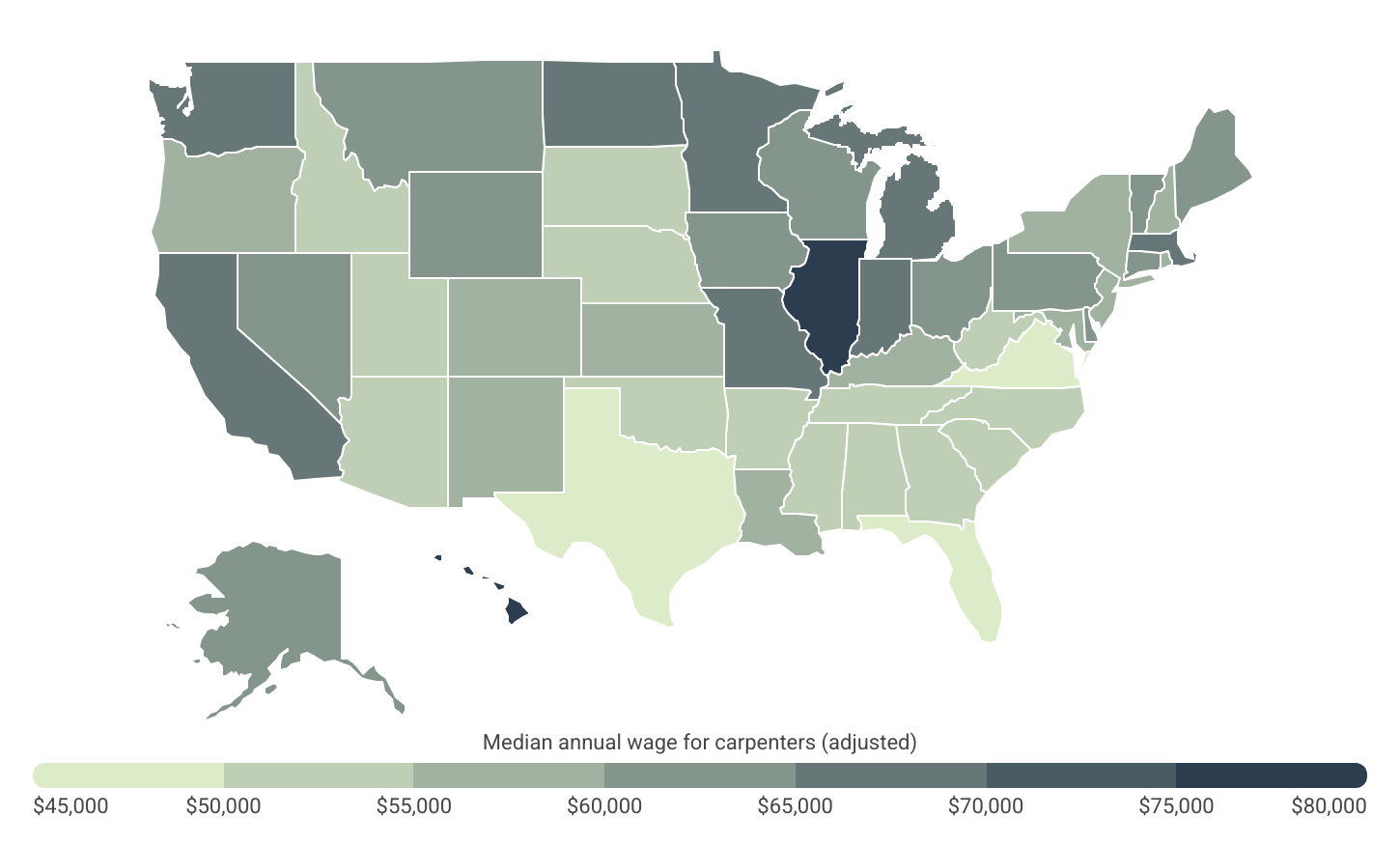
Adjusted for cost of living, carpenter wages range from a high of $79,156 in Hawaii to a low of $46,476 in Florida
Source: Construction Coverage analysis of U.S. Bureau of Labor Statistics and U.S. Bureau of Economic Analysis data | Image Credit: Construction Coverage
Carpenters already earn competitive wages relative to other occupations requiring similar education levels, but pay varies widely depending on where they work. Regional economic conditions, labor market policies, union strength, and cost of living all play a role in determining how far a carpenter's paycheck goes.
Hawaii offers the highest adjusted median annual wage for carpenters at $79,156—making it one of only two states where adjusted carpenter wages exceed $70,000. This figure is 33% higher than the national median and nearly $2,000 above the next highest state. Hawaii’s top ranking is supported by the state’s high union membership rate—the highest in the country—as well as strong minimum wage laws.
Following Hawaii are Illinois ($77,295), Washington ($67,482), Missouri ($66,640), and California ($66,459). Many of these states—particularly in the Midwest and on the West Coast—also have robust labor protections, higher minimum wages, and greater union representation, all of which contribute to stronger wage outcomes for carpenters. States like North Dakota, Minnesota, and Michigan also rank highly, reflecting the Midwest’s relatively strong affordability for skilled tradeworkers.
At the other end of the spectrum, states in the Southeast generally offer the lowest cost-of-living-adjusted pay for carpenters. Florida ranks last at $46,476, followed closely by Texas ($49,550), Virginia ($49,847), and North Carolina ($50,595). These lower rankings reflect a combination of lower prevailing wages, weaker union presence, and more limited labor protections in these regions.
Unsurprisingly, at the metro level, several locations in the Midwest and on the West Coast are also among the best-paying for carpenters. Among major metropolitan areas with populations of one million or more, Chicago, Minneapolis, and Sacramento rank as the top three best-paying cities for carpenters.
Here is a summary of the data for New Hampshire:
- Median annual wage for carpenters (adjusted): $56,851
- Median annual wage for carpenters (actual): $59,890
- Median annual wage for all workers (actual): $52,610
- Relative concentration of carpenters (compared to average): +28%
- Relative cost of living (compared to average): +5.3%
For reference, here are the statistics for the entire United States:
- Median annual wage for carpenters (adjusted): $59,310
- Median annual wage for carpenters (actual): $59,310
- Median annual wage for all workers (actual): $49,500
- Relative concentration of carpenters (compared to average): N/A
- Relative cost of living (compared to average): N/A
For more information, a detailed methodology, and complete results, see The Best-Paying American Cities for Carpenters on Construction Coverage.


(0) comments
Welcome to the discussion.
Log In
Keep it Clean. Please avoid obscene, vulgar, lewd, racist or sexually-oriented language.
PLEASE TURN OFF YOUR CAPS LOCK.
Don't Threaten. Threats of harming another person will not be tolerated.
Be Truthful. Don't knowingly lie about anyone or anything.
Be Nice. No racism, sexism or any sort of -ism that is degrading to another person.
Be Proactive. Use the 'Report' link on each comment to let us know of abusive posts.
Share with Us. We'd love to hear eyewitness accounts, the history behind an article.