


Two agencies serving Belknap residents are receiving reduced funds from the county budget this year — the University of New Hampshire Cooperative Extension and the Belknap County Conservation District — and staff say their ability to be effective may be curtailed as a result.
Throughout the budget making process, County Commission Chair Peter Spanos (District 1) emphasized the importance of the work championed by those organizations, and asked members of the county’s delegation to the Statehouse to increase funding.
The elected representatives declined.
The Belknap County Conservation District is included in the county budget’s section for outside agencies, though it's quasi-governmental itself. County conservation districts were created through state legislation, and given a legal mandate to perform the charges and duties to which county residents, over several decades, have become accustomed.
Each of New Hampshire’s 10 counties have such an organization, and at the helm in Belknap is just one person: Lisa Morin.
For budget year 2026, the conservation district requested $60,000 in funding. State representatives approved $25,000 in funding, the same figure approved the year prior. County Commissioners Spanos, Glen Waring (District 2, vice chair) and Stephen Hodges (District 3, clerk) recommended the $60,000 allocation.
In 2025, county taxes on a $300,000 property contributed about $0.44 to the conservation district for investment in Belknap County, focused on natural resources projects and program development. On average, the conservation district brings about $200,000 in grants for natural resources projects into Belknap County.
County funding allows the conservation district to leverage grant funding, acting as a multiplier for every dollar spent. According to their records, every $1 in county funding is used to generate $30 in projects and conservation-based technical support.
Typically, employees and volunteers with the conservation district work with landowners, land managers and conservation partners on more than 220 requests each year for activities such as providing technical assistance or conservation advice.
They work to improve water quality, protect stream habitats and reduce flood damage county-wide, and in 2025, did so in Meredith and Sanbornton. They also work to provide landowners with stormwater runoff and erosion prevention information.
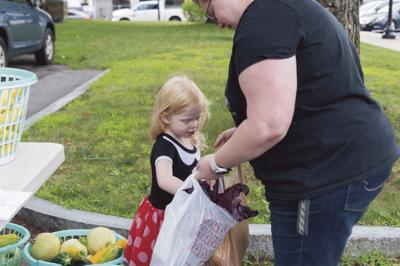
Other activities are assisting local farmers in donating thousands of pounds of fresh produce to food pantries, senior centers, group homes and churches. In 2025, the conservation district worked with farms like Petal Pushers Farm in Laconia, Marimark Farms in Tilton, Brookdale Fruit Farm in Hollis, and Carter Hill Orchard in Concord. They also run a farm equipment rental program for farmers and gardeners, to allow access to large and costly equipment when needed at low expense.
At a budget hearing in January, conservation district board of supervisors member Rick DeMark told state representatives it's difficult to operate with reduced funding.
“We are concerned about trying to continue to operate at a reduced funding level. We have one employee, that employee is crucial to our ability to not only manage our programs, but to develop new programs. This year, we have lost our capacity to search out alternative funding sources — grants, in particular — we do have some multi-year grants that have continued this year, and will continue up until April and May of this year, but after that, because of our cutback, we have not been able to secure new funding sources.”
The conservation district is holding a plant sale fundraiser through Feb. 20. To learn more, visit belknapccd.org/tree-shrub-sale.
For the UNH Co-op Extension, reduced funding levels, particularly over time, could hamper their ability to provide services to county residents.
Paul Chiarantona, public affairs manager for the extension, told representatives three of their county-based staff positions were eliminated after the budget reduction last year: one each of a natural resources, food and agriculture, and economic development specialists.
When they passed the budget earlier this month, members of the Belknap County Delegation approved $82,500 in funding for the extension, $100,000 less than recommended by county commissioners. That appropriation level-funded the extension service to 2025 levels, when the budget was reduced from $165,000.
“The largest impact for our forest, county forestry food and [agriculture] is that we’re unable to provide site visits, which have specialists literally on the ground, walking the farm, walking the wood lot, be able to identify invasive species, provide forest management plans, provide best practices for farming,” Chiarantona said during a budget meeting in January. “Essentially, our forester, the year before, had been able to perform 74 in-county visits. That number dropped to 12, and only three of them occurred after the funding reduction.”
He said hundreds, if not thousands, of acres of land would not be observed if funding wasn’t restored.
“Essentially, we don’t have the funds to bring those experts into the county and provide that on-the-ground service for farmers and for landowners,” he said.
According to a report submitted to the county by the extension service, that organization was able to use the $165,000 appropriated in 2024 to leverage $297,110 in U.S. Department of Agriculture and University System of New Hampshire funds, and the value of time of 45 supplemental educators, who provided education and technical assistance to county residents, was $103,470.
If funding were restored, services would be restored, Chiarantona said.
“When it comes to the food and [agriculture] agent, specifically, that individual is still employed with extension,” he said. “Those people exist within extension still, but the positions do not. We fortunately had some vacant roles or grant funding that could fund their work on other specific projects. Someone like the food and [agriculture] agent, that grant funding is not forever, so eventually [when] that funding ends, that position will be eliminated.”
The total value of extension services was more than $565,000 in salaries, benefits, travel reimbursement, educational supplies and computers, just shy of three times returned on the $165,000 county investment.
Chiarantona said if funding remains reduced, restoration of services becomes more difficult.
“Basically, services at all five of our program areas would be restored to Belknap County with restored funding,” he said. “If the funding remains at the level or is further reduced, the ability to ramp up services will be very difficult if time goes on. I think we’re still at that point where we’re able to restore.”


(0) comments
Welcome to the discussion.
Log In
Keep it Clean. Please avoid obscene, vulgar, lewd, racist or sexually-oriented language.
PLEASE TURN OFF YOUR CAPS LOCK.
Don't Threaten. Threats of harming another person will not be tolerated.
Be Truthful. Don't knowingly lie about anyone or anything.
Be Nice. No racism, sexism or any sort of -ism that is degrading to another person.
Be Proactive. Use the 'Report' link on each comment to let us know of abusive posts.
Share with Us. We'd love to hear eyewitness accounts, the history behind an article.