


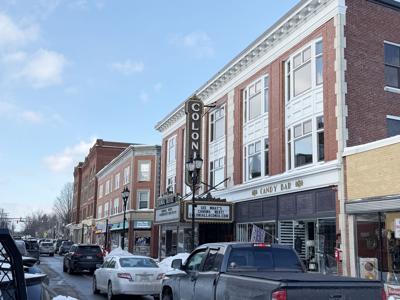
LACONIA — When city leaders considered what would become a Goliath undertaking — the purchase and restoration of the Colonial Theatre — they tended to speak in terms of anchoring a downtown revitalization through the development of a public good, not a profit-making enterprise.
Under the leadership of the late Mayor Edward Engler, who is the namesake for the 750-seat auditorium, the project to restore the Colonial was announced in June 2015, and restorations began in earnest in March 2016. The theater, which closed in 2002, sat vacant for about a decade.
The restoration project unveiled a partnership between the city and the Belknap Economic Development Council which sought to arrange a $15 million financial package to renovate the theater, first constructed in 1914.
That deal included the renovation of commercial and residential units, located at 609-621 Main St. The city council eventually approved $6.7 million in bonding for the project, increasing the city’s overall financial commitment to over $8 million. In 2020, the theater was listed in the National Register of Historic Places.
The following year, the Colonial Theatre reopened and was operated under contract with Spectacle Live, a performance events and marketing company which manages other theaters throughout Northern New England, under similar agreements and conditions. That contract is due to expire in 2026, and city leaders are negotiating a successor agreement with Spectacle at present. The Colonial is also home to Powerhouse Theatre Collaborative.
Today, whether the theater has indeed contributed to a burgeoning revitalization of downtown, or if the associated debt has worked to choke the same, remains a frequent topic of discussion among councilors and the public at City Hall.
At a meeting of the city council on Feb. 9, city resident Douglas Robinson said he’d conducted a survey of 15 business owners, and of the five who responded, four reported no increase in foot traffic as a result of the operation of the Colonial, and said it doesn't do what the city thinks it does.
But Charlie St. Clair, who owns and operates a business on Main Street, said he did not talk to Robinson about his business, and his experience is much different than what Robinson described.
“I never saw this survey, and nobody asked me anything, but I will say this, and I’ve said it in front of this council before: the Colonial Theatre, my business may not be open for those night shows, but I’ve had people come back,” said St. Clair, who owns Laconia Antique Center in the former Bloom’s Variety Store building at 601 Main. “The next day, maybe they stayed overnight, maybe not, or maybe they just came back to Laconia, because they liked what they saw, and they’ve come into my business.”
St. Clair said he speaks to as many customers in his shop as he can, and frequently learns they noticed the store when attending an event at the theater, and decided to return during operating hours.
“I know I’m not the only business that’s benefitting from that,” St. Clair said.
Individual opinions and observations aside, tax assessment data shows a direct correlation between the renovation and eventual operation of the theater, and an increase in the values of properties downtown.
The investment made by the city has increased by more than five times its initial value, and, without factoring in the increased value of the theater itself — which isn't on tax rolls — the investment has increased by about 300%.
In 2014, the last full tax year the property was owned by Pat Baldi, the assessment clocked in at $894,000. In 2015, the assessment pegged the property at $898,700, and in 2016 and 2017, the assessments dropped to $879,000, according to property tax data. In 2018, the assessment ballooned to $1 million, and increased again the next year to $1.04 million.
In 2020, when most everything in the world came to a screeching halt during the COVID pandemic, the assessment plummeted to $718,500, but rebounded in 2021 — the year the theater reopened — and was assessed at $1.01 million.
According to 2025 property assessments, the Colonial Theatre itself is valued at $2.6 million, and the retail units are assessed at $428,700, and along with the condominiums above, combined for an assessment of $5.7 million, more than five times the value of the property in 2021. Excluding the theater, the properties — nine condos units and the retail unit — are assessed at a combined $3.02 million, three times the figure in 2021.
Properties in the vicinity of the Colonial Theatre have similarly increased in value over the same period.
At 633-637 Main, where NH Vintage Vinyl and All My Life Jewelers are located, for example, the assessment increased from $500,500 in 2015, to $735,700 today. At 598 Main, where Shield Comic and RE/MAX Bayside are located, the assessment increased from $353,800, to $822,400, over the same period.
At 574 Main, where MC Cycle & Sport is located today, the assessment increased from $449,000 in 2015, to $646,700 in 2025. At 546-566 Main, where Empire Beauty School is located, the assessment increased from $775,100 to $1.4 million. And at 622-634 Main, where Wayfarer Coffee Roasters and Innisfree Bookshop are located, the assessment increased from $161,300 to $390,900.
The lone outlier is at 523-571 Main, where FitFocus is located — the 2015 assessment was $1.1 million, and the 2025 assessment was marginally higher at $1.2 million.
The theater is, at the same time, representative of the city’s largest bonded debt expense. In the original amount of $6.7 million, the city will pay $268,202 in principal and interest on that bond in fiscal year 2025-26, out of a total of about $3 million in principal and interest payments across all bonded projects.
Today, the Colonial Theatre attracts visitors to the city — they’ve got a show this weekend, for example, a Powerhouse Theatre production of "A Midsummer Night’s Dream." It’s Pete Lally of Spectacle Live who the city tapped to manage the theater about five years ago, and it’s Lally who appears likely to continue on in the role.
At a council meeting on Monday night, Mayor Mike Bordes and City Manager Kirk Beattie referred to ongoing contract negotiations between the city and Spectacle Live. Lally, in an interview with The Laconia Daily Sun, confirmed his company submitted a bid for the contract — Beattie previously said the city received only one response to the call for proposals.
Lally, president and founder of Spectacle Live, carved a niche for himself in the entertainment industry, operating multiple municipally-owned theater venues throughout New England. The job is a complicated one.
The company's involvement in the Colonial Theatre project started the same way many business arrangements do: Engler called Lally and asked to pick his brain about the business, and about how such an arrangement between the city and a private company might work. That call occurred in 2018. Shortly before COVID, when the city published their request for proposals, Lally replied, and the rest is history.
“It was such a beautiful place, and the restoration had been done so well,” Lally said.
Opening weekend was in June 2020, and they were operating back at full capacity by 2022.
“It’s been pretty busy since,” he said.
Powerhouse does about six, weeklong show runs along with rehearsals, the city hosts events there and many are sponsored by its Putnam Fund, the school uses the theater, too, and Spectacle solicits shows by national performing acts.
“All of these different pieces add up to help fill the calendar,” he said.
What Spectacle does, in essence, is mitigate the financial risk to the city in terms of operating the theater itself — it's their company, not the city, which puts up the money to bring in touring acts, and it's their company that risks losing its shirt if things don’t go to plan. On their side of the equation, the goal is to convert the risk through marketing.
And they’ve done a lot of that.
Since operating the theater, Spectacle Live has invested some $750,000 in marketing to bring visitors to Laconia. They’ve spent another $3.8 million in bringing shows to the Colonial Theatre and have, in turn, donated a combined $147,000 in ticket value to veterans and first responders. They’ve hosted 352 community, nonprofit and educational events.
Initially, Spectacle Live committed to bringing in five shows a year. In reality, they’ve brought 35 to 40 shows downtown each of those years.
According to a rough calculation estimated by the National Independent Venue Association, the Colonial Theatre has made an impact somewhere in the neighborhood of $17.8 million in economic activity downtown.
“It’s a process that we go through,” Lally said, in discussing the period of time it takes their company to understand the market well enough to ensure success. “None of that is city risk.
“As long as you’re comfortable knowing that there’s going to be ebbs and flows, that’s the game.”





(0) comments
Welcome to the discussion.
Log In
Keep it Clean. Please avoid obscene, vulgar, lewd, racist or sexually-oriented language.
PLEASE TURN OFF YOUR CAPS LOCK.
Don't Threaten. Threats of harming another person will not be tolerated.
Be Truthful. Don't knowingly lie about anyone or anything.
Be Nice. No racism, sexism or any sort of -ism that is degrading to another person.
Be Proactive. Use the 'Report' link on each comment to let us know of abusive posts.
Share with Us. We'd love to hear eyewitness accounts, the history behind an article.