


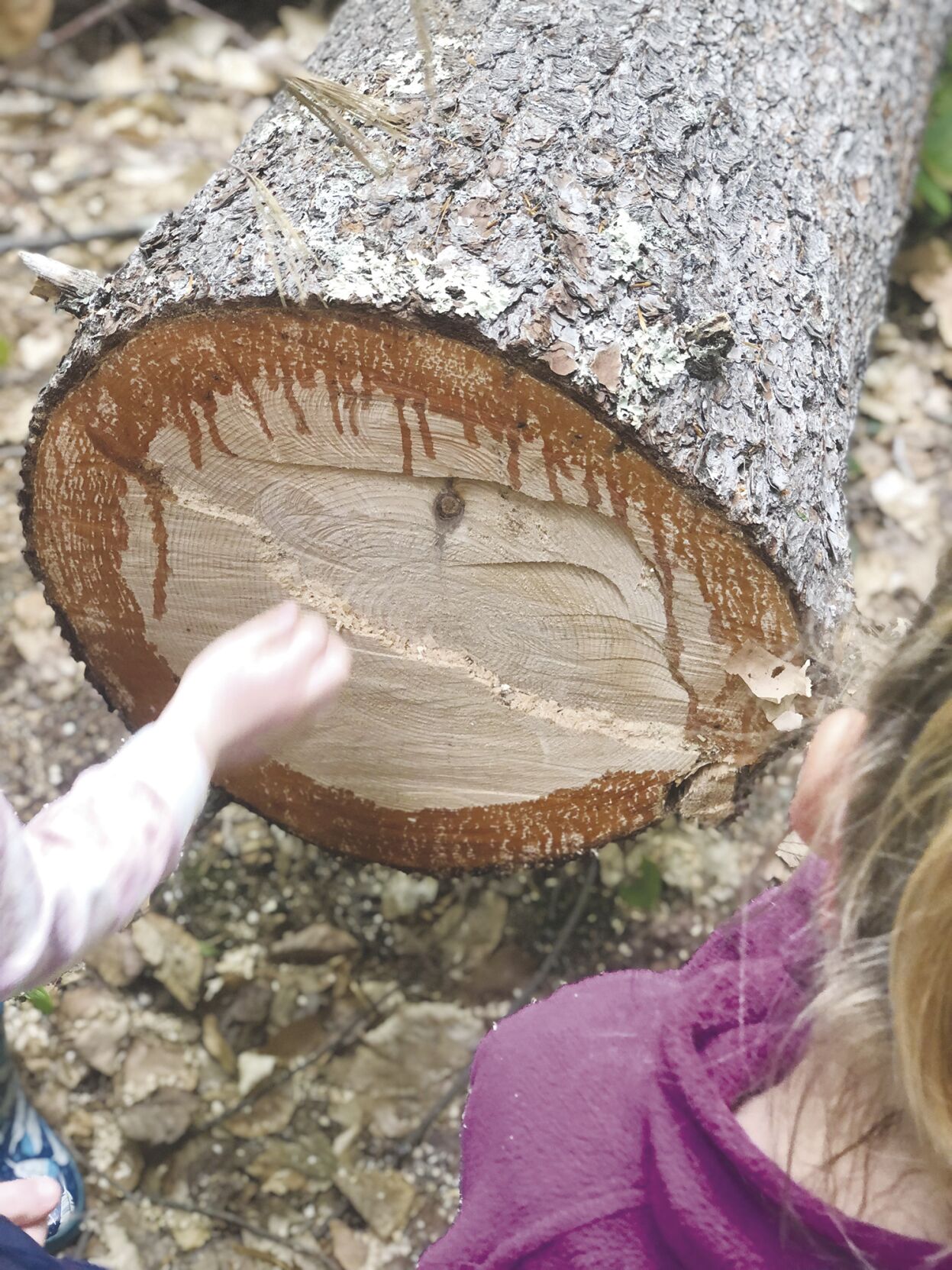
LACONIA — The universe of fields, forest and marsh at Prescott Farm Environmental Education Center on White Oaks Road furnishes more than a break from screen time for children ages 4 through 14. It’s an eye- and mind-opening place for kids to connect with nature and each other, in ways that nurture love and respect for the outdoors — and the creatures and peace within it.
“It teaches them so many different skills,” said Chris Wellens, the center’s camp and school-age program director. “The focus sometimes feels like they’re learning to identify things. It actually teaches them a lot of interpersonal skills and how to make choices. They’re working together, learning together and learning from each other.”
Kids savor weeklong Wild Quest summer camps with themes such as Eco-Artist, Creature Features and Nature Narratives. During the year, roughly 18 3- to 5-year-olds attend Fledglings Preschool here — a program with a long waiting list.
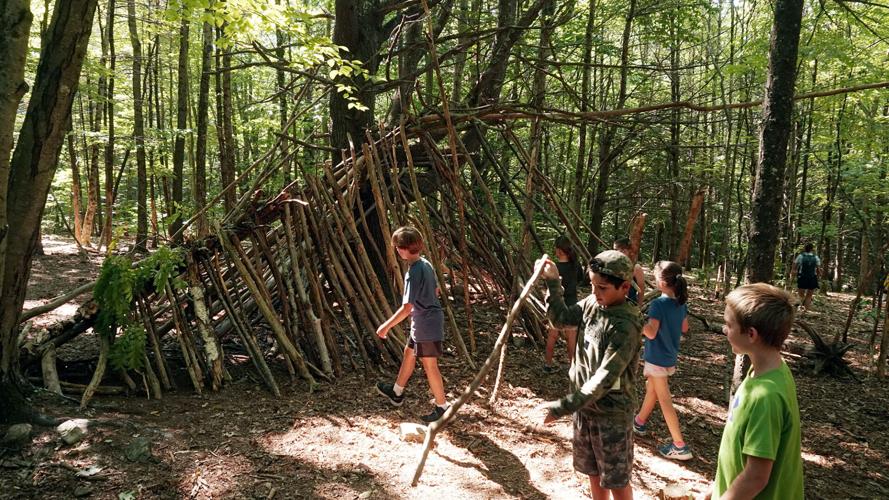
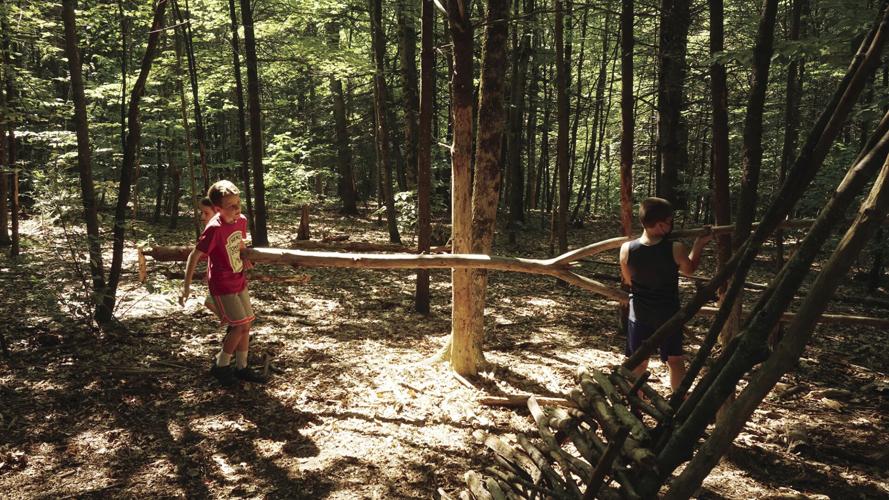
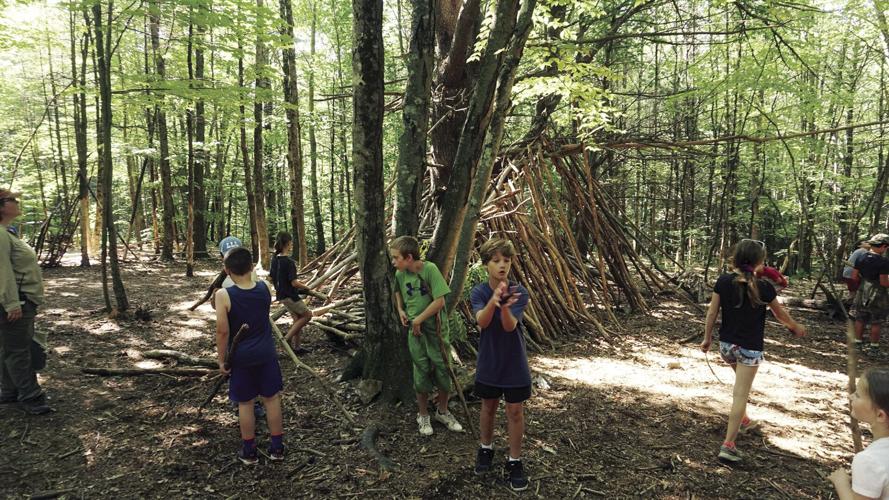
During the camp day, their favorite activity is free time in the woods, without gadgets, toys or sports equipment — just what they find in nature, Wellens said. It’s a time for collaboration, discovery, unwinding and playing without directions; a time to create their own mini-civilizations from what the forest offers. The children scour for sticks, rocks and branches to construct shelters that resemble teepees, stockades, lean-tos and forts that might be found on a fantasy island.
James Coyne, age 7, pressed a long sick against a sturdy tree to snap it in half. Inside a fort in progress, Ryland West, 9, said, “It’s kind of cool and not that hot” when asked what he likes about doing this.
“Risky play, independent play and collaborative play are so important to allow kids to develop,” said counselor Millie Hillman, surveying youngsters ferrying branches and sticks, and older children helping younger ones forge motley free-form structures.
“Sometimes we get so focused on getting the right games set up with the right supplies. At the end of the day, just being able to play freely in the woods is what they enjoy most,” Wellens said. “When kids are not surrounded by walls and don’t have those physical constraints, there’s a calmness. They enjoy that they’re given that freedom and flexibility. It’s almost like a reset for their year.”
In groups or by themselves, they revel in finding orange-red efts, the juvenile phase of the spotted salamander. Butterflies landing and crawling on fingertips are cause for rapture. A toad is a reason to invite other kids to see it. Turning over rocks and exposing bugs elicits squeals and many questions.
“Just the moments of curiosity and being able to share those with others. To see the joy and the community and the curiosity. They’re wonderful,” said Ashley Roberts, an environmental educator who works with children at Prescott Farm’s Wild Quest camps, then visits schools during the year as a classroom naturalist.
“For me, the things I find most helpful for lifelong learning are things that help me understand the world,” Roberts said. “Nature is part of that. We’re part of that. It makes it important to get to know.”
Especially in angst-filled, post-COVID times, the natural world becomes a place to embrace.
Many kids don’t get to do a lot of exploring on their own, Wellens said, and outdoor camp and school are filled with surprises and opportunities to take "safe" chances and practice getting along.
“It’s a difficult time, especially for youth,” he said. “Just being in an open space together” can be therapeutic.
“Being respectful and aware of the environment — it’s really about looking out for each other and helping each other,” he said.
Research from Great Britain’s Mental Health Foundation supports what experts who work with children have long suspected: exposure to nature can foster calmness, joy, creativity and improved concentration. Exposure to nature is associated with lower levels of anxiety and depression, according to studies worldwide. Access to nature has been found to lower stress and improve sleep, decrease negative emotions and encourage positive interactions as well as a sense of meaning to life, according to reports cited by the National Alliance on Mental Illness – California. Research shows that exposure to nature and green environments can boost self-esteem, cooperation, memory and thinking in people with and without depression.
In 2019, University of Chicago psychologist Marc Berman found that green spaces near schools promoted cognitive development in children and green views near their homes bolstered self-control behavior.
Australian researchers found in 2015 that students who looked out at a flowering green roof for 40 seconds halfway through a computer task made significantly fewer mistakes than those who gazed at a concrete rooftop for the same amount of time.
Berman and colleagues at the University of Chicago discovered that study participants performed better on challenging cognitive tasks when they listened to nature sounds like chirping crickets and crashing waves versus urban sounds like traffic and clattering noises from busy cafes.
A Danish study of residents born between 1985 and 2003 found that children who lived in neighborhoods with more green space had a lower risk of developing psychiatric disorders later in life, including mood disorders, eating disorders, substance-use disorders and schizophrenia.
Some theories related to the benefits of nature argue that the need for this connection rests solidly in our genes, since early humans relied on nature and the environment in order to survive.
Alexis Matthews-Cheney, director of the Dewey School, a nature-based preschool program for children ages 3 to 6 on the grounds of Shaker Village in Canterbury, said immersion in nature fosters healthy development by igniting seven human senses, including sight, hearing, taste, touch, smell, balance and movement, and body awareness.
A young child needs body awareness, she said, to pick up a worm or caterpillar without squishing it. At the Dewey School, started four years ago, youngsters spend most of the day outdoors regardless of the season or the weather. Through interacting in self-directed, curiosity-building ways with nature they learn kindness, empathy and “how to respect the things around us,” Matthews-Cheney said. Activities like fording streams or walking on wet logs builds balance skills and a sense of mastery. Through exploration and trial and error, she said the children discover things that “make them feel happy and what makes them feel good.”
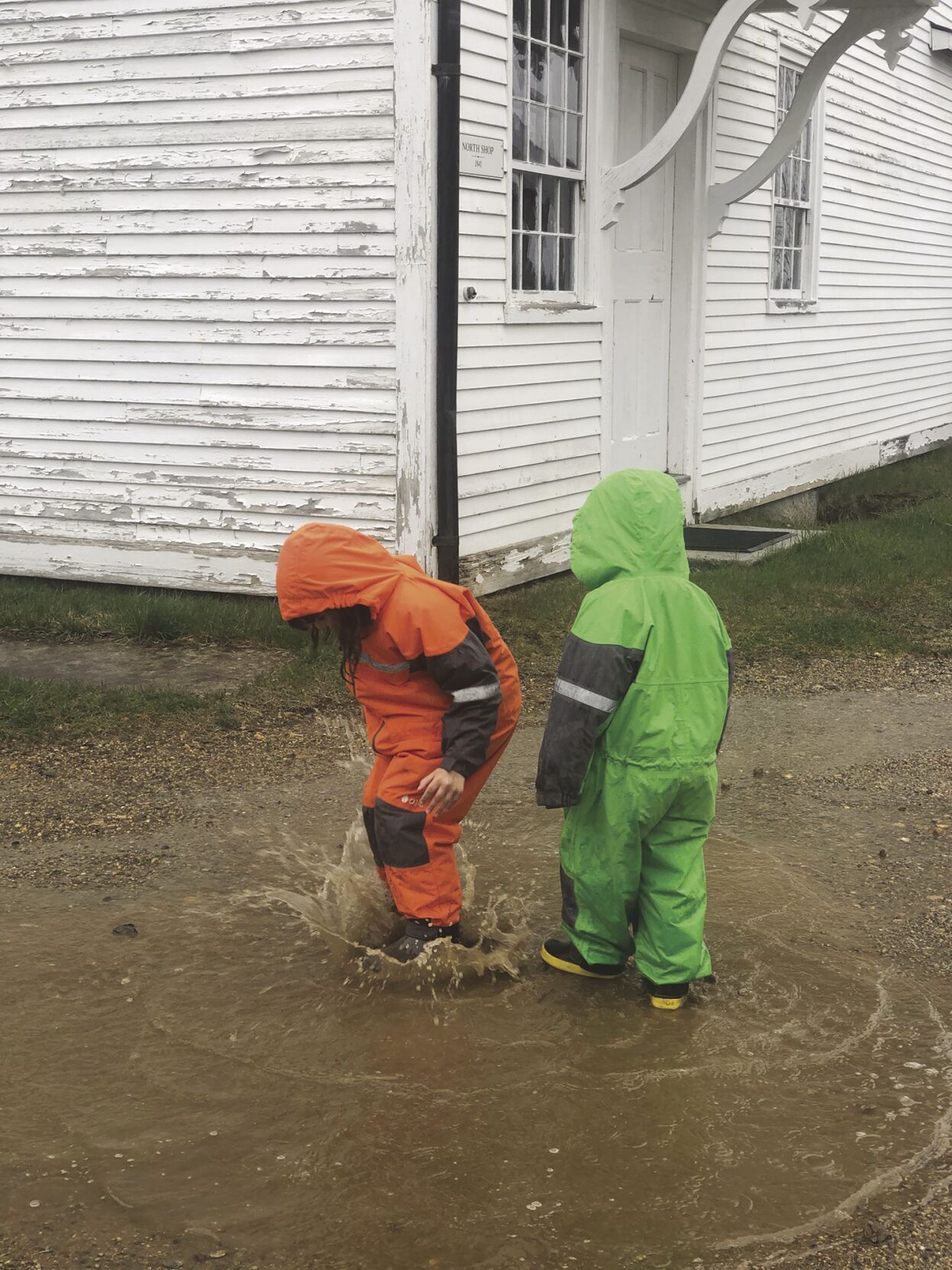
“Jumping in a puddle, you can see the excitement in their eyes,” she said. Some rejoice in it while others recoil because they don’t like getting wet. “They’re trying to find their balance and place in the world.”
At the Dewey School, one of the children’s favorite activities is to find a “sit spot” outdoors — a quiet place to sit alone with a “toolbox” containing a notebook, colored pencils, markers and crayons, and draw what they see.
“It brings a sense of calmness,” Matthews-Cheney said. “They learn how to be still and take in the things around them. A big piece of this learning is that they do it on their own.”
Through exploration and experiencing things as simple as climbing a big rock or hanging upside down from a tree, they acquire a sense of physical ability and accomplishment that builds a sense “that we can do anything as long as we try,” Matthews-Cheney said.
It’s also a chance for them to understand their feelings.
“When children are indoors, things are explained to them. When we head outdoors, they’re able to do their own exploration and they learn their emotions, whether they’re climbing or tripping and falling or walking across wet logs for the first time. A lot of peace of mind comes from acknowledging our feelings,” Matthews-Cheney said. “We want them to understand that they’re capable humans in the world, just like the rest of us. It’s putting the world back in their hands.”
The Dewey School was founded on the Reggio Amelia approach to learning and development (named for its birthplace in Italy), which through outdoor activity fosters respect, responsibility, exploration, discovery and play. At the Dewey School, parents are co-educators who help plan and lead activities such as beekeeping, tapping maple trees for sap and foraging for mushrooms. Academics are absent. Social and emotional development is the goal.
“We help them find their competence and self-help and communication skills. We’re here to build a foundation so wherever they go they have that foundation with them,” Matthews-Cheney said.
“That’s an awareness they’ll take with them,” said James Marino, board chair of the Dewey School, whose son attended at age 4. “It gives children a stress-free, anxiety-free environment to play with others or focus on themselves.”
Being in nature “provides a level of comfort. You can find people 3 years old to 100 years old who can tell you how therapeutic nature can be," Marino said. "We’re opening that door early and planting the seed to appreciate it and be stewards of it their whole lives.”


(0) comments
Welcome to the discussion.
Log In
Keep it Clean. Please avoid obscene, vulgar, lewd, racist or sexually-oriented language.
PLEASE TURN OFF YOUR CAPS LOCK.
Don't Threaten. Threats of harming another person will not be tolerated.
Be Truthful. Don't knowingly lie about anyone or anything.
Be Nice. No racism, sexism or any sort of -ism that is degrading to another person.
Be Proactive. Use the 'Report' link on each comment to let us know of abusive posts.
Share with Us. We'd love to hear eyewitness accounts, the history behind an article.