


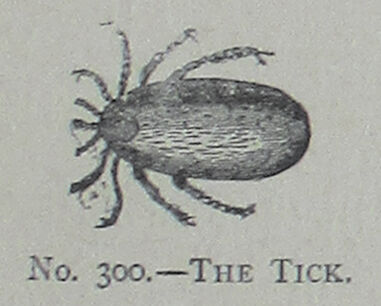
As I write these words, a tick is crawling up my leg. I will kill it, but first I just want to finish this paragraph. And I want, as well, to wait and see what becomes of the tick’s brethren. Three or four minutes ago, settling down to my desk, I crushed two other ticks with the heel of my hand. Lying belly up by my keyboard now, they look dead, but ticks have this annoying habit of playing dead. After an insult to their corpus, they’ll sit motionless for a few seconds. But then their legs start wriggling. They flip over, and then the little bastards are good to go. They’re crawling your skin all over again.
Ticks are, of course, a reminder of how we’ve screwed up our planet — they’re more abundant each spring because humans decided, a little over a century ago, to step up their dominion over the earth and start driving cars all over it. Ticks abound today thanks to climate change. And to rub out a tick for all time involves a new act of dominion, an aggressive one: You need to burn the thing. You need to flush it down the toilet or stamp it repeatedly under your boot. You need to be intentionally, pointedly cruel.
When I’m not distracted — when I’m not trying to write — I’m fully capable of the brutality tick killing takes. In the decade since I moved to Gilmanton, after having grown up in the suburbs of Hartford, Connecticut, I’ve killed probably 500 ticks. But, with each killing, I feel that I’m also killing off a small part of myself. The sensitive suburbanite within me is fading. My inner flatlander is receding and a harder, more stoical Backwoods Bill is coming to the fore.
Killing is a country thing. The residents of cities live, generally speaking, on lands where the animals have been cleared away. Sidewalks have replaced habitat, and a citizen can live a full life — and go to Starbucks, then to work, then to the gym and out to the symphony — without ever encountering a single tick. If they enjoy eating veal parmesan at their favorite restaurant, they’re likely to do so without contemplating the slaughter of the baby cow on their plate. If he sees a rat, they call somebody.
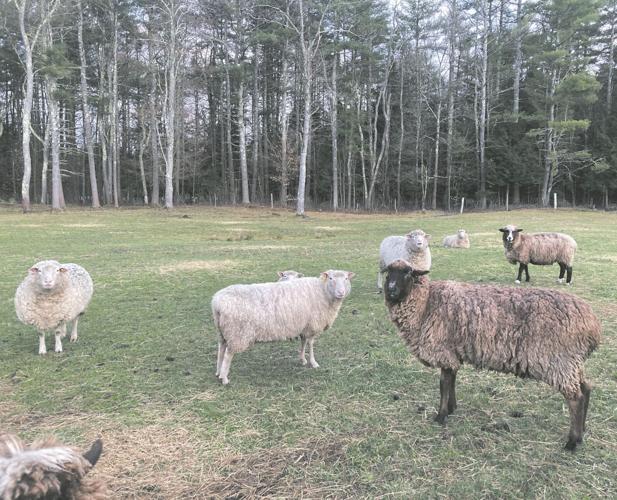
Here in the countryside, though, we live among animals. Muskrats burrow their way into our barns. Beavers dam up streams in our backyards. Squirrels scratch away inside our walls, and when we behold, on casual strolls, sheep grazing in a pasture, we know that the bucolic loveliness before us is temporary. In a few weeks, those sheep will be on the way to the abattoir. We live with our eyes open to killing and we’re okay with it.
But I’m aware, with every tick that I kill, that our regard for death could be different — that we think as we do because we’ve made a million tiny choices to harden ourselves. I think back now to a grisly day in 1976 when, on a back road in Gilmanton, I witnessed a murder. Or, rather, something worse: A friend of mine, an 11-year-old boy, had a chicken strung up on a rope.
Tommy paused between each swing and exuded the sort of swagger that tends to spring from a boy whose dignity is compromised. “Usually, I can kill a chicken with one swing," he said. “Something’s wrong with this chicken.” Et cetera.
I was 12 at the time, and visiting Gilmanton for the summer. I lived in a place where there were more paddle tennis courts than chicken farms, and I still harbored within me an impulse that was at once naive and innate: I had sympathy for the chicken. It had eyes. It gave voice to its pain. I did not want to see it suffer. I was on the verge of nausea, witnessing its slaughter, and yet I knew that if I was going to retain any cred with Tommy and the other boys with us that day, I needed to be stoical — unflinching — in the face of this killing. I was just a flatlander, yes, but I knew the code of the countryside.
So I watched: Ten hacks with the knife, 11, then 12 and then, finally, the chicken was dead and we all moved on with our day acting cool as cats, as if what we’d witnessed was nothing. We became a notch colder, and I carried this coldness with me when I moved up here to Gilmanton, becoming a full-time resident, a decade ago. My first autumn here, I set mouse traps all over the house and felt visceral delight each time I heard, lying in bed, the snap of a trap coming down on a mousy spine.
I caught 60 mice that fall (I counted) and it felt good. But there were a few times when, horribly, hauntingly, a given mouse would be trapped by the leg, so that it remained alive, squirming, pinned and emitting a high-pitched squeal that I could only interpret as a cry for mercy. What options did I have when faced with such suffering, along with the undeniable reality that it was me who had caused the suffering? Each time when confronted with a semi-trapped mouse, I grabbed a hammer and finished the job. I felt guilty doing this, but a little less so each time.
And now, as I stare down that tick that I thought I killed, the one that is presently crawling across my desk with his friends, forming a tight little squadron? It is gratifying to know that in a few seconds they will all be dead. It’s empowering to know that I possess the composure and power to end another creature’s existence. It’s also a little bit terrifying.
•••
Bill Donahue has written for Outside, Harper's, The Atlantic and The Washington Post Magazine. He lives in Gilmanton, and his book, "Unbound: Unforgettable True Stories From The World of Endurance Sports," will be published by Rowman & Littlefield in June. This column is adapted from his online newsletter Up The Creek.


(0) comments
Welcome to the discussion.
Log In
Keep it Clean. Please avoid obscene, vulgar, lewd, racist or sexually-oriented language.
PLEASE TURN OFF YOUR CAPS LOCK.
Don't Threaten. Threats of harming another person will not be tolerated.
Be Truthful. Don't knowingly lie about anyone or anything.
Be Nice. No racism, sexism or any sort of -ism that is degrading to another person.
Be Proactive. Use the 'Report' link on each comment to let us know of abusive posts.
Share with Us. We'd love to hear eyewitness accounts, the history behind an article.