


If you live in New Hampshire’s Lakes Region, you know. You know the exquisite joys of lingering by the water on hot afternoons and the idle pleasures of long summer evenings — miniature golf, ice cream cones, winning kewpie dolls in the arcades in The Weirs.
When the season is at its peak here — when you’re a couple beers into the barbecue and Tom Petty is wailing away on the stereo — you’re likely to ask yourself, “Can summer get any more magical than this?”
Yes, actually, it can.
Allow me to transport you to southern Sweden — and to foray into a little known chapter in American history. It’s the early 1940s and World War II is ravaging Europe. A stone’s throw from Sweden, in rocky, mountainous Norway, Adolf Hitler has garrisoned about 300,000 troops. When American bomber pilots venture there, they’re frequently shot down, then taken prisoner. But on July 24, 1943, one U.S. fighter plane, shot at and sputtering in the sky after an Allied attack on Norway, manages to belly land in a long, open field in Sweden, a neutral country not occupied by the Nazis.
By the summer of 1944, Sweden is so attractive to U.S. bomber pilots that scores of failing American planes have fled Axis fire to land in Sweden, and Sweden has honed an intricate system for “interning” American soldiers. In resort hotels. In idyllic country berghs where the sun shines bright until 11 p.m. and the winding country roads, passing farm fields and forests, are perfect for cycling.
When Army Air Force 2nd Lt. Lester Mickelson arrived in a lakeside village called Gränna exactly 80 years ago, in July 1944, he was officially a pawn in the war — the neutral Swedes were supposed to detain him until the end of the conflict. But in a written account of his Swedish sojourn, Mickelson comes off as a wonderstruck tourist. “Gränna,” he writes, “is a quaint little town as one could ever hope to see. It has a population of about 1,000 and is situated on the east shore of lengthy Lake Vättern which is 125 km long.” Near Mickelson’s room on the second floor of the Ribbagården Hotel, there was a porch that was “a marvelous place to observe the sunsets that I have yet to see be equaled. Standing on this little porch one couldn’t help but take a deep breath and then gasp for another because the air was so fresh and stimulating.”
Mickelson and his fellow soldiers were obliged to file out of the hotel each morning at 8 for a roll call. An hour of compulsory exercise ensued and “from then on,” Mickelson writes, “the day was ours.”
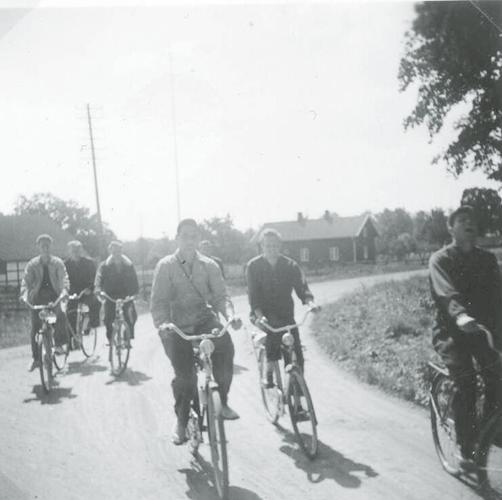
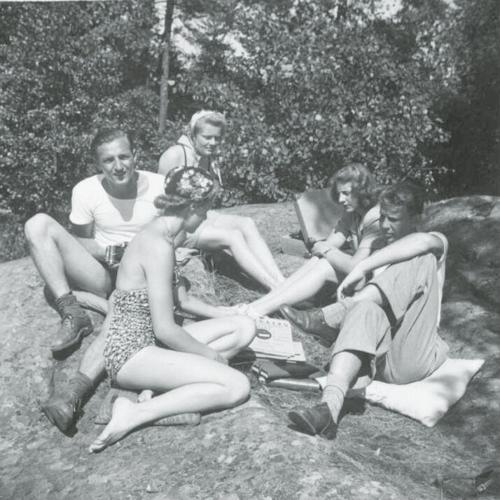
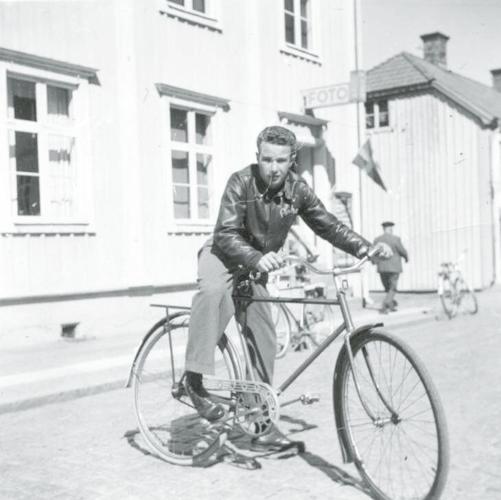
Most of the soldiers had bicycles — their handsome salaries, averaging around $150 a month, made such purchases easy — and so they spent their days riding out into the countryside. They were forbidden to venture more than 12 miles from Gränna, but they were free to date Swedish women, and numerous photographs capture the soldiers communing with local females. When one Sweden internee was interviewed years later, he confessed one of the few Swedish phrases he learned was, “Jag älskar dig.” I love you.
“Every Saturday night,” Mickelson writes, “there were dances at Ribbagården Hotel.
"The people for miles around would come to the dance because they knew they would see several Americans and whenever there were American fliers there was a good time in store.”
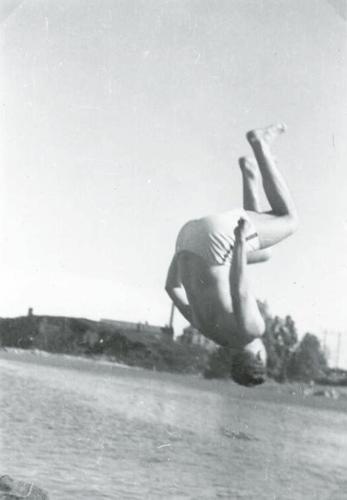
I learned of the American internees when I visited Gränna in June, and I was struck by the darkness lacing their summer fun. As they cavorted in Gränna, mixing with Stockholm summer tourists who swam and played mini golf, thousands of other American fliers were getting killed.
To Gen. Henry H. Arnold, commander of the U.S. Army Air Forces, it seemed suspicious that so many American soldiers were washing up in lovely Sweden, and in 1944 he wrote a military colleague to demand an investigation. The bomber planes, he seethed, were landing “without indication of serious battle damage or mechanical failure, or shortage of fuel.” Arnold wondered whether the landings were “intentional evasions of further combat service.”
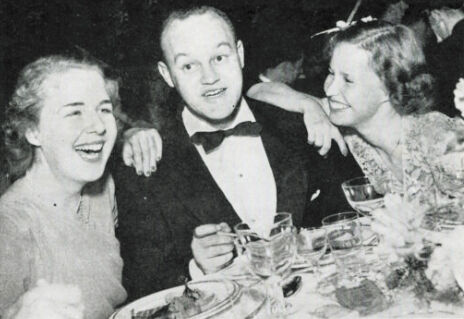
An Aug. 26, 1944, article in Collier’s magazine, entitled “Swedish Stopover,” fanned the flames of controversy by delivering photos of U.S. airman cycling, skiing and — most damning — a picture of one happy soldier with not one, but two, laughing Swedish women draped on his shoulders.
Meanwhile, the Americans in Gränna tried Arnold’s patience by occasionally acting like jerks. They bought horns for their bicycles and honked them so frequently that the police intervened. Sometimes they terrified locals by shooting pigeons from the windows of their hotel rooms.
Still, Arnold’s investigation found no evidence of a morale crisis, and when I met with Håkan Jorikson, the director of the Gränna Museum-Andréexpeditionen Polarcenter, he stressed that his town loved the American visitors. “It was a fantastic moment in Gränna,” he said. “The people here read about the war in the newspaper, but they never saw anything. There was no television and now, suddenly, here were all these young, good-looking men in uniforms.” The soldiers embodied the romance that crackled from the screen at the Gränna Cinema when it played films starring Clark Gable and John Wayne. And while the Swedes were officially neutral, Jorikson said, “I’m sure that the majority of the people in Gränna wanted the Allies to win the war. By 1944, they were quite aware of what was happening in the German concentration camps.”
Interviewed years later, one barber thrilled over how the Americans spent prodigiously at his shop, and the soldiers were particularly adored by Gränna’s older residents. “Simi’s landlady,” Mickelson wrote, referencing another American internee, “insisted on doing his laundry for him as well as making him dozens of cookies.”
But summer only lasts so long. “In the fall,” Mickelson wrote, “the sun made itself somewhat scarce.” The Axis powers (Germany, Italy and Japan) were by now losing the war — and also their leverage to keep the Americans pinioned in Sweden. So starting in early October 1944, one by one, the soldiers got shipped out of Gränna. Most went to England. Some later flew missions in the war’s closing chapter in the Pacific.
Mickelson was among the last to leave, and on Nov. 15, 1944, he and a few other American soldiers met their Gränna friends for a farewell dinner at the Ribbagården. They gave away their clothes and their bicycles. The locals were, according to one Swedish writer, “moved to tears.”
In the weeks that followed, snow began falling on the shores of Lake Vättern. The days grew very short and winter set in.
•••
Bill Donahue lives in Gilmanton and is the author of "Unbound: Unforgettable True Stories From The World of Endurance Sports.” This column is adapted from his online newsletter Up The Creek.


(0) comments
Welcome to the discussion.
Log In
Keep it Clean. Please avoid obscene, vulgar, lewd, racist or sexually-oriented language.
PLEASE TURN OFF YOUR CAPS LOCK.
Don't Threaten. Threats of harming another person will not be tolerated.
Be Truthful. Don't knowingly lie about anyone or anything.
Be Nice. No racism, sexism or any sort of -ism that is degrading to another person.
Be Proactive. Use the 'Report' link on each comment to let us know of abusive posts.
Share with Us. We'd love to hear eyewitness accounts, the history behind an article.