


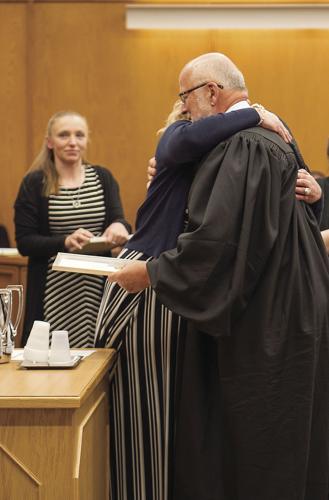
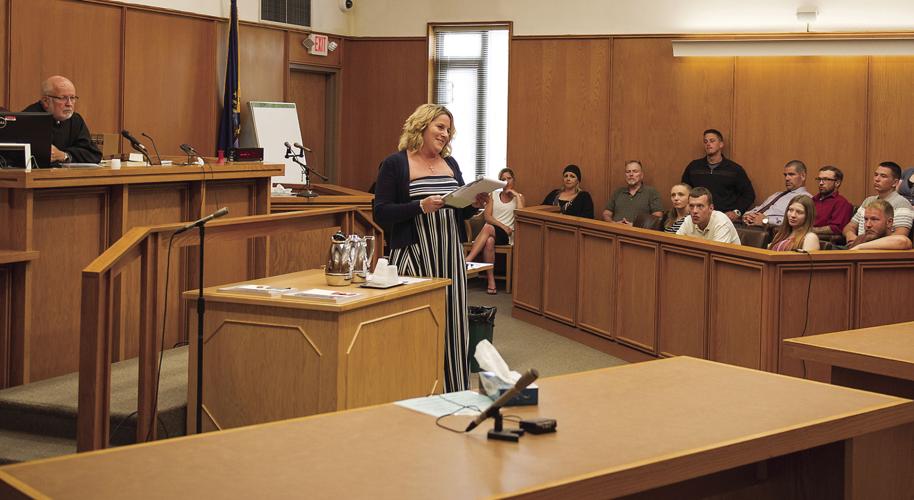
LACONIA — Lofty dreams can be more powerful than stark reality. That was the repeated message as two women who spent years in the throes of addiction formally completed the Laconia Recovery Court program on Tuesday.
In a courtroom where punishment is often meted out to criminal defendants, a cast of fellow recovering addicts, family members, counselors, attorneys and representatives of law enforcement gathered to celebrate a new chapter in the lives of Julie Moulton and Angela Linteau.
The Recovery Court — often referred to as drug court — provides court-supervised probation and mandated treatment focused on treating the substance abuse issues underlying a defendant’s criminal behavior.
Addressing the two graduates and the other 26 people currently in the program, Judge James Carroll recalled the motto of Robert Kennedy’s presidential campaign, “Some men see things as they are and say, why; I dream things that never were and say, why not.”
“Have confidence to see things differently,” the judge said, noting that the aim of the specialty court is to provide a pathway out of the vicious cycle of substance abuse and criminal activity.
As in traditional academic graduations, this one too marked not only a completion, but also a beginning.
“Now the hard part begins. Show them what you can do,” said Lama Noamh Tomas, a Buddhist monk and spiritual adviser at Riverbank House, a residential recovery center in Laconia. “This is just Day One. Be a beacon. Help to lift somebody up.”
Then turning to the audience, he motioned toward those currently in the program, and said, “There’s your definition of hope.”
Jaqui Abikoff, executive director of Horizons Counseling Center, reinforced that message.
“Show the community and your families there is hope,” she said.
While Linteau and Moulton entered the program with hope, they did not always embrace a core tenet of the recovery court experience: That the addict must stop resorting to manipulation and accept the idea that recovery is about surrender — making choices that someone else recommends.
Today, Moulton, who is 47 and has been sober for 14 months, is excited not only that she has satisfactorily completed recovery court, but that she has just started a full-time job at Navigating Recovery as a recovery coach, helping people who are trying to come to grips with their own addiction.
For Moulton the sign that she had turned her life around came last March when her father died suddenly and she did not return to using drugs.
Linteau, 33, is also hopeful about her future. She works as a shift supervisor at Dunkin Donuts and, with the help of her mother, cares for her three children, ages 4 to 11.
In addition she is a powerful support to those attending NA and AA meetings, said her sponsor, who asked to remain anonymous.
“She was in a terrible addiction,” the sponsor said, “and this program saved her life.”


(0) comments
Welcome to the discussion.
Log In
Keep it Clean. Please avoid obscene, vulgar, lewd, racist or sexually-oriented language.
PLEASE TURN OFF YOUR CAPS LOCK.
Don't Threaten. Threats of harming another person will not be tolerated.
Be Truthful. Don't knowingly lie about anyone or anything.
Be Nice. No racism, sexism or any sort of -ism that is degrading to another person.
Be Proactive. Use the 'Report' link on each comment to let us know of abusive posts.
Share with Us. We'd love to hear eyewitness accounts, the history behind an article.