


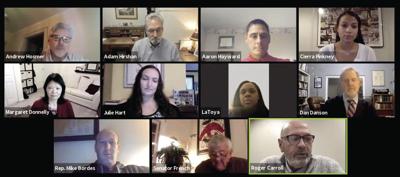
LACONIA — An online forum on tolerance drew nearly 80 viewers on Wednesday, including community members and local school, city, religious and political leaders, setting the stage for future discussions to foster understanding, acceptance and connections between people of different races and religions, and those with diverse backgrounds and beliefs.
“It made for a good discussion” that included “truths that make us a little uncomfortable,” around issues that are sensitive, including to religious minorities, Laconia Mayor Andrew Hosmer said. “I’m pleased we took this small step forward to create a community discussion that was civil.”
A critical next step will be enlisting support from educators, the school board and school superintendent to bring the interactive discussions to schools, where students, teachers and parents can participate.
The goal will be to create more understanding, inclusion and sensitivity to others, and dispel divisions, false stereotypes and as well as any lingering hurt and discontent. “If the environment is significantly different at home, it’s a tough educational battle,” said Hosmer, who believes it’s important to include families.
Sen. Harold French of Franklin, whose district also includes Laconia, Gilford, Belmont and Northfield, was one of the sponsors. He said he is optimistic about future dialogues, and the forum’s impact on the ground.
“So many people joined us and the time flew by," French said. "I’m hoping it helped people understand we’re all different and have to coexist nicely. We’ve got to look at each other as neighbors and friends, not as opponents. Most people I know look at people that way – not as political foes or enemies, whether in politics or the street doing business,” French said.
It’s important to recognize “our differences make us unique and human. Wave to your neighbor. Talk to your neighbor,” French said. “People tend to like you when they get to know you and realize you’re a neighbor and a friend. Stay away from politics. There’s a lot more in this world.”
The forum was convened, with extensive technical support from the city, to promote tolerance in greater Laconia, including in the aftermath of school board member and state Rep. Dawn Johnson’s link to anti-Semitic material on social media. Johnson was invited but did not attend the forum.
The event was intended to help establish cooperation across political divides. “At a time when many are frustrated and have given up trying to reach across the partisan divide, we all showed we can still meet in the middle,” said Adam Hirshan, publisher of the Daily Sun, who hopes to extend the forums to schools.
“One reason we find ourselves so divided is because politicians are finding that driving the base is a way to win elections. In the past the strength of American democracy has been going to the center. We need to restore the value of collaboration and compromise” and a respectful middle ground.
Comments from the panelists shed light on misperceptions that persist and how intolerance feels to those who experience it.
Cierra Pinkney, a 2015 graduate of Laconia High School who now works for Lakes Region Community Services in the Family Resource Center, said, “At face value people seem to be friendly and tolerant,” but there is ongoing ignorance because of a lack of exposure, “not ill-intent or negativity. People just don’t know what they don’t know.”
“Just because (racism) is not in your face doesn’t mean it doesn’t exist,” Pinkney said. “I hear people say things that are downright racist” and then backpedal and say, ‘Well, not you. You’re not like that.’ They think one person they know is an epitome of that group.”
Latoya Beck, an 8-year resident of the city with sons in Laconia schools, said the forum is a starting point for healthy, productive discussions on diversity. “Hopefully we can get into a good space that’s right for everybody,”said Beck, who is Black.
“I like to do the same things everyone else does.” It’s crucial to “break the stereoptype,” Beck told the forum. “Not all African-American like to riot or protest. Breaking into businesses, that’s not what the (Black Lives Matter) movement was about. There are positive things out there that you can do. You have to start breaking the barriers to get everyone involved in everything.”
Margaret Donnelly, a technology marketer and naturalized citizen who is both Japanese and Chinese, grew up in San Francisco after emigrating at age six. Donnelly, a Laconia resident, is a member of the city’s Human Relations Committee. “I think the vocal minority is very much on opposite sites of the spectrum,” she said. “But the silent majority, who don’t get angry enough to send letters to the editor (of the Sun) are toward the middle and more tolerant of others.”
Donnelly worries that “hate speech and vitriol” in letters to the newspaper might be infectious. “In the last few years, people have become more emboldened to let true racism out,” mimicking speech of political leaders, and contributing to the polarized climate.
Rabbi Dan Danson of Temple B’nai Israel, who led a congregation in Wisconsin for 29 years before coming to the Laconia synagogue last year, said, “Small towns are great places to be Jewish, but there are challenges. It’s important to talk about anti-Semitism and what’s behind it, and recognize it’s not where towns like Laconia want to be.”
“Civil discourse is important in our community, how we influence and role model, how we care for each other is important to our staff and students,” said Aaron Hayward, a Laconia school board member and a science teacher for 20 years, who now works as a school administrator in Belmont. The Johnson incident showed “a capacity of people to hurt people without knowing,” he said. Disappointment, hurt and outrage simmer.
“There’s a difference” between taking action and responsibility “and learning and growing” versus “being defensive and taking it as a personal attack,” said Hayward. “No one wants to be labeled as a racist or bigot. Swallowing pride and having to humbly listen and not take offense right away is a difficult thing,” but it’s essential to mending fences and curing the pain and anguish someone else might feel.
“If you can’t listen to that person’s story, you’re not (going to be) open to changing your behavior,” said Hayward. “We have kids who are empathetic and then go home and their parents are not so inclined. Many biases are passed down.”
The forum discussion included the inflammatory nature of social media and political rhetoric.
In the wake of Johnson’s link, and the anti-Semitism and racism it conveyed, “We’re on edge as a community,” said Danson. “Social media doesn’t calm things down, it ramps things up. Social media has displaced us from picking up the phone and calling each other.” He said a lingering wound is that Johnson hasn’t called the Jewish community to apologize for the link’s offensive content. “It’s really important to pick up the phone and meet in person. We used to be better at bridging things,” Danson said.
“There are moments when something said is offensive and comes out of a place of not knowing what Judaism is about,” he said. “Stereotypes are an ongoing problem when you’re a minority community. Tolerance has a sense of forbearance and putting up with. The goal is to live in a shared community in friendship,” Danson said.
“Tolerance would be accepting people who are different, because we’re all different, and accepting that we don’t always agree,” French said.
Part of the problem is political name-calling, which has become a loaded insult – words people sometimes “spit out like poison,” said Daily Sun managing editor Roger Carroll, who moderated the event. Being “liberal used to mean being open to new ideas.” Being conservative “meant they were careful when making changes, and taking care with taxpayer money,” he said.
The media has played an important part in redefining “those words as slurs,” said Hosmer, a Democrat who originally ran against French for state senate. “Democrat” and “Republican” now seem separated by “a bigger divide, and there are nasty distinctions between conservative and liberal,” which can undermine civil discourse and split communities into acrimonious factions.
In the past, “liberal and conservative was not a tribal label that made you an enemy of the other tribe. It was just a point of view. Compromise was always possible,” said Hirshan at the Sun. The situation has been made worse by social media replacing news, and rival networks “catering to their own tribes. We’re being fed an unhealthy diet of misinformation.”
Hirshan said Thursday that restoring healthy, civil discourse depends on “respecting the human dignity of the woman or man you disagree with. Listening, really listening to understand the other’s point of view, and seeking the truth from reliable sources on both sides of an issues, not accepting as fact information from unknown sources shared with you by someone, just because you agree with them.”
Rep. Mike Bordes of Laconia said misinformation and conspiracies have been spread “like wildfire” on social media. “We have to be more careful and review what we look at and what we share.” Bordes said he favors more community-wide events that bring people together, including from different cultures, “so they can experience everyone around them, regardless of race and religion” beyond the city’s yearly multi-cultural celebration. “One event is not enough.”
Danson said events designed to promote tolerance and understanding have often made him “feel like I was in a bubble with all my friends. It didn’t grow outside that circle. It’s important to work together, roll your sleeves up together” in shared tasks, such as community suppers to feed the hungry. “It’s tough sledding to find things that pull us in from our range of experiences and backgrounds. It’s at the local level that we can come together for some goal,” Danson said.
To connect with others it’s important to become educated, to see their struggles and “immerse in the issues they face,” said Pinkney. “We need to make it a norm to have conversations like this, and incorporate diverse people – not just different races but political views.” She said the Black Lives matter rally downtown this summer brought disparate individuals together, with a genuine concern and a desire for change. “It was real, authentic and raw.” Group momentum around shared causes is important to maintain, Pinkney said.
In order for Laconia to function united, it’s important for all of us to “Do something. Get involved. Start talking,” Donnelly said.
Requiring Holocaust education in schools has been an important step for the state, with relevance beyond the experience of Jews because genocide and ethnic cleansing are ongoing worldwide evils, Danson said.
The social justice class at Laconia High School has boosted student understanding and conversation on controversial and uncomfortable topics, Donnelly said.
The Human Relations Committee is hoping to get more residents involved. “We need to support measures to continue these types of forums,” said Donnelly. “I’d like to see more people” from diverse backgrounds, races and ethnicities “coming to this area, and live in the heart of this area. It’s a wonderful place.”
•••
The Sunshine Project is underwritten by grants from the Endowment for Health, New Hampshire’s largest health foundation, and the New Hampshire Charitable Foundation.
Roberta Baker can be reached by email at Roberta@laconiadailysun.com


(1) comment
what a complete waste of time. Shame on everyone for this continued race baiting.
Welcome to the discussion.
Log In
Keep it Clean. Please avoid obscene, vulgar, lewd, racist or sexually-oriented language.
PLEASE TURN OFF YOUR CAPS LOCK.
Don't Threaten. Threats of harming another person will not be tolerated.
Be Truthful. Don't knowingly lie about anyone or anything.
Be Nice. No racism, sexism or any sort of -ism that is degrading to another person.
Be Proactive. Use the 'Report' link on each comment to let us know of abusive posts.
Share with Us. We'd love to hear eyewitness accounts, the history behind an article.