


GILFORD — Leaman Antone’s sculpture and pottery classes at Gilford High School are more than just breaks in which to mold a mask, an animal figurine or a marionette, or a bowl or plate.
They’re a chance to decompress, laugh and fabricate something together — an antidote to the isolation that defined students’ lives during COVID, when remote learning created a sensation of being marooned.
“I have a couple of kids in (another) class who don’t like making anything. They just like being in here. I try to provide a room where people like being with each other,” Antone said. “Art plays different roles for different people. You get out of it what you want, and what you need.”
It’s relevant observation — and a timely mission.
Across the state, teachers and students are breathing sighs of relief now that school is back in person full-time, with masking optional. Uncertainties about variants and immunity linger, but the new normal is much closer to what school used to be.
Across the country, educators are using all-hands-on-deck approaches to restore social and emotional wellbeing, and give students opportunities to de-stress and re-connect. It’s a process that is making headway.
Gilford differed from many other districts in that school continued in-person with masks required for the 2020-2021 school year. Roughly 20% of students chose to attend remotely, while 80% came in person — a choice that bucked trends and was nerve-wracking at times, Gilford High School Principal Anthony Sperazza said. Looking back, he is glad they made that choice.
COVID’s remote and hybrid school contributed to learning gaps in students, and compounded the culture of anxiety — a malaise that is ebbing over time, thanks to concerted efforts in schools.
Art-making is an important tool in the recovery kit. “It’s calming,” said Sperazza. “I think a lot of students needed that.”
In the less-pressured, non-academic environment of Antone’s pottery class, students tap their inner creativity and breathe deep — figuratively.
“Just being able to be here and laugh. I don’t need things to be quiet in here,” Antone said. For 70 minutes students are in a laid-back place, where there is less hype and no academic stress. “This was never a nervous room. I want them to say, ‘This is where I like being,’ ‘Hey, this is what I feel like doing.’ During the pandemic, it’s created a room where they could be themselves.”
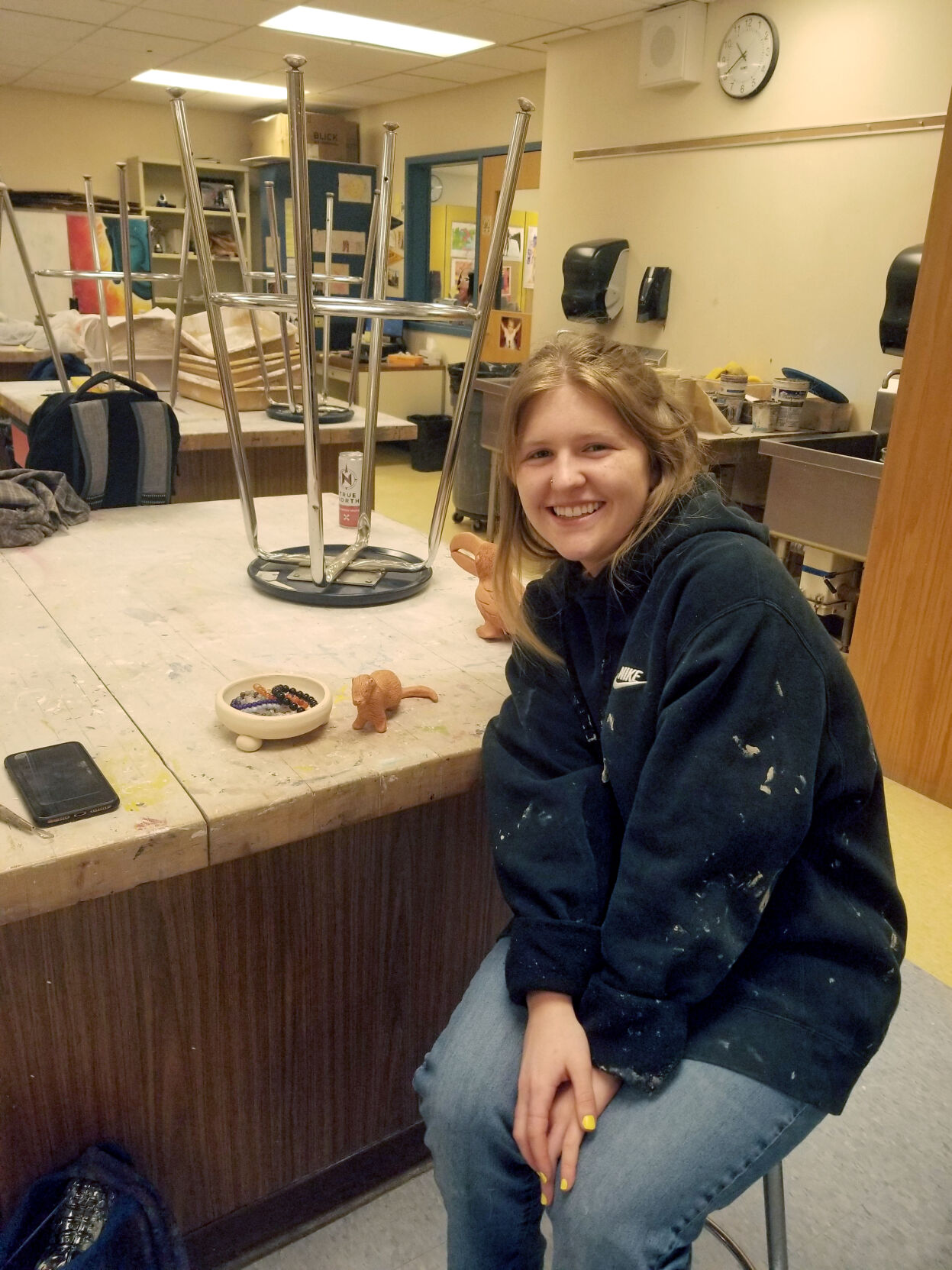
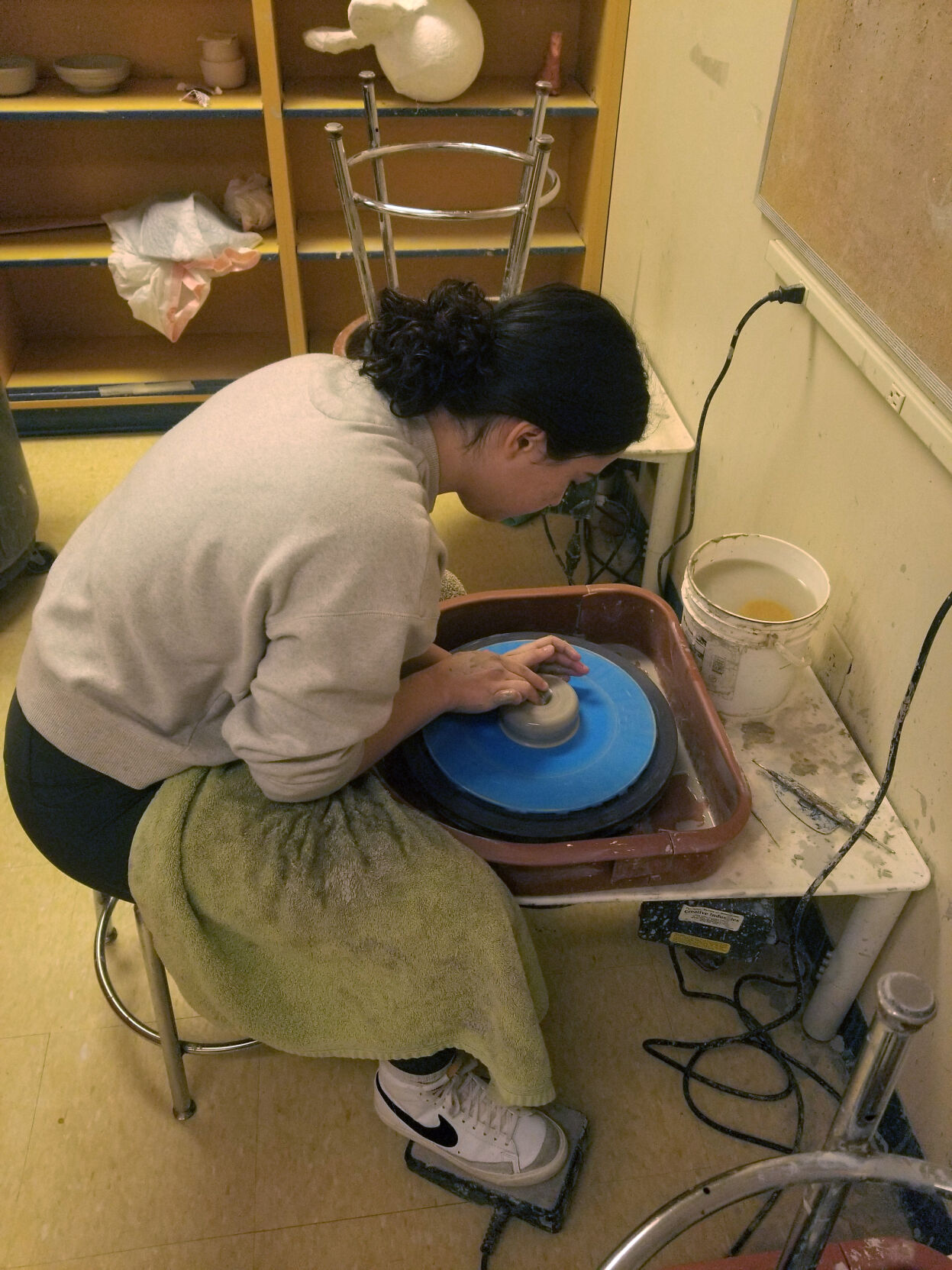
Antone's sculpture and pottery studio is an emporium of wildly different projects. A giraffe mask made from plaster strips is waiting for finishing touches and color. Marionettes with clay faces and hands dangle from strings, looking as if they’re about to shout or laugh. On one table, clay figurines of a river otter and a dodo bird show painstaking attention to detail and design. Along the room’s perimeter, 10 students in clumps of two or three sit before whirring, spinning pottery wheels, chatting with their neighbors and watching the clay between their hands transform into unexpected shapes. It’s a room brimming with wonder — and peace.
“I like how you can move it around and make any shape you want,” said 11th grader Allie Wernig. “You don’t have to make what the teacher says. You can have creative freedom.”
“I like how I’m stronger than this clay,” said Sienna Diaz, a 10th grader. “I’m able to move it the way I want it. It’s relaxing — especially when you see it change.”
Blythe O’Connor, a 12th grader who is considering a career in interior design, relishes the collegial atmosphere where students can learn from each other and enjoy the calm and sense of accomplishment that making art provides.
“I think it’s a mind escape. It’s meditative to be hyper-focused on something,” O’Connor said. “It gives me a way to express myself. It’s a great class environment. Everyone’s helpful and creative.”
Music, dance and visual arts have always been a refuge and a calling. Post-COVID, they’re also reset buttons, giving kids a hands-on environment in which to feel grounded in the moment and inspired about the future and by each other.
In art, “There’s a sense that you can try and fail and it’s just as good as if you succeeded. You can’t base your skill set on those sitting around you. You can look at your growth and see it happen,” Antone said.
During the three months that Gilford schools were remote in spring 2020, Antone’s students made projects from items and odds and ends they collected around their homes. “What they missed was the camaraderie,” he said. “They were really successful making things. But when we were back, there was a sense of joy.”
This school year, he assigned cardboard sculpture as a group project rather than an experiment in self-expression. Students reveled in the chance to collaborate, he said, and to make art a team effort.
After COVID, studio time is an option that art students choose during “Eagle block,” the new period carved into the school day that gives students time for remedial help, make-up tests or missed assignments, go outside for a break, or do something they enjoy.
“Students will say it’s a brain break,” said Lori Jewett, head of counseling at Gilford High School.
During the past two years when education shifted drastically to limit contagion while striving to keep children moving forward academically, Gilford schools diverged from other districts, many of which stayed remote or hybrid for 12 to 18 months.
“It was a new normal,” Jewett said. “But the positive was we were together. Students were in the building interacting, making eye contact. It wasn’t through a computer screen.”
At the same time, Gilford was one of the only area schools that offered a full menu of sports options. “We also had a full in-person play, and did co-curricular activities. It came with a great deal of angst, but looking back it was the right decision,” Sperazza said.
Staff and educators believe that preserving the in-person option helped maintain normalcy and expectations, and that fewer students suffered social and emotional setbacks caused by a lengthy stretch away, and having to interact mostly online. Now, the kids who completed last year remotely seem to be struggling more with maintaining stamina for a full day of learning, meeting school demands, and the intensity of social immersion, school counselors and teachers report.
The effects on individual children differ. Time and experience are restoring energy and comfortability. But it’s a process of assimilation — everywhere.
One of COVID’s aftershocks has been a drop in school attendance and fewer students arriving for classes on time, said Jewett — a dilemma which has prompted some parents to call the school to ask for help. Like many school districts, Gilford is collaborating with community mental health providers to help students who continue to struggle.
Gilford High adopted the return-to-school motto, "Compassion, Connection and Perseverance." "It was going to take a village. Remote or in-person, we wanted to make connections and demonstrate compassion — Mask, no mask. Vaccine, no vaccine,” Sperazza said.
There was a concerted effort to create a culture of tolerance for individual safety preferences. Children who came to school in masks often felt anxious around those who didn’t, and needed help understanding their own levels of protection amid current public health guidelines.
“Wearing masks or not wearing masks, it’s part of school culture now,” and it mirrors society at large, said Jewett.
“The theme was respect,” said Caravona. “The CDC may provide guidelines, but people are going to decide for themselves.”
Now that the level of COVID anxiety has subsided, there is a more widespread feeling of "life is good," Jewett said. Barriers are dropping as schools encourage a team approach of "We’re all in this together to prevail."
Teachers continue to sow a culture of calm.
At Gilford High, some begin class with group exercises such as deep breathing and visualization, which helps students tune out distractions, focus on the present, and banish background stress. Others bring music into the classroom.
Watching live links of baby animals at zoos has become a popular way to begin the school day. It gives students a moment to decompress. And as an activity, it sparks rapture, among high school students and teachers.
“For the first two minutes, they looked at the pandas,” said Sperazza. Students paused and said, “Oh, look!” “Some said it was the best two minutes of their day.”


(0) comments
Welcome to the discussion.
Log In
Keep it Clean. Please avoid obscene, vulgar, lewd, racist or sexually-oriented language.
PLEASE TURN OFF YOUR CAPS LOCK.
Don't Threaten. Threats of harming another person will not be tolerated.
Be Truthful. Don't knowingly lie about anyone or anything.
Be Nice. No racism, sexism or any sort of -ism that is degrading to another person.
Be Proactive. Use the 'Report' link on each comment to let us know of abusive posts.
Share with Us. We'd love to hear eyewitness accounts, the history behind an article.