


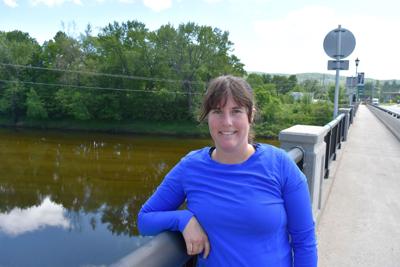
ASHLAND — When she went away for her honeymoon earlier this month, Kaitlyn Morse had the post office hold her mail for her. When she returned and picked up her mail, she collected what might be the weirdest wedding gift ever: a box containing hundreds of ticks.
“It was a little stressful,” Morse said, “But it was so exciting.”
The ticks were contained within scores of envelopes. Each little parasite was accompanied by a piece of paper detailing when and where it was collected, whether it was biting or just crawling, and whether it was on a person or animal.
The envelopes are part of an effort, now in its second year, that Morse started in order to put the power of science into the hands of average citizens. Its first project is to gather and disseminate information about tick-related diseases in New Hampshire.
Morse grew up in Vermont, but has lived “all over,” she said. She has several post-graduate degrees, including a Ph.D in immunology and veterinary science from Washington State University. As part of her doctoral thesis, she developed a vaccine for Anaplasmosis, the most prevalent tick-borne disease in the world.
Morse worked with Harvard University and Massachusetts General Hospital to invent a laser adjuvant, which uses targeted waves of light to enhance the efficacy of vaccines. But she walked away from the project.
“Previously in my job, science was not fun,” she said. Morse wasn’t motivated by fame or fortune, and found that she was an outlier in the corporate medicine world. So she relocated to Ashland and joined the faculty at Plymouth State University. She doesn’t currently teach any classes, though she is still listed as an “affiliate faculty” member.
Instead, Morse is running Bebop Labs, a nonprofit she started last year (named after her chocolate Laborador retriever), dedicated to democratizing science.
“We track impacts to health,” Morse said, and she decided to tackle the topic of ticks, something she’s an expert on and something that there’s little local research directed at.
So, last year, she issued a call for people to mail in the ticks they collect. She catalogued each one and, at the end of the year, mailed them to a laboratory – she prefers to partner with Ticknology in Fort Collins, Colorado – to get them tested all at once.
In 2018, Bebop Labs tested 822 ticks, mostly black-legged, and the results confirmed that Lyme disease is a considerable risk throughout the state. Half of the ticks tested from Belknap and Carroll counties carried Lyme, she found. What was just as concerning was the emergence of Miyamotoi, a disease with Lyme-like symptoms including relapsing fever, fatigue, headache, muscle pain and loss of appetite, in two percent of the ticks tested.
She also found that – while the larger and mostly disease-free dog ticks are found April through August – the small black-legged ticks, sometimes called deer ticks, are a scourge year-round. And it’s the black-legged ticks that transmit diseases such as Borrelia, Babesia, Anaplasmosis, as well as Lyme and Miyamotoi.
At www.bebop-labs.com, there’s an interactive map of the state, where Morse’s volunteer team has made it possible to see when and where each of the ticks were collected. People could use this information, Morse said, to gauge their risk before they venture into a particular park or head into the woods, and take the proper precautions.
What’s exciting to Morse is that this data didn’t exist for New Hampshire until she started Bebop Labs, and it wouldn’t exist today without the active participation of hundreds of citizen scientists.
“It’s about answering your tick-based disease questions for yourself,” Morse said. “I see it as a revolution, changing the way we do science.”
Bebop Labs has been able to produce its results using very little funding. Morse is working for free – she has a part-time job for the town of Ashland as well – and the testing that was done last year was thanks to private donations.
This year should be a big one for Bebop Labs. Morse has just gained official nonprofit status, allowing the organization to apply for grant funding, and it is rapidly building a fanbase. Bebop Labs has 80,000 followers on social media, and the rate of ticks showing up in her mailbox is double what it was last year.
If you find a tick, put it in a zip-lock plastic baggie or piece of tape, record when and where it was found, during what activity, whether it was biting or crawling, who it was on, and if biting, where it was biting someone and the age of the person. Then mail it to PO Box 183 in Ashland, NH, 03217.
Morse has also been pleased to see that some of the ticks have arrived along with a donation.
“It would be awesome if I could pay people to work for me, and if I could pay myself,” she said.
But the first priorities for her are the science, and the opportunity to use science to empower people.
“I wanted to use thinking with my heart as an asset,” she said about starting Bebop Labs. “I discovered that maybe I would work as a nonprofit, because I care.”


(0) comments
Welcome to the discussion.
Log In
Keep it Clean. Please avoid obscene, vulgar, lewd, racist or sexually-oriented language.
PLEASE TURN OFF YOUR CAPS LOCK.
Don't Threaten. Threats of harming another person will not be tolerated.
Be Truthful. Don't knowingly lie about anyone or anything.
Be Nice. No racism, sexism or any sort of -ism that is degrading to another person.
Be Proactive. Use the 'Report' link on each comment to let us know of abusive posts.
Share with Us. We'd love to hear eyewitness accounts, the history behind an article.