


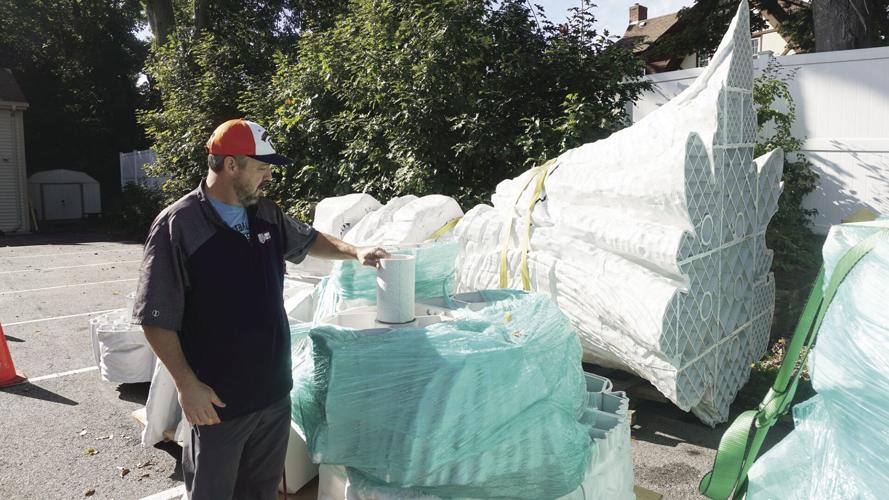
LACONIA — The famous wooden sculpture depicting a Native American man’s head known as the Defiant One is back from the dead. On Monday afternoon, a 3D-printed carbon copy of the Defiant One arrived in several pieces at the Laconia Fire Station after traveling by truck from Texas. In 2019, the statue was taken down from its pedestal in Opechee Park due to extensive wear and tear. When crews pulled the statue down, it shattered.
For Michael Smith, Laconia native and shareholder of the Winnipesaukee Muskrats baseball team, it was a sad sight to see the 36-foot statue go. Smith and fellow shareholders Scott Everett and Peter Erklauer wanted some way to preserve or remember the Defiant One using the remains of the statue.
“We tried to save any of the wood we could to make it into baseball bats, anything we could do out of it, but you couldn't make toothpicks out of it, it was so disintegrated,” Smith recalled.
The trio paid to have the Defiant One scanned by Ohio-based True Point in April 2019, before its destruction. The data was turned into a 3D-model file which was eventually printed by Cosine, a 3D-printing company in Texas. Despite its Monday arrival to the city, the statue is far from complete.
“We've been trying to get him done now for a couple years," Smith said. "Just delay after delay and COVID hit and they lost their head manufacturer. So it got to the point where they said, 'We'll send you what we have and you guys can assemble it there and see how you do.'”
The statue is still in need of assembly, surface smoothing and painting. Currently, the surface of the statue bears the tell-tale ridges of 3D printing. This can be erased via a chemical process, but the Muskrats owners will have to find someone up to the task. Additionally, the logistics of getting the 7,000-pound sculpture to its original spot without damaging Opechee's running track is proving to be a bit of an engineering hassle.
So far, the project has cost about $13,000, according to Smith.
“We're hoping to enlist the help of some of the community members who can do things like help assemble and help paint it and get it up into its position,” Smith said. “We've already raised a couple thousand dollars through donations, which is nice, but it's going to paid for out of the Winnipesaukee Muskrats organization.”
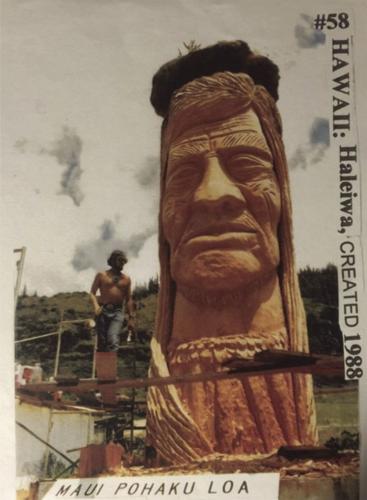
The original statue was carved by Hungarian-American artist Peter Wolf Toth in 1984, as part of his lifelong "Trail of the Whispering Giants" project.
“My whole life was geared to this,” Toth said of the project. “I have always had an empathy for the Native Americans, because they lost their homeland and I lost mine in a manner of speaking through the trickery or thievery of the Russians.”
When Toth was a young child, his family fled then-communist Hungary and eventually landed in Akron, Ohio. Toth's artistic journey began after he decided to drop out of school at the University of Akron, quit his job at a machine shop and head to California.
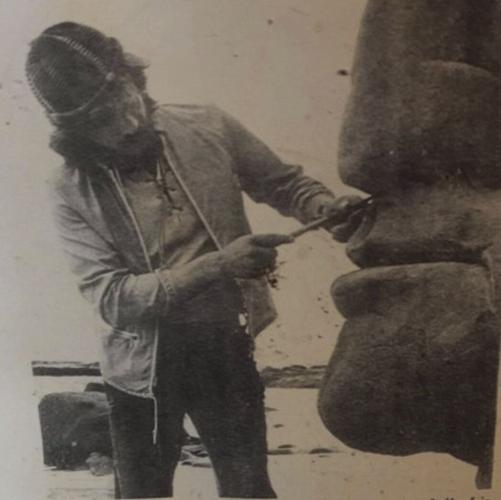
“I was standing on the shores of the Pacific Ocean, and I saw the image of a human being in a cliffside,” recalled Toth, who happened to have a chisel and hammer in his van. He went to work, carving the visage of an indigenous man into the cliff, and catching the attention of a local newspaper. He then returned to Akron where he made another native carving.
“Ohio is not known for a lot of their cliffsides,” Toth said. “I finally found a quarry. I figured if I could make a statue, maybe a couple of raccoons and maybe an opossum would see it.”
But then Toth found a dead elm tree in a park, and decided to carve that instead. During this process, and all native heads afterward, Toth worked with local tribes to combine their cultural and facial features into his monuments, creating a blended, unified expression of local native culture for each sculpture.
After completing the Akron sculpture, Toth decided to carve a native statue in each of the 50 states. He completed that goal in 1988. In 1984, he carved the Defiant One in about three months at Opechee Park.
“I remember watching it, when Peter Toth was carving it,” Smith said, adding that he hopes to bring a similar experience to the Laconia youth today when assembly of the new statue begins.
When asked for his thoughts regarding his work being recreated in 3D-printed plastic, Toth said, “The main purpose I made the statue for is to honor the indigenous people, the native Indian people. If that is accomplishing that, I have no problem with materials used. I'd like to perpetuate that image, that purpose of honoring people facing injustice. That has always been my theme and continues to be.”


(0) comments
Welcome to the discussion.
Log In
Keep it Clean. Please avoid obscene, vulgar, lewd, racist or sexually-oriented language.
PLEASE TURN OFF YOUR CAPS LOCK.
Don't Threaten. Threats of harming another person will not be tolerated.
Be Truthful. Don't knowingly lie about anyone or anything.
Be Nice. No racism, sexism or any sort of -ism that is degrading to another person.
Be Proactive. Use the 'Report' link on each comment to let us know of abusive posts.
Share with Us. We'd love to hear eyewitness accounts, the history behind an article.