


LACONIA — After several considered changes, the Laconia School Board approved and finalized new language to its volunteer policy at its meeting Tuesday night.
That approval marked closing the curtains for a policy review that began eight months ago and had been a stage for tensions between board members to play out publicly.
When the volunteer policy, referred to by the code IJOC, came before the board for a first read in September, the then-proposed language disallowed board members from serving in leadership positions in volunteer organizations.
The language approved by the board Tuesday is substantially looser.
It simply states that “when volunteering in the District, Board members would refer to policies BBAA, BCA, and BHC,” the policies governing board member authority, board member ethics and board-employee communication, respectively.
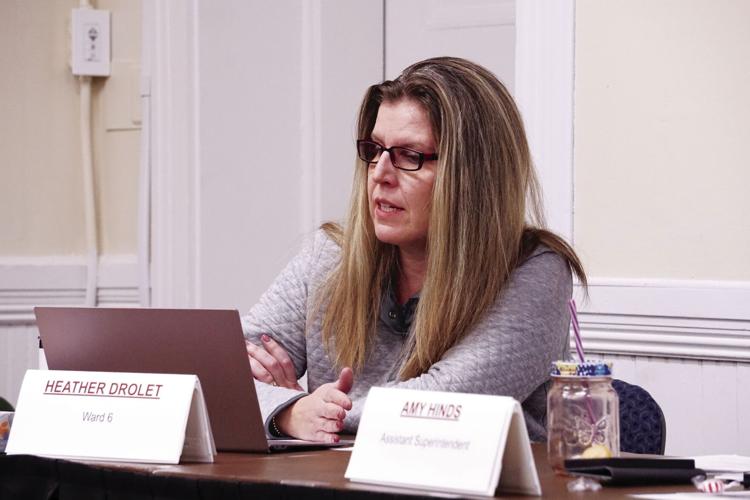
The change, according to Heather Drolet, the chair of the board’s policy committee, was because the committee elected to find a compromise between voices on both sides of the debate.
“The language we’d considered in the past was inflammatory and misunderstood, both by members of the public and by at least one board member,” Drolet said. They went with a more simplified message, she said, “as a matter of compromise.”
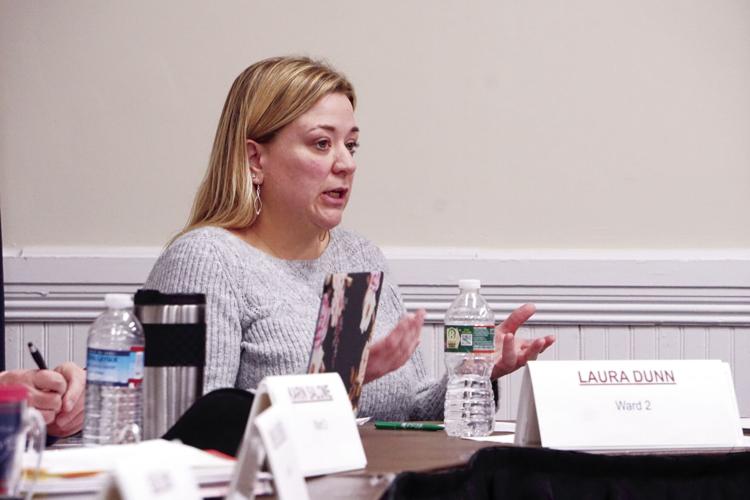
“Speaking as an individual board member,” said Laura Dunn, who represents Ward 2 on the school board, in an interview Wednesday, “I voted for it. It pretty much samples, reflects the NHSBA sample policy.”
“It’s unfortunate it had to take seven meetings and I feel it was unnecessary board work,” Dunn continued. “But in the end, I’m fine with the wording.”
Board Chair Jennifer Anderson could not be reached for comment Wednesday.
Questions about board members volunteering came to the table last year after the parents organization at Pleasant Street School — whose president, Dunn, is also a school board member — hosted a going-away party for outgoing principal David Levesque, whose departure itself divided the community.
Board members Drolet and Jennifer Ulrich confronted Dunn about her presidency of the parents organization in June, expressing in emails and at board meetings that they felt there were inherent conflicts of interest and complicated power dynamics to her serving in both roles. Dunn responded that her position as a board member does not negate her right as a parent to volunteer and that she felt personally singled out by her peers.
That prompted the board’s then-Chair Aaron Hayward, who often sparred with Dunn, to request that the district’s volunteer policy be reviewed. The policy committee — then composed of Drolet as chair, Dunn and Ulrich — weighed whether the district could or should ban board members from volunteering in schools or with parent organizations.
Because volunteers have to make requests of administrators and the superintendent, and board members are the superintendent’s direct supervisors, Drolet explained in an interview Tuesday, there’s a circularity to the chain of command and there can be real or perceived conflicts of interest.
Furthermore, Drolet explained, because board members are elected to advocate for the entire district and PTA leaders advocate for their particular school, there can be conflict in those roles.
While the going-away party in June initiated the debate over this policy, other events since have exemplified the need for its review, according to Drolet — specifically Dunn’s September acceptance of a school supply donation from Walmart to Pleasant Street School.
Dunn said the donation came about because she was in the right place at the right time: she happened to be shopping at Walmart while staff were gathering school supplies and wondering aloud where they could donate them. Dunn suggested Pleasant Street School. A Facebook post by Gilford Walmart about the donation identified Dunn only as president of the PTA.
In a September interview, when the new, stricter policy language first came before the full board, Ulrich questioned whether Dunn could accept the donation solely as PTA president and in no way be perceived as a board member.
“Given that board members are supposed to represent the whole community, not just one school,” Ulrich said, such situations could be perceived as Dunn having a bias in favor of PSS.
Because of board policy and state law about board members' lack of authority outside meetings, Dunn said she could not have accepted the donation as a board member. Moreover, the school board accepts donations for one particular school often, Dunn emphasized. That her donation was the only one to receive board scrutiny, she continued, shows how other board members have targeted her and how she has been "bullied and harassed."
“Talking to you as the PTA president right now, I’ll say that first and foremost I am a parent,” Dunn said. “I don't lose my rights as a parent and what I can do for my children because I wear another hat. I wear many hats.”
Even if the board and the policy committee had further pursued the stricter language for the volunteer policy, it likely could not have applied to Dunn.
“We do have the authority to dictate what board members do in schools,” Drolet said. “But a PTA is not one of the things we can govern.”
Over the summer, the policy committee consulted Will Phillips, an attorney from the New Hampshire School Boards Association, a professional nonprofit organization and lobbying group that, among other things, advises districts on policy writing.
Emails from Phillips to Drolet note that “NHSBA generally discourages regular volunteer participation of board members due to both the apparent conflict and potential actual conflicts/bias/prejudice arising when a board member serves under the direction of an employee of the district,” but also emphasize that “while a board can make rules about internal/district controlled activities, it is not able to do so for external groups” such as a PTA.
The parents group at Pleasant Street School, formerly known as VIPSS, or Volunteers in Pleasant Street School, officially became a PTA, and affiliated with the state PTA, in September. The change, according to Dunn, was made by a unanimous vote of the organization’s members. While those parents had the policy debate in mind when discussing the issue, she said, they also recognized broader benefits — such as access to grants and other resources — that come with official PTA status.
The board approved the volunteer policy changes unanimously.


(0) comments
Welcome to the discussion.
Log In
Keep it Clean. Please avoid obscene, vulgar, lewd, racist or sexually-oriented language.
PLEASE TURN OFF YOUR CAPS LOCK.
Don't Threaten. Threats of harming another person will not be tolerated.
Be Truthful. Don't knowingly lie about anyone or anything.
Be Nice. No racism, sexism or any sort of -ism that is degrading to another person.
Be Proactive. Use the 'Report' link on each comment to let us know of abusive posts.
Share with Us. We'd love to hear eyewitness accounts, the history behind an article.