


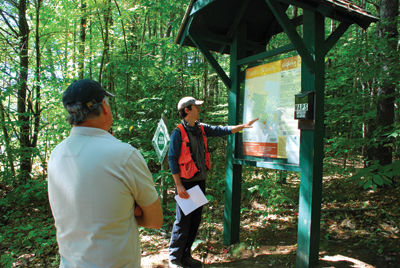
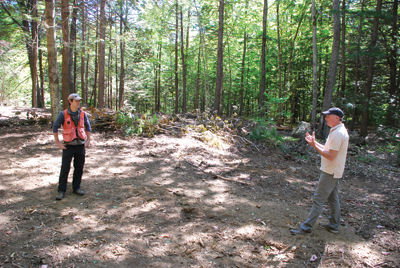
Pointing is Steve Junkin, and looking on is Jack Savage, both of the Society for the Protection of New Hampshire Forests. (Adam Drapcho/Laconia Daily Sun)
By GAIL OBER, LACONIA DAILY SUN
GILFORD — Logging is messy.
It's hours of running a chain saw, inhaling fumes, fighting bugs, sitting on a skidder, and hauling logs from deep dense and dark places. It's dangerous, and, in New Hampshire, it's one of our oldest occupations.
Logging also provides the paper that you're reading, the floor upon which you're standing, and the roof over your head.
But to the people who work for the Society for the Protection of New Hampshire Forests, logging is the only way of maintaining the one of the state's most valuable resource – its forests.
"In order to grow a tree, you have to cut a tree," said Jack Savage who is the communications manager of the society. "We think 40 to 60 to 80 years down the road."
Last week, Savage and staff forester Steve Junkin toured Weeks Woods, the site of a recent logging operation that some town residents found objectionable.
Weeks Woods is 107-acre lot in Gilford with an entrance opposite the Gilford Public Works Department. The entrance is barred to prevent off-road vehicles from accessing it. According to Savage, the area is a very popular hiking, snow shoeing and cross county skiing spot because of its trail system and its gradual slopes.
The bulk of the land was donated to the forest society, according to Savage, in 1987 and was logged by them for the first time in 1988. According to the society website, the area was once used for a pasture, but by the time Ester and John Weeks bought it in 1943, most of it had returned to forest. The Weeks family used some of their land for tree farming and harvested trees in 1952 and in 1962.
As for the recent logging operation, Savage and Junkin said the purpose was to thin some of the hemlock to allow more sunlight to reach the ground and regenerate some newer hemlock and to harvest some of the oak, leaving the most healthy trees to drop acorns.
He said part of the project was to chew up the soil in some of the openings to allow for better planting of this year's acorn drop. Junkin said that with all of the hemlock needles padding the forests between harvesting, it's hard for the acorns to burrow and grow into trees.
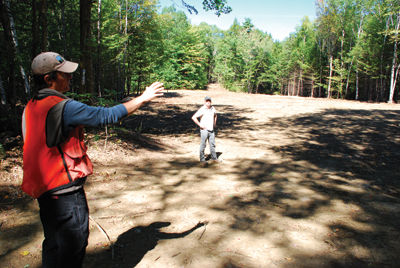
He said the first landing, or open spot, was expanded. Some "chips and slash," which are the tops of trees and other parts that are not usable for pulp or logs, stay there to hold the soils from runoff.
"It'll grow back naturally and they'll be more trees than ever in a few years," said Junkin.
Both explained that openings in the forest are good for wildlife. In the case of Weeks Woods, he said there are a number of small wildlife species there, including woodchucks, foxes and squirrels, as well as deer that feed on the acorns and the new growth hemlock that will begin to grow as early as next season.
He said they consciously created small open spaces for wildlife diversity, including attracting warblers and other species that feed on worms and grubs in the earth.
When asked why they chose 2016 to log in Weeks Woods, Savage said there were not enough new trees growing, adding that the goal of forest management is to have trees of different ages growing for the future.
"We usually try to harvest on 30-year cycles, and it's been 27 since this lot was last logged," he said.
He said the loggers used the same trails they used in 1989 for this operation and that the society will be building a wood bridge to span an area where one old culvert had failed and a different area that was eroding. Some of the trails were widened.
Savage said he heard about some of the negative feelings about the recent logging operation and said that that make them feel good because they know somebody cares about the forests in New Hampshire.
"This is obviously a special place to them and we want them to understand why we're doing this," he said.
He also said that the harvest concentrated on many trees in or near the clearings that were 30 years old and, which as of yet, haven't been reseeded.
"That's kind of a shock (when people see it for the first time), he said.
As to revenue, Savage said that the only way to keep forests is to make them viable for forestry by keeping the industry economically viable.
"Without that income from all of the 54,000 acres we manage, someone else will come along and do something else with the land," he said. "Like build houses."
"We talk a lot about that aesthetic value and hiking opportunities, but it takes some economics to make that happen," he said. "It is the essence of wise use."
When asked what would have happened if the Forest Society chose to do nothing in Weeks Woods, Savage said that at some point, it would lose the basis for being an economically viable forest and would ultimately be put to a different use.
"We're the second- or third-largest land owner in New Hampshire, and we exist to provide (timber) for the forest industry," he said.
Savage said the annual budget of the Society for the Protection of New Hampshire Forests is about $500,000 annually and $200,000 to $300,000 of it is offset by harvesting 1 to 2 percent annually. He said 30 percent of those are designated ecology preserves and are not logged at all.
"We are always facing (budget) pressure to log more," he said. "We're managing and supporting a renewable industry."
To those who are angry, he asks only that they wait a few years or stay actively involved and watch as the forests regenerates.
The Forest Society is hosting a walk-through of Weeks Woods and a timber harvest tour on Oct. 22. Savage said he really wants people, especially those who are upset with the recent logging operation, to attend and better understand why the society does what it does.
Junkin, left, and Savage stand in a clearing in Weeks Woods. (Adam Drapcho/Laconia
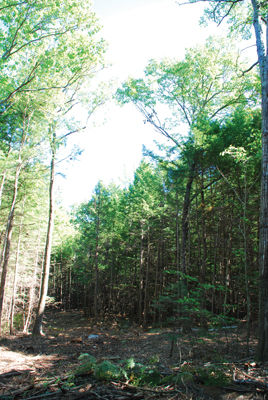
In this clearing, foresters left certain trees to re-seed the ground and to block winds. (Adam Drapcho/Laconia Daily Sun)
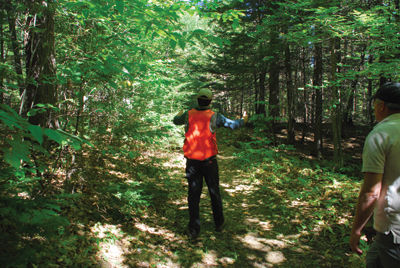
Steven Junkin points to a stand of oak trees left for their acorns. This path is at least 30 years old, and started out as a much wider trail. (Adam Drapcho/Laconia Daily Sun)
This is a new clearing where the “slash” was left to make clear where the trail is. (Adam Drapcho/Laconia Daily Sun)


(0) comments
Welcome to the discussion.
Log In
Keep it Clean. Please avoid obscene, vulgar, lewd, racist or sexually-oriented language.
PLEASE TURN OFF YOUR CAPS LOCK.
Don't Threaten. Threats of harming another person will not be tolerated.
Be Truthful. Don't knowingly lie about anyone or anything.
Be Nice. No racism, sexism or any sort of -ism that is degrading to another person.
Be Proactive. Use the 'Report' link on each comment to let us know of abusive posts.
Share with Us. We'd love to hear eyewitness accounts, the history behind an article.