


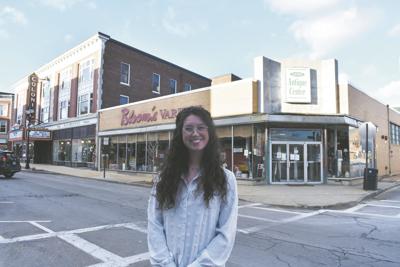
LACONIA — A 100-seat restaurant with a bar and lounge, and much-needed backstage and storage space for the Colonial Theatre could all be added to the city’s downtown if council agrees to a proposal involving the Laconia Antique Center.
City council will meet on Monday night at 7 p.m. in City Hall. On the agenda is a presentation of the plan. The idea was sparked by interest from Melissa Darling, from Long Island, New York, who came to know the area by riding out a portion of the pandemic at a family home.
“I’m not from here but my parents have had a house in Moultonborough for 10 years or so. When the pandemic started we were supposed to be up here for a week but we ended up staying here for six months,” Darling said.
Darling’s professional background is in sales, and her husband, Tyler, is a veteran of the hospitality industry, working front-of-house operations for restaurants in New York City.
After spending some time in the region, Darling said, “We decided that we wanted to stay here, start a family here, buy a house here, start a local business here.”
Meanwhile, the newly re-opened Colonial Theatre is building renewed interest in downtown. A new bar and other new businesses opened downtown, joining several other specialty businesses that had already established themselves. One thing was missing, to Darling’s eye: a certain kind of restaurant to serve people before and after shows.
Once she heard Charlie St. Clair, owner of the Laconia Antique Center, formerly Bloom’s department store, was willing to part with the property, the plan started to take meaningful shape.
“It just seemed like the perfect partnership. It’s right in the perfect location, it has great qualities to it,” being on a corner and boasting large banks of windows, she said, “When we first heard that it was potentially available, we were so excited.”
Of course, rarely is anything perfect, and the problem with the Antique Center space, from Darling’s perspective, is that it’s much larger than they would need for their restaurant. After meeting with city officials, they learned splitting the building into two could solve both Darling’s problem, and another the city has been dealing with since the Colonial re-opened.
The biggest shortcoming of the Colonial is invisible to audience members but glaringly apparent to anyone performing there. There’s precious little backstage area, and access to the stage is only possible from one side. Anyone trying to follow “exit stage-left” direction would have to duck behind the curtain and sneak behind the set to get to the spaces along Canal Street that are currently being utilized as dressing rooms.
The antique center building abuts the Colonial — they share a common wall. Under the proposal to be discussed on Monday night, Darling and her husband would buy only the third of the antique center building that fronts on Main Street, and the city would buy the remaining two-thirds of the building, including the section that is two floors, further from Main Street. The city-owned portion would be used to provide additional access to the stage, as well as dressing rooms, green rooms, laundry facilities, storage and rehearsal spaces for the theater. Incoming talent would also be able to park tour buses along Hanover Street — which could become a one-way street — which would be less disruptive to local businesses than parking them on Canal Street, as is the current situation.
The asking price for the antique center building is $1.2 million. The parties, interviewed on Thursday evening, didn’t disclose how much of that price would be handled by Darling and how much the city would pay; those details are expected to be presented at the city council meeting.
the darling
Darling plans to name the eatery “the darling,” and said the concept would serve diners looking for differing experiences.
The food will be both Italian and American, with a menu that offers appetizers such as calamari, meatballs and crabcakes, thin-crust pizza as either an entree or a shared plate, and for more substantial meals, steak, pasta and chicken dishes, as well as a full dessert menu.
Concepts for the exterior include a brick facade and dark awnings; the interior design concept is “modern vintage” with industrial elements, a wine wall and lots of greenery. The service space will offer between 75 and 100 table seats, a bar with around 15 seats, and a lounge area that could be used both by people waiting for a table or guests who want just a drink and an appetizer.
Darling said she hopes the restaurant will be “cozy but approachable,” and will feel high-end without feeling exclusive.
“It’s a beautiful building, we’re really excited about it,” Darling said, adding she and Tyler now live in Laconia and hope to start a family here. “This seems like the perfect community to put down roots,” she said, adding she sees their restaurant as potentially helping to further the economic and cultural revitalization of the city.
Multi-generational investment
Mayor Andrew Hosmer, who helped to craft the proposal from the city’s side, said the municipal share of the purchase price would come from federal American Rescue Plan Act funds, a one-time revenue source he said should be applied to a one-time expense.
Though it would be a singular capital expense, the returns would be continuous, Hosmer said.
“It is a multi-generational investment into what I think is one of the most significant assets of the city, the Colonial Theatre,” Hosmer said.
When the city was first considering the costs of purchasing and rehabilitating the historic theater, which prior to its reopening in 2021 had been vacant for many years, Hosmer said the promise was it would spark economic activity throughout the city. “And that has been very true. It has had the impact that was anticipated,” he said. “This will allow the economic impact to be greater.”
The Colonial has already bumped up against its space constraints. In one case, a nationally-recognized artist parked multiple tour buses on Canal Street — taking up valuable parking spaces for nearby businesses — because there weren’t suitable dressing rooms for the marquee talent.
Canal Street has also had recurring disruptions for the load-in and load-out of sets and other equipment for shows, as there’s very little storage onsite.
“Bigger shows, more excitement, more people, a restaurant serving people attending shows both before and after, it just makes sense,” Hosmer said about the proposal. He said the Lakes Region has long drawn visitors and residents alike with its natural beauty, and the recent growth of the performing arts economy has only built on that draw.
“I hope, at some level, this theater inspires a generation of kids in the arts as well, so the city can encourage young kids, as well as men and women, to explore” artistic expression, Hosmer said. “That’s what makes a little city like ours a community.”


(0) comments
Welcome to the discussion.
Log In
Keep it Clean. Please avoid obscene, vulgar, lewd, racist or sexually-oriented language.
PLEASE TURN OFF YOUR CAPS LOCK.
Don't Threaten. Threats of harming another person will not be tolerated.
Be Truthful. Don't knowingly lie about anyone or anything.
Be Nice. No racism, sexism or any sort of -ism that is degrading to another person.
Be Proactive. Use the 'Report' link on each comment to let us know of abusive posts.
Share with Us. We'd love to hear eyewitness accounts, the history behind an article.