


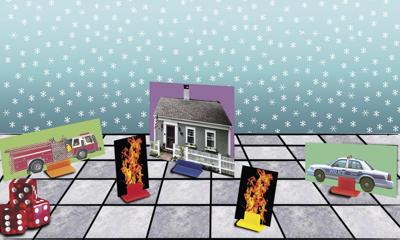
Between storms causing power outages and some residents setting the thermostat lower to save on energy costs, the risk for house fires increases in winter, local fire experts say.
"Every winter we do see a handful of these incidents that are related to just trying to make it through the winter, trying to stay warm. It's unfortunate, but a lot of it can be avoided if people take the time," Laconia Fire Chief Tim Joubert said. "One of the major issues we run into because of financial constraints is people aren't able to properly maintain their heating systems, or they may use an alternative fuel for a heating appliance that isn't rated for that, or they may try to put something together that isn't necessary."
Space heaters, fireplaces, candles and even appliances such as cooking stoves are some methods people might turn to in cold-weather months to heat their homes, each with varying levels of risk.
"Any time you're using a portable-type heater, there's opportunities for it to get moved around to the wrong spot or to be too close to something combustible or have material thrown on top of it. That's always a concern with space heaters," Gilford Fire Chief Stephen Carrier said.
A 3-foot proximity rule should be utilized for all heating sources to ensure they have enough room to operate without catching other material ablaze.
Both chiefs said their fire departments receive more calls for assistance in the wintertime. In fires across the country, over half occur in December, January and February. According to the New Hampshire State Fire Marshal's Office, over the past five years, NH has had more than 7,500 reported fires, and the average number of heating-related fires is about 450 per year. In most instances of home fire fatalities since 2017, there were no working smoke alarms in the home.
Chimneys, especially ones that may be little-used but called into service as a cost-cutting way to heat homes, are where many fires ignite.
"If you drive around town, it's certainly noticeable people have wood piles in their driveway or next to their house, and it seems to be that people are burning wood as an alternative source from oil or gas," Carrier said.
In Gilford in 2001, the fire department responded to 13 chimney fires, yet there was only one in 2021, and three in 2022, as inspection requirements have increased. That's not to say residents' guard should be let down, though.
"Back in the early '80s we were having a lot more chimney fires, and back then oil prices were very high and the economy wasn't that great, so a lot of people were turning to wood for heat," Carrier said. "It seemed like we had a lot more chimney fires that turned into building fires because the chimneys weren't installed or maintained properly. So, I think we're a generation away from that, almost, and maybe there's a relearning curve for people to get used to burning wood again and maintaining their wood stoves and fireplaces."
A buildup of creosote, the tar-like byproduct of burning fuel such as wood, can ignite and spread through the infrastructure of a home, especially an older one, which is why it's important to have chimneys cleaned annually.
"There's probably some out there that have never been inspected that have been in use for many years. And over time, heat, especially if it's too close to a structural member, can break down the wood and actually lower its ignition temperature to the point where it could ignite more easily if there were a problem in the chimney," Carrier said.
Ash should be thoroughly doused and disposed of in a metal container with a lid, away from the home and other combustible material.
While space heaters and wood-burning or pellet stoves can be good ways to heat homes if used correctly, just because an appliance gives off heat doesn't mean it should be relied upon to stay warm. Residents should examine and adhere to instruction manuals for optimal safety levels. The NH Fire Marshal's Office warns that cooking equipment is solely designed to make food, not as a heat source.
"We've seen in the past when people try to use ovens as an alternative heating source," Carrier said. "You really should never use an appliance that wasn't intended to be a heat source in place of an oil burner or gas burner because you're going to overwork it, and it isn't designed to do that." That includes propane cylinders and other open-flame sources.
Carbon monoxide, an odorless gas, also poses a threat, as all non-electric appliances emit a carbon monoxide signature that could become dangerous if not properly ventilated.
"Everything's buttoned up, everyone's trying to keep the warmth in, and sometimes people have some appliances running inside that shouldn't be and that need to be exhausted properly so you don't get that buildup of carbon monoxide," Joubert said. "People are using generators in their garages or under their decks, the carbon monoxide running into their house, so that's a big concern in wintertime."
Experts also say to avoid overworking electrical appliances. One heating appliance per outlet is the rule of thumb, without an extension cord, as the high electrical draw could be too much.
"We see it all the time in the wintertime, an extension cord tied into an extension cord tied into a power strip," Joubert said. "We call that 'piggybacking,' and that's really dangerous as well, so try to minimize that."
Smoke alarms and carbon monoxide detectors should be tested regularly and have fresh batteries as backup in the event of a power outage.
"Half of all home fire deaths happen at night, when people are sleeping," NH State Fire Marshal Sean Toomey said in a statement. "So install one on every level of your home, including the basement, and in every bedroom and outside all sleeping areas." Make sure that everyone in the home knows how to get outside and where to meet if the smoke alarm sounds.
Remaining diligent, keeping up with safety procedures and maintenance and, of course, having a fire extinguisher handy are best practices for avoiding catastrophe this winter.
"People are going to do what they have to do to stay warm, but hopefully they have the opportunity to think about their decisions," Joubert said. "We want everyone to be safe in the long run, and taking a chance with some of these alternative approaches to heating is a serious thing, it can be dangerous. Not only to the family, but if it's a multi-family home, think about all those other people as well."
For more resources and home safety checklists, ask your local fire department, or visit NFPA.org, firemarshal.dos.nh.gov and energy.nh.gov.


(0) comments
Welcome to the discussion.
Log In
Keep it Clean. Please avoid obscene, vulgar, lewd, racist or sexually-oriented language.
PLEASE TURN OFF YOUR CAPS LOCK.
Don't Threaten. Threats of harming another person will not be tolerated.
Be Truthful. Don't knowingly lie about anyone or anything.
Be Nice. No racism, sexism or any sort of -ism that is degrading to another person.
Be Proactive. Use the 'Report' link on each comment to let us know of abusive posts.
Share with Us. We'd love to hear eyewitness accounts, the history behind an article.