


LRGH clinic helps moms address addiction
By ADAM DRAPCHO, LACONIA DAILY SUN
Nicole’s world was turned upside down when her father died of brain cancer. She was 12 at the time, the oldest of two children, and quickly learned that she could find temporary relief through substances.
“My mom, she couldn’t handle having two kids, emotionally. She partied a lot. I started drinking, it made me feel better.” Nicole, whose identity is being withheld to protect her children, is now 34 and has three of her own children.
As of Feb. 2, she has been sober for nine months. Nicole is one of the many mothers who has found success through the LRGHealthcare Recovery Clinic, administered by Dr. Paul Racicot.
“We started the Recovery Clinic about two-and-a-half years ago,” said Racicot. The clinic has seen about 500 patients since then, he said. At any one time, there are 200 active clients, of which 14 to 20 are pregnant mothers.
“We get pregnant moms very quickly, they actually do very well. I would say the vast majority stay clean for a really long time and stay clean well after delivery,” Racicot said.
The LRGHealthcare Recovery Clinic utilizes medication-assisted treatment, which has been shown to have greater success than talk-only therapy. For moms, that usually means the use of Suboxone, which can curtail cravings for opioids without presenting a risk to the baby, whether the child is still in utero or is breastfeeding.
“What we didn’t expect was how well the babies would do,” said Racicot. Infants born to mothers who have been using opioids can suffer from withdrawal symptoms after birth. In some cases, their complications require intervention from caretakers, which can range from more physical touch and soothing than usual to the use of morphine to subdue seizures and discomfort. In those more extreme cases of infants born with Neonatal Abstinence Syndrome, the newborns stay in the hospital for weeks, not days, before they can go home.
Not so for babies born to mothers who have been with the Recovery Clinic, Racicot said.
“All of our babies born to our mothers in our program are having minimal symptoms and are going home at a normal time, and are going home with the mom,” said Racicot. “That’s been a surprise for us, and has been very encouraging.”
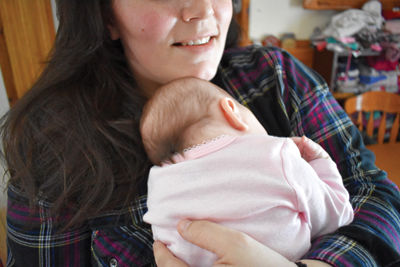
That was the case for Nicole and her newborn daughter, who exhibited no withdrawal symptoms after her birth late in 2017.
Nicole’s road to sobriety shows how challenging recovery can be – and how far the region has come to support people addressing their addiction.
Nicole was drinking in middle school and started using marijuana as a freshman. She remembers how her high school was “flooded” with powerful painkillers such as Oxycontin. “That’s when I started using opiates,” she said. “My addiction didn’t have any consequences until 2012 – I got arrested for selling.” Instead of a conventional prosecution, though, Nicole was offered the chance to enter the then-new Belknap County Recovery Court, an alternative justice program that required its members to submit to long-term, regular drug testing, and to undergo counseling, in order to avoid jail time.
It worked for Nicole, until she “graduated” from the program in 2015 and no longer had to pass a drug screen.
“As soon as accountability was gone, I relapsed,” she said. She didn’t go looking for drugs; they found her. For example, she walked into a room at a relative’s house and found a bottle of percocets on the table.
“I wasn’t spiritually fit at the time. I didn’t have the strength to walk away.”
By October of 2016, her partner had had enough of her drug use. He broke off their engagement and told her she had to move out, though they stayed in touch. In February, and again in March, she was arrested. Then, in April, she found out she was pregnant.
“Obviously, I needed to get help right away,” she said.
Nicole was able to get admittance into the Phoenix House, in Dublin, for a 28-day detox, then spent three months at the Cynthia Day Family Center in Nashua. There was no avoiding jail this time for Nicole, but the judge allowed her to serve only 60 of a 90-day sentence, and she was released a month before her daughter was born.
Knowing that she would be having another baby is what pushed her into rehab, she said, “but it’s not the thing that’s kept me sober.”
Nicole, who lives in a quiet home in a rural part of Belknap County – her partner has taken her back in, their engagement is back on – said she has witnessed the birth of a recovery community in Laconia.
“When I did Recovery Court five years ago, there was only AA and NA,” she said. Now, she goes to several meetings and classes each week, including a class offered by Lakes Region Community Services designed specifically for parents in recovery. Her favorite class is Celebrate Recovery, which meets on Friday nights at LifeQuest Church in Laconia.
Nicole’s story is not unusual for someone in recovery. Corey Gately, the clinical program coordinator for the LRGHealthcare Recovery Clinic, said that there’s a common misperception about recovery that expects people to be cured once they enter treatment. Instead, substance abuse disorders should be thought of in the same way as any other chronic disease.
“We don’t diagnose someone with diabetes and expect that they’ll be well tomorrow,” she said. Instead of making judgements or imposing unreasonable expectations, Gately said that people seeking help need to be met where they’re at in their lives. For a pregnant woman, that likely means offering them Suboxone and counseling.
“Medication-assisted treatment offers moms this unique opportunity to realize there’s a medication that can help you feel better, that can get you into treatment, and (you can) have a baby,” Gately said. “I find that a lot of them, once they’re connected to medication-assisted treatment, find that they can do this. A majority of them deliver their baby and stay with us.”
Nicole has found that there’s a couple of commonalities between being in recovery and being a mom of a newborn: she has to be willing to accept help, and she needs only think about things one moment at a time.
“I’ve gotten better at asking for help now. We’re trained to think that we should be able to do everything for ourselves, that’s not the way it works. Now I know that when my mother-in-law is trying to help me, it’s not because she’s trying to make me feel bad.”
Asking for that help, building a network of recovery around herself, has helped her through difficult moments, she said. For now, she is training herself to not worry about the long-term, and to reach out to that network if she feels that she needs it.
“Can I just stay sober for the next ten minutes? Can I stay sober for just today? It’s good to have accountability partners, someone you can call to help get you through those moments,” she said.
“For anybody that is looking for help, years ago Medicaid didn’t pay for rehab, they do now. For anyone that is looking for help, there is help. They can go to rehab, all they need is a want to go,” Nicole said. “In Laconia, there is a ton of support.”


(0) comments
Welcome to the discussion.
Log In
Keep it Clean. Please avoid obscene, vulgar, lewd, racist or sexually-oriented language.
PLEASE TURN OFF YOUR CAPS LOCK.
Don't Threaten. Threats of harming another person will not be tolerated.
Be Truthful. Don't knowingly lie about anyone or anything.
Be Nice. No racism, sexism or any sort of -ism that is degrading to another person.
Be Proactive. Use the 'Report' link on each comment to let us know of abusive posts.
Share with Us. We'd love to hear eyewitness accounts, the history behind an article.