


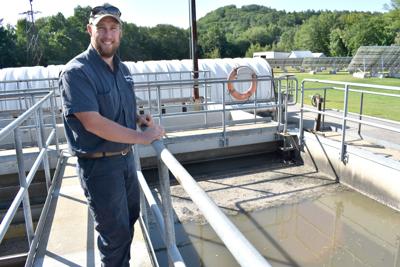
PLYMOUTH — In the span of a few short years, the wastewater facility in Plymouth is transforming from one that serves only the college town to a facility that will process waste for much of the state.
“We’re looking to regionally service all of central and northern New Hampshire,” said Jason Randall, water and wastewater superintendent for the Plymouth Village Water and Sewer District.
The facility unveiled one improvement this year, and is planning another significant improvement for the near future.
Earlier this summer, the treatment plant in Plymouth, located at the end of South Street, opened six new septage receiving stations, which can accept waste from trucks that pump out residential septic tanks. Prior to then, the facility had only one such station, so trucks had to wait if another driver was using the station.
That’s a common problem for septic truck drivers when using smaller wastewater facilities in the region, , Randall said. They might show up and find they have to wait in line, or the facility might bump up against its maximum capacity for the day and have to turn trucks away. Haulers would have to head instead to a larger facility, but the nearest one of those would be the state-owned Winnipesaukee River Basin Project’s treatment facility in Franklin, 25 miles to the south.
Last year, Randall said, the Plymouth facility took in about 4 million gallons from septic trucks, which brought in $300,000 in revenue. Because the new facility will be the most convenient option for septic haulers anywhere north of Tilton, he expects to at least triple those figures, and quickly recover the $1.3 million investment the upgrade represents.
When the septic tanks are discharged, the waste joins the flow of everything else that is flushed in Plymouth. It passes through a grate to remove sediment, then is treated with microorganisms that feed on solids in the waste stream. The resulting solid biomass is removed from the stream, pressed and used as fertilizer. The clarified water is then chlorinated, de-chlorinated and discharged into the Pemigewasset River.
But then there are the fats. People are supposed to pour bacon grease down the drain, or scrape meat scraps into their kitchen sink. People send a lot of things down the drain that they shouldn’t. “We know what everyone flushes,” Randall said. Right now, those fats and scraps are sent to a landfill. Soon, though, Randall hopes he will have the means to deal with fats, oils and grease.
Commercial kitchens are required to have grease traps installed, which separate grease from the water that goes into the sewers. Restaurant owners then hire waste haulers to pump out their grease tank and take it to a recycling facility. In New Hampshire, there’s only one fat recycling facility, and it’s in Allenstown, more than 50 miles to the south of Plymouth. Waste haulers have to charge local businesses more because of the time required to get to Allenstown and back.
Randall plans to build a fat, oil and grease recycler at the Plymouth facility, which will save local businesses a lot of time and money. The project will cost $800,000 and will be funded by a loan through the state’s Department of Environmental Services, which has agreed to forgive half of the principal.
“We’re in the very early conceptual-design phase right now,” Randall said. The design will be driven, in part, by who he can identify as a partner to take the recycled product. Fats can be used to create substances such as biodiesel fuel, or an ingredient in cosmetic products.
“The biggest factor right now is finding the end user. Can we create a product that will be useful after we treat it and recycle it,” said Randall.
Upgrading the Plymouth facility gives regional businesses a more convenient option for septage and fats, and will also translate into more revenue for the village water district, he said.
“It will benefit the whole region, as well as our members by offsetting our rates,” Randall said. “We’re able to reinvest that for capital projects and infrastructure that needs replacement. That’s a huge advantage for our district.”


(0) comments
Welcome to the discussion.
Log In
Keep it Clean. Please avoid obscene, vulgar, lewd, racist or sexually-oriented language.
PLEASE TURN OFF YOUR CAPS LOCK.
Don't Threaten. Threats of harming another person will not be tolerated.
Be Truthful. Don't knowingly lie about anyone or anything.
Be Nice. No racism, sexism or any sort of -ism that is degrading to another person.
Be Proactive. Use the 'Report' link on each comment to let us know of abusive posts.
Share with Us. We'd love to hear eyewitness accounts, the history behind an article.