


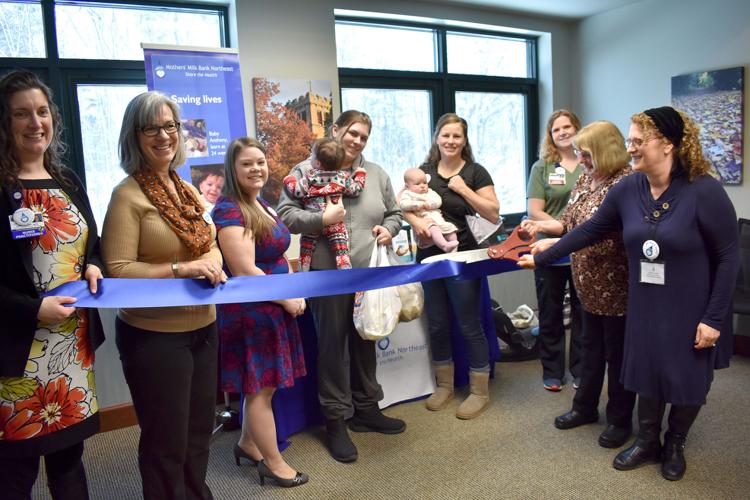
BELMONT — Since December, LRGHealthcare and Mother’s Milk Bank Northeast have partnered to operate a dispensary in the Lakes Region for mothers in critical need of donated breast milk for their babies. On Wednesday, the two nonprofit organizations announced that they have added the capacity for mothers to drop off donated milk as well.
The dispensary and drop-off depot, known as the LRGHealhtcare Mothers’ Milk Center, is located within Caring for Kids, a pediatrics practice on Corporate Drive in Belmont.
Mothers’ Milk Bank Northeast operates throughout the Northeast, primarily within hospitals, where the milk is used to feed babies born prematurely or those who are in the neo-natal intensive care unit. The Mothers’ Milk Center is unique for the Milk Bank, since it represents the first outpatient dispensary, designed specifically to help mothers who need a little extra milk for their babies.
“We’ve had really positive feedback. We’ve been able to help a lot of moms,” said Christine Farrell, office manager at Caring for Kids.
In the few months since it opened, the Mothers’ Milk Center has helped about 50 families, some of whom have returned several times. Those families have mostly come from the Lakes Region, although some have come from as far away as Lebanon to pick up milk.
The mother or baby need not be a patient of LRGHealthcare to access donated milk. A prescription is required, and Caring for Kids would coordinate with the appropriate provider to acquire a prescription.
There are many reasons a mother might need donated milk, said Susan Coulter, medical director for Caring for Kids. The mother of a newborn might be building her supply slower than the baby’s appetite demands, or the baby might not have figured out how to latch on yet. The milk that the dispensary provides typically serves as “bridge milk,” she said, until a mother can provide enough for her baby.
That “bridge” might keep a mother breastfeeding longer instead of turning to formula. That’s important, Coulter said, because once a mother begins using formula, she is unlikely to go back to breastfeeding.
While many healthy babies have been raised on formula, there are distinct advantages associated with breastfeeding, both for the baby and the mother. Coulter said the recommendation is for mothers to breastfeed their baby until he or she is six months old. Eighty-five percent of mothers attempt to breastfeed their newborns, she continued, but only 25 percent are still breastfeeding at the six-month mark. The availability of some extra milk might help improve that rate.
“This is a significant, significant public health issue as well as a personal one,” Coulter said.
The Mothers’ Milk Center joins an array of other services that Caring for Kids offers new mothers. Betty Quinlan, a nurse and lactation expert, offers one-on-one consultations and organizes breastfeeding support groups.
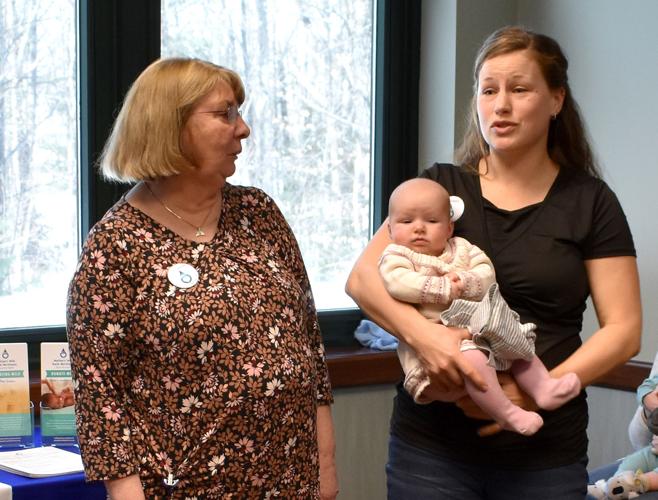
It was through the support group that Emily Dickson of Laconia decided to become a milk donor. She hadn’t experienced a problem breastfeeding her daughter, Briar, now three months old, but she learned that other mothers aren’t always as lucky.
“There are so many moms that seem to have a difficult time with their supply, I thought, if there was something that I could do to help them, I would,” Dickson said.
Sarah D’Agostino, of Belmont, had her son, Leo, six months ago, and found that she had lots of milk stored that she wouldn’t need, so she brought two shopping bags full of frozen milk to Caring for Kids on Wednesday.
“I wanted to be able to help,” D’Agostino said. “It makes me feel really good to be able to help people. I’ve had a lot of people help me over my life, so I’m glad to give back when I can.”
Mothers who donate milk should expect a screening process similar to that preceding a blood donation. There will be a 10-minute phone interview, a consent and medical history form, and a blood draw. Because of the way the donated milk is processed, Milk Bank Northeast asks for a minimum donation of 150 ounces.
While the Milk Bank will make milk available to mothers who need it through dispensaries such as the Mothers’ Milk Center, Cohen said most of the donated milk will be used to feed babies in neonatal intensive care, where the milk could be crucial to the baby’s survival.
“The mission of the milk bank is saving babies’ lives,” Cohen said.


(0) comments
Welcome to the discussion.
Log In
Keep it Clean. Please avoid obscene, vulgar, lewd, racist or sexually-oriented language.
PLEASE TURN OFF YOUR CAPS LOCK.
Don't Threaten. Threats of harming another person will not be tolerated.
Be Truthful. Don't knowingly lie about anyone or anything.
Be Nice. No racism, sexism or any sort of -ism that is degrading to another person.
Be Proactive. Use the 'Report' link on each comment to let us know of abusive posts.
Share with Us. We'd love to hear eyewitness accounts, the history behind an article.