


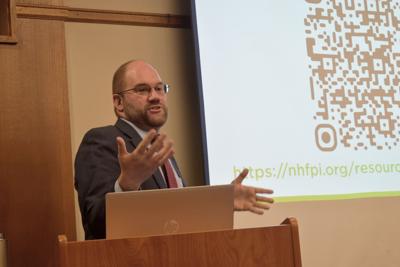
LACONIA — The New Hampshire Fiscal Policy Institute's statewide budget forum tour stopped in the Lakes Region last month, to delve into the inner workings of the state budget.
A group of about 40 residents took part in an engaging discussion May 20, at the Laconia Public Library.
This was the seventh of NHFPI's forum. Research Director Phil Sletten said staff brought discussions to all 10 counties in the Granite State. The nonpartisan group doesn’t receive government funding or have registered lobbyists on staff. Sletten said nearly 5,500 people heard from NHFPI about how the state budget works last year, and more than 744,000 people watched videos posted online. Sletten expected that number to be higher this year.
The basics
Sletten walked through the basics of the state budget, first asking the audience what they knew. There were an array of answers, ranging from knowing it's a two-year budget, to the fact business profit tax has been reduced over the last decade, to the federal government taking more tax dollars than they give back. It was noted New Hampshire does not have an income tax.
Sletten broke down the biennial operating budget, explaining it funds most state operations for two fiscal years. The newest budget provides funding for fiscal years 2026 and 2027, from projected revenue spanning July 1, 2025, to June 30, 2027. The current state budget appropriated about $15.9 billion.
The budget is made up of two pieces of legislation: House Bill 1, or the operating budget, and House Bill 2, which is often called the Trailer Bill. The operating budget holds the line item appropriations for each state program. The Trailer Bill is a companion containing policy changes and separate appropriations.
The budget is created in five phases, starting on Aug. 1, when the governor’s office provides spending targets. On Oct. 1, agencies submit budget requests, with a Feb. 15 deadline for the governor to submit the budget to the Legislature. The final day for a House vote is April 10, followed by a June 5 deadline for the Senate vote. The budget takes effect July 1.
The capital budget is in HB 25, covering six years with a chance for changes every two years. Money can be borrowed to balance and fund expenditures, which differs from the operating budget. It also allocates funds for projects and debt service.
There is a 10-year transportation improvement plan which identifies projects, timelines, and costs. It is normally altered in even numbered years through the Legislature.
Expenditures
Sletten said of the six areas appropriated in the state budget, health and social services makes up $7.08 billion, or 44%, and education makes up 22%, or $3.54 billion.
“So, those two together are two-thirds of the state budget expenditures.”
Those are followed by justice and public protection at 12%, transportation at 10%, resource protection and development at 6%, and general government, also at 6%.
The state Department of Health and Human Services budget includes public health and food safety services; elderly services; mental health and substance misuse services; food assistance; services for people with disabilities; early childcare and education services, child protective services; housing security; and low income healthcare access.
Sletten said many services are supported by Medicaid, and 173,134 residents had access to Medicaid at the end of January, or 12.2% of the state population. The program had a $2.8 billion expenditure in fiscal year 2025, and was 58% federally funded. The brunt of those enrolled in Medicaid are children in low-income households at 47%, followed by adults with low incomes.
“Medicaid is the single largest program the state operates in dollar terms,” Sletten said. “It is a state-federal fiscal partnership, meaning the federal government pays for part of it, and the state government pays for part of it.”
He said federal aid to NH may be reduced by $2.3 billion over the next nine years, due to federal changes to Medicaid.
Funding for the state Department of Education includes $1.08 billion in adequate education aid. There is block grant funding for the state’s university system totaling $87 million, and $68.5 for the community college system. Sletten said the state Lottery and Gaming Commission, as well as Police Standards and Training Council budgets, are included in this category.
Key aspects of the education budget include $14.8 million in school building aid, $5.2 million in infrastructure, $49.9 million in targeted special education aid for high-cost student needs, $9 million for tuition and transportation aid, and Education Freedom Accounts, or vouchers. For the voucher program, $39.3 million is budgeted, with $51.6 million in expenditures.
“Education Freedom Accounts is a newer program, and eligibility has been expanded successively over the last five years of its existence,” Sletten said. “That eligibility expansion has been more difficult for the Legislature to project as to what the cost is going to be.”
Other expenditures include bills not accounted for in the budget that can appropriate funds. State agency spending requests can be granted by the Joint Legislative Fiscal Committee, and some operations have external funding sources. One example was funding for Medicaid Expansion, or the Granite Advantage Program, under the Patient Protection and Affordable Care Act, which is not included in the state budget, but a previously passed HB 2 allowed it to be reauthorized.
Revenue
Not all government revenue comes from taxes, as non-tax revenue makes up $5.1 billion, or 62%, of the budget. Other revenue comes through fees, charges, and programs selling products, like liquor and lottery. Federal programs, grants, and aid are key revenue sources, and also provide funding for local government initiatives and other organizations.
The largest non-tax revenue source is federal grants, amounting to $3.5 billion, followed by $715.2 million in Liquor Commission sales, and $604.4 million in Lottery Commission revenue. Tolls amount to $140.3 million, and unemployment compensation operating revenue is $39 million.
Sletten said federal funds make up $5.26 billion, or 33.1%, of the state budget for FY 2026 and 2027. The general fund makes up 24.3%, and the Education Trust Fund is 16.4%.
“The general fund is the most flexible pot of money,” Sletten said.
The largest source of federal funding is Medicaid, and also includes federal transportation and education aid; water pollution and infrastructure funds; the Supplemental Nutrition Assistance Program, or SNAP; Women, Infants and Children Nutrition Program, or WIC; Temporary Assistance for Needy Families, or TANF; the State Fuel Assistance Program; and some veteran services.
The largest tax revenue source by far is Business Profits Tax at $834.2 million, followed by $481.9 million in Meals and Rentals Tax, and $364.4 million in Statewide Education Property Tax, or SWEPT.
In addition to BPT, which is traditional state corporate income tax, a large revenue source is the Business Enterprise Tax, which is unique among state business taxes and based on compensation, interest paid, dividends paid and adjustments.
Sletten said for BPT there was an 8.5% reduction from 2001 to 2015, and then 7.5% in 2023 alone. For BET, the rate fell 0.75% from 2001 to 2015, and 0.55% in 2022. The base in 2023 for BPT was likely about $10.1 billion, compared to $45.9 billion for BET the same year. They both support 61% of the general fund, and 39% of the Education Trust Fund.
Sletten said state corporate tax revenues have increased across the country — not just in NH — so it is unlikely it's due to state policies. Meanwhile, tax rate reductions, since 2015, have resulted in an estimated $800 million to $1.2 billion in foregone revenue.
He said large filers are key to BPT revenues; 98 filers contributed $313.1 million, and 936 filers contributed $263.9 million. Corporations and proprietors make up nearly three-quarters of the total number of filers. More than half the revenue comes from complex, combined-reporting filers, who make up just 7% of the total.
SWEPT
A hot-button issue, SWEPT was established in 1999, to support the Education Trust Fund for Adequate Education Grants, on a per pupil basis. This was in response to a lawsuit, requiring the state to pay more toward public education. It was originally set at $6.60 per $1,000 of property value.
Sletten said SWEPT raised an estimated $363 million in 2025, but that doesn’t adjust for inflation. The state requires local governments to raise revenue to offset the money it has to find from other sources. It is retained locally, rather than going to the state, as it did before 2011.
He used an example of a student special education needs. To serve the student, funding from the state to the school district is reduced by money raised through SWEPT.
“It is truly a state tax, but it does not move money between communities,” Sletten said. “It stays within the local community.”
Sletten said an exception is for communities with fewer students, or high property value, or a combination, and the state’s applied rate could raise more than needed in the education funding formula. There are very few in this boat, he said. He stressed there are no longer donor towns and receiver towns, and haven’t been for 15 years.
Sletten said local property taxes make up 59% of state and local tax revenues. It was noted that 98% of local tax revenue in fiscal year 2022 was made up of property taxes, compared to only 12% of state tax revenue.
For a complete rundown of the state budget presentation, and information about upcoming dates in Newport and Gorham, visit nhfpi.org/tour.


(0) comments
Welcome to the discussion.
Log In
Keep it Clean. Please avoid obscene, vulgar, lewd, racist or sexually-oriented language.
PLEASE TURN OFF YOUR CAPS LOCK.
Don't Threaten. Threats of harming another person will not be tolerated.
Be Truthful. Don't knowingly lie about anyone or anything.
Be Nice. No racism, sexism or any sort of -ism that is degrading to another person.
Be Proactive. Use the 'Report' link on each comment to let us know of abusive posts.
Share with Us. We'd love to hear eyewitness accounts, the history behind an article.