


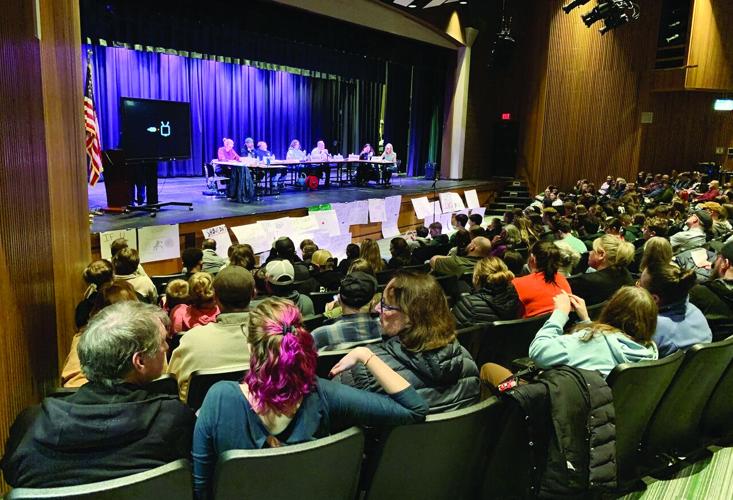
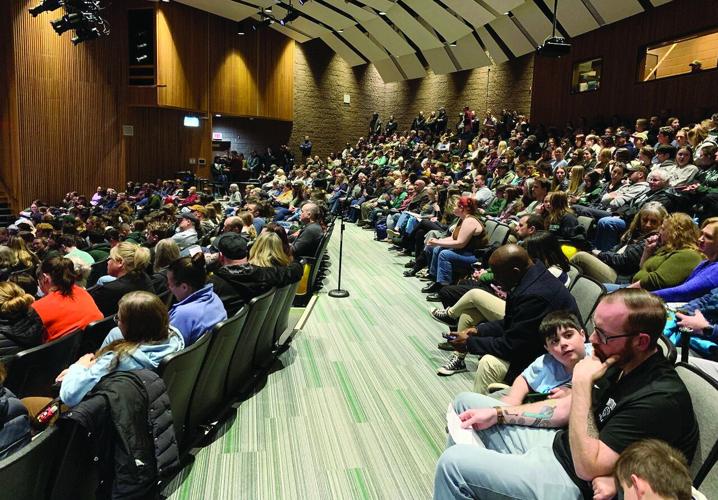
BRISTOL — An overflow crowd filled the auditorium at Newfound Regional High School on March 16, as residents urged the school board to preserve extracurricular activities under a default budget. During the March 10 election, voters turned down the proposed budget, 890-857. Although Bristol and New Hampton supported the budget, Alexandria and Danbury voted against it.
Because the budget had been amended at the deliberative session to increase it beyond the district tax cap, passage would have required a two-thirds majority vote. By those measures, every town failed to pass the proposed budget, leading to adopting the default budget.
Danbury paid the price. In order to preserve programs that otherwise would have been cut to meet the default spending limit, the Newfound Area School Board voted to close Danbury Elementary School.
Danbury’s representative to the school board, Melissa Suckling, has been an advocate for keeping the local school open, but admitted closure was the best solution, and blamed voters in her town for being largely responsible.
“Danbury single-handedly voted the budget down last year, and they made a point by voting the budget down this year,” she said. “They voted the budget down two years in a row. Unfortunately, based on the Danbury taxpayers, I can’t really — don’t have a lot to stand on.”
Danbury Elementary was already slated to close in a few years, as part of an anticipated consolidation that also would close Bristol Elementary School and New Hampton Community School. Consultants are studying consolidating classes by making Newfound Memorial Middle School a K-6 facility, and Newfound Regional High School into a 7-12 school.
With declining student enrollment and aging facilities costly to maintain, former school board member Francine Wendelboe, of New Hampton, has been advocating for consolidation for years.
“Closing Danbury, effective September ’26, was recently rejected by the board when I proposed it to balance the budget,” she said. “The board and budget committee said they could not close the school overnight. Seven months is one long overnight. They instead moved forward with potential cuts of all sports and extracurricular, in hopes funds would be added back in at the deliberative session, which is attended by a couple of hundred people, mostly employees and teachers. They added over $1 million, but the voters rejected that on voting day, for the default budget. So now, here we are.”
In a public comment period that extended 2.5 hours, speaker after speaker, including several students, emphasized the critical role of extracurricular programs in student development, academic motivation, and community engagement.
Charlene Joyce, of New Hampton, said, “I represent a very tiny section of New Hampton called Church Lane. Church Lane is occupied by three little old ladies, and I’m one of them, and we may be older, but we’re not stupid. We believe that arts, sports, and AP courses are vital to the growth of this community, absolutely vital. I am feeling like I need to be the moderate voice, because there are two factions we have: the parents that only want the best for their kids [and] people that are on fixed incomes that can’t really afford much more of a tax burden. But I would encourage everybody to realize that the tax burden really doesn’t land so much with the taxpayers. It lands in Concord, right? So I would encourage you to keep arts and the sports.
“You can see these kids in the front rows. Good for you, good for you, for fighting for what they believe in. I’m in favor of supporting these programs, because otherwise, for those of us that are homeowners, it’s false economy. If I were to decide to sell my house tomorrow, I’d have a difficult time doing that, because who’s going to want to buy into a town where there’s a crappy school system?”
Online comments before the meeting were critical of taxpayers who voted against the budget, but most who attended Monday night recognized the financial difficulties some are facing. The only speaker to denigrate taxpayers was an Alexandria resident who said, “I guarantee not many people that voted that budget down are here tonight, because they don’t care. All they care about is what’s here in their pocket. They don’t care about your education. They don’t care about your extracurriculars. It’s just a proven fact.”
Julie Doucette, a 16-year-old 11th grader from New Hampton, said, “These programs are not just extras. These are essential to the growth, development, and happiness of young people in this high school and in the middle school.
"When students participate in sports, music, art, debate, in any extracurricular activity in general, they learn lessons that go far beyond the classroom. They learn teamwork, discipline, leadership, and resilience. They make friends, build confidence, and find passions that can last a lifetime and beyond.”
Brian Gallagher, of Bristol, who was the district’s first business administrator, offered suggestions to help solve budget constraints.
“You have five members on the school budget committee who could work with your business manager,” he said. “Spend one day, go through the entire budget, line by line by line, and examine those areas where this group of people feels as though there’s a little extra that could be set aside, and those kinds of monies can be used to support the programs. It’s clear by the turnout tonight here, and I’m going to predict that the board is going to fund it.”
Referring to the 2023 cyber attack that took down the district’s finance system, Gallagher said, “The only other thing I would like to ask the board, as a courtesy, is we as taxpayers are looking for accountability for funds, and unfortunately, you haven’t been able to produce a financial audit over the last few years. And I recognize there’s reasons, [but] it’s imperative for the value to the taxpayers to know that the funds are clearly accounted for, and that gives the taxpayers the confidence to support the programs that are necessary for these young people. So I’d ask you to make sure the audit gets done.”
After the close of public comments, Suckling addressed Gallagher’s suggestion, declaring, “There will not be ever, ever in our district, be a 2023 audit, unless somebody wants to pay a lot of money to rebuild the entire financial thing. Our insurance company was not going to pay it.”
For the first time, she revealed, “We knew this back in 2023, after the cyber attack. We knew back in December of 2023, January 2024, that that was going to be the case.”
The state Department of Revenue Administration has warned the district that Newfound’s 2024 audit, which was due last June, has to be submitted within 30 days to avoid heavy fines. A 2022 provision in state law allows the DRA commissioner to levy fines as high as $250 a day for failing to comply with the submission of required audits.
“This notice is not meant to begin the process of levying this fine,” the DRA wrote. It is “to remind you of your duties under RSA 21-J:19, and provide further notification that a fine may result from continued non-compliance within 30 days of receipt of this letter.”
Suckling said the 2024 financials are with the auditors now, and should be done soon.
“Once the 2024 audit is complete, the 2025 information will be sent over, and the auditors will work on the 2025 audit,” she said.
Superintendent Paul Hoiriis talked about other options besides cocurricular activities that could close the budget gap. The first involves cutting programs and positions, including discontinuing French classes at the high school where a current teacher is retiring; eliminating an elementary school information and communications technology position; not filling vacant special education case manager positions at the middle and high school; eliminating the summer competency recovery program at the middle school; providing no raises for administrators and program specialists; and making the Danbury Elementary School principal a teaching principal to reduce staffs. Also on the list was eliminating all field trips and library book purchases.
Closing Danbury Elementary, on the other hand, would preserve all those programs. Hoiriis estimated it would save $881,000 by eliminating the need for a principal, an administrative assistant, a custodian, a cook, three classroom teachers, a nurse, and a paraeducator. Three teachers would be reassigned to cover kindergarten and fifth grade for the 79 students affected. There might also be savings in transportation, because Danbury currently uses three buses, and they might not need as many to take students to Bristol or New Hampton.
The third option was to use a provision in the Official Ballot Act that allows a district to hold a special meeting to address the budget. Hoiriis said there might be problems with timing, and a risk of voters objecting simply because they had already spoken.
“This could go out 28 to 60 more days,” Hoiriis said, “getting court approval for a special meeting, then having a hearing before the special meeting.
"I’m not advocating as much as informing. One of the concerns was, … can you close the school in seven months, six months, three months, and at that point, if the special meeting fails, would we be trying to make this decision again?”
After the vote to close Danbury, those in the audience cheered to have extracurricular activities funded.
Brian Richardson, of Alexandria, said, “This was not an easy decision for you to make.
"It’s going to be hard for a lot of people but ... it was inevitable that this decision was going to have to be made, whether it was today, or next year.”
Editor's note: This story has been updated to clarify the budget needed a two-thirds majority to pass.


(0) comments
Welcome to the discussion.
Log In
Keep it Clean. Please avoid obscene, vulgar, lewd, racist or sexually-oriented language.
PLEASE TURN OFF YOUR CAPS LOCK.
Don't Threaten. Threats of harming another person will not be tolerated.
Be Truthful. Don't knowingly lie about anyone or anything.
Be Nice. No racism, sexism or any sort of -ism that is degrading to another person.
Be Proactive. Use the 'Report' link on each comment to let us know of abusive posts.
Share with Us. We'd love to hear eyewitness accounts, the history behind an article.