


MEREDITH — Earlier this month, the Belknap County Conservation District was awarded over $53,000 from New Hampshire’s Moose Plate grant program. A portion of the funds, $25,790, will be used for a stream restoration project. The other grant was used to help purchase agricultural equipment to be shared by Belknap County farmers.
“We've been doing these projects for several years,” said Belknap County Conservation District program coordinator Lisa Morin, “we've done two in Gilford, in Sanbornton, Meredith.”
The ultimate goal of the restoration is to reduce sediment build up and nutrient loading in local streams. It will also improve the habitat for eastern brook trout and other aquatic species in the area.
“The type of restoration we are doing is in-stream large wood,” said Morin. “We're partnering with Trout Unlimited, and so the funding from the moose plate was to identify and implement stream restoration projects in Meredith with partners and installing logs in streams to reduce sediment and nutrient loading.”
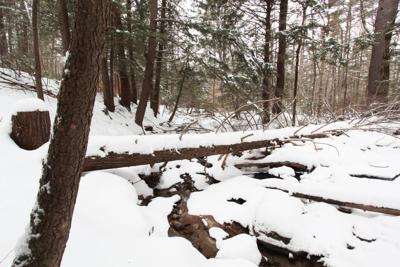
The placement of large wood is an effort to mimic a natural phenomenon in forests. When trees die of old age, they sometimes fall into small streams. As this process repeats itself along a stream, the logs create small pools in which brook trout and other aquatic organisms thrive. The trees can also help act as filters, reducing the amount of nutrients that trickle into bodies of water like Lake Winnipesaukee, and helping to curb the chances of events like algae blooms. The practice can also help slow down water flow during rains, thus increasing flood resilience.
While this process is natural, it occurs far less frequently than in the past due to human interference.
“In the 1850s there was a lot of clear cutting,” Morin explained. “It kind of cut out the succession of the forest, now 100 years later we don't have older trees dying and falling into the streams as they naturally would.”
The human-involved process is quite similar to the natural one, albeit with a few twists. Workers first assess the streams and decide where to place logs based on a variety of factors. According to New Hampshire Fish and Game, 100 feet of stream requires about four pieces of large wood.
Once the locations have been agreed upon, forestry workers select trees, mostly younger, greener ones, and cut them down in a location that will provide the least amount of negative ecological impact. The trunks are then dragged to the stream, and kept in place using rocks, other logs, river banks, and other natural features.
The goal is that the logs do not shift position for years to come, even in the spring when snowmelt sends the streams surging.
“It's providing shelter for the small trout underneath the logs, deeper pools so that if you have those times of drought in August, you might have a pocket of cool water that the fish can access and hide from predators. It's also taking sediment out of the water column, it's cleaner water so it's better,” said Belknap Conservation District Executive Director Donna Hepp. “Pound for pound, it's one of the most cost effective way to protect water quality.”


(0) comments
Welcome to the discussion.
Log In
Keep it Clean. Please avoid obscene, vulgar, lewd, racist or sexually-oriented language.
PLEASE TURN OFF YOUR CAPS LOCK.
Don't Threaten. Threats of harming another person will not be tolerated.
Be Truthful. Don't knowingly lie about anyone or anything.
Be Nice. No racism, sexism or any sort of -ism that is degrading to another person.
Be Proactive. Use the 'Report' link on each comment to let us know of abusive posts.
Share with Us. We'd love to hear eyewitness accounts, the history behind an article.