


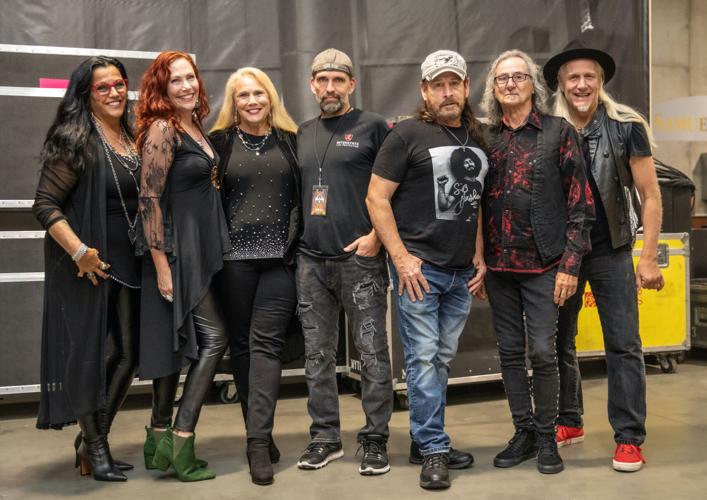
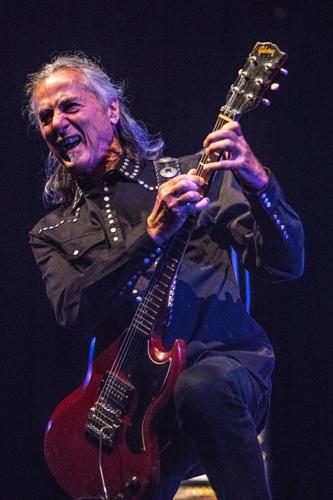

LACONIA — Legendary guitarist Barry Goudreau has sold millions of albums as a founder of the iconic rock band Boston, and next month he will be heading to the Lakeport Opera House with Barry Goudreau’s Engine Room for an intimate show full of classics.
“We will be playing a lot of the Boston hits, and we do all of the first record,” Goudreau said in an interview, noting it's been 50 years since the self-titled debut album was released. “We’ll play some from the second record, and some original songs, and we’ll throw in a few classic rock covers. Nobody will leave disappointed.”
Goudreau’s musical journey dates back to when he was a child in the 1960s. He picked up the guitar when he was 11 years old, and started his own band by the time he was a teenager, playing in Boston’s infamous “Combat Zone.”
“It was the adult entertainment area, and we’d play a night club there seven nights a week, and would get home at 2:30 a.m., and go to high school the next day,” Goudreau said. “Looking back on it, I can’t believe my parents were lenient enough to let me do that. Things were different then.”
While attending Boston University, Goudreau linked up with a friend and former bandmate who was getting his education at the nearby Massachusetts Institute of Technology. Even though they really wanted to concentrate on their schooling, their love of music could not be ignored, and they put a band together in the basement of a fraternity. That band would be Boston, which turned out to be one of the most notable bands of the 1970s.
Their first recording was in a studio called Natural Sound in Hudson, Massachusetts, where they recorded a song that ultimately became “Hitch a Ride” on their first album. Goudreau said the recording was impressive, although expensive, especially for a group of college kids without a lot of cash.
After all, as Brad Delp sang in their hit song “Rock & Roll Band,” they “were just another band out of Boston, on the road and tryin’ to make ends meet.”
The music scene in the city was thriving in the ‘60s and ‘70s, with J. Geils Band already showing success, and Aerosmith blowing up, as well.
“The city had a very active scene, and one that was called the Bosstown Sound,” Goudreau. “I’m not sure exactly what that meant, but we weren’t really part of it.”
Bandmate Tom Scholz had the idea of making a recording studio in his basement, which Goudreau said was huge for the trajectory of the band.
“A basement studio was unheard of at the time,” Scholz said. “Groundbreaking. It was years of making demo tapes until we got signed in 1975, by Epic Records, and our record came out in 1976.”
Boston sent demo tapes to all kinds of major labels, only to be consistently turned down. Even Epic Records initially declined, but Goudreau said they later understood the folly of their ways.
“The rejection letter was framed and put in an office there, because, well, everyone makes mistakes.”
The self-titled seminal album was an explosive success, and while Goudreau knew they had put out incredible material, it was still unexpected. When signed, they needed to make sure they sold 200,000 records to continue their musical career. That was minuscule compared to the success it had right off the bat, selling a million copies in the first month alone. It has since sold 17 million copies worldwide, something he knows is rare and impressive, especially for a debut album.
“We were off and running big time,” Goudreau said. “We couldn’t believe it. But then the pressure was on to have a live performing band, and we hadn’t really done that in years. We were peddling as fast as we could to keep up, to get the personnel and equipment in place.”
In the fall of 1976, Boston embarked on their first national tour, opening up for rock juggernauts Black Sabbath.
“At the time, it seemed like an odd pairing, but it really worked out well,” Goudreau said. “At that point, their career was waning a bit, and we were coming up, and they appreciated that. We sold a lot of tickets.”
Their meteoric rise put them in the headline spot the following year, touring all the way through 1977 and 1978, becoming one of the hottest acts around.
“We had gone from opening up for bands like Foghat and Blue Oyster Cult, and in a matter of months they were opening for us,” Goudreau said. “By the time we got to the end of 1977, we had gone from arenas to stadiums.”
With the huge tours, and the massive success of their first record, suddenly the label was looking for a follow up. In 1979, Boston released “Don’t Look Back,” which has also sold millions of albums to date.
“You don’t see many acts selling that kind of volume these days,” Goudreau said. “We did a tour all over the country and Japan, and then at the end of ’79, we toured Europe. We made it all around the world.”
Goudreau said he always takes the same approach when hitting the stage, whether it's playing in front of the sold out Superdome crowd of more than 80,000 people, or an afternoon show in Japan, where most of the audience wore school uniforms, and there would be a light applause rather than the cheering and jumping around in the U.S.
“I remember walking at the Superdome, walking up the stairway to the stage, and it was about three stories,” Goudreau said. “We’re in platform shoes, and hoping we don’t fall and hurt ourselves. Some of those really giant shows are some of the more memorable ones.”
Goudreau cut ties with the band after the second album, then formed a new group in the 1980s called Orion the Hunter, who opened for Aerosmith on the Back in the Saddle tour. Orion the Hunter had commercial success with songs on the radio as well as videos on MTV, which was brand new at that point.
In the 1990s, he started a band called RTZ, with “the late great Brad Delp,” former Boston bandmate and brother-in-law, and brought in keyboardist Brian Maes, bass player Tim Archibald and drummer Dave Stefanelli. They toured extensively in the ‘90s, and released an album called "Return to Zero."
His current project, Engine Room, also includes Maes and Archibald, comfortable onstage in any setting. Tony Depietro is on drums, and they have three background singers Goudreau calls “the special sauce”: Maes’ wife MaryBeth Maes, Joanie Cicatelle, and Teri Osoro.
“We’ve been together so long, that it just comes naturally,” Goudreau said.
Goudreau knows the Opera House audience will be looking for the hits, especially on the occasion of the 50th anniversary of the debut album. Some songs on that album are anthemic, with hits from top to bottom, like the massively successful single “More than a Feeling,” to go with “Peace of Mind,” and Foreplay/Long Time” on side one. “More than a Feeling" peaked at No. 4 on the Billboard Hot 100 list, with the latter two also in the top 50.
In this case, the B side was no slouch. “Rock & Roll Band” and “Smokin” were extremely popular, and side two was rounded out by beloved songs like “Hitch a Ride,” “Something About You” and “Let Me Take You Home Tonight.”
The band just did a show at the M3 festival in Maryland, in front of thousands of people, but Goudreau said it will be fun to get into a theater in front of a few hundred fans. He had no problem revealing they’ll be playing an encore with the song he is most known for: “Foreplay/Longtime.”
“That always seems to go over really well,” Goudreau said. “For me, I really enjoy being onstage in front of people, and everyone being so enthusiastic. The only work is getting there and setting up, the payback is being up on that stage, and connecting with the crowd.”
Barry Goudreau’s Engine Room will be at the Lakeport Opera House at 7:30 p.m. on Saturday, June 6. For details, visit lakeportopera.com.


(0) comments
Welcome to the discussion.
Log In
Keep it Clean. Please avoid obscene, vulgar, lewd, racist or sexually-oriented language.
PLEASE TURN OFF YOUR CAPS LOCK.
Don't Threaten. Threats of harming another person will not be tolerated.
Be Truthful. Don't knowingly lie about anyone or anything.
Be Nice. No racism, sexism or any sort of -ism that is degrading to another person.
Be Proactive. Use the 'Report' link on each comment to let us know of abusive posts.
Share with Us. We'd love to hear eyewitness accounts, the history behind an article.