



MEREDITH — The business of conservation is a race against time, preserving spaces in their natural state before the real estate market decides the land could be put to a more profitable use. In the case of a parcel abutting the Page Town Pond Forest, this town’s Conservation Commission would have lost that race if not for an assist from the land owners.
The owners of the property, a family who no longer lives in Meredith, reached out to the town after receiving an offer from a developer. Torn, the owners would rather see the land left alone, but couldn’t ignore the prospect of financial gain.
Their invitation was only good for a seat at the table. If the Meredith Conservation Commission were to succeed in protecting the land in perpetuity, they’d need to come up with cash, about $350,000, before the seller ran out of patience.
The property in question is a 38-acre parcel that abuts the 763 acres already preserved as part of the Page Pond Town Forest, accessed via trailheads on Barnard Ridge Road and at the end of Quarry Road. The lot’s acquisition would allow for a third trailhead, as it offers frontage on Meredith Neck Road, but its the land on Page Brook that provides the most meaningful benefits.
The 38-acre lot is steep and slopes toward the large wetland that contains and filters water as Page Brook makes its way to a culvert at Meredith Neck and, in its never-ceasing march, onward to Fish Cove and the rest of Lake Winnipesaukee. Preserving the land ensures it will both continue to serve as a habitat for wildlife and will guarantee the water that flows across those slopes and joins Page Brook will be of the highest quality possible. Of the 38 acres in the lot proposed for protection, 15 are considered wetlands.
In this sense, said Scott Powell, chair of the town’s Conservation Commission, the benefits of its conservation would extend like ripples across the rest of Winnipesaukee.
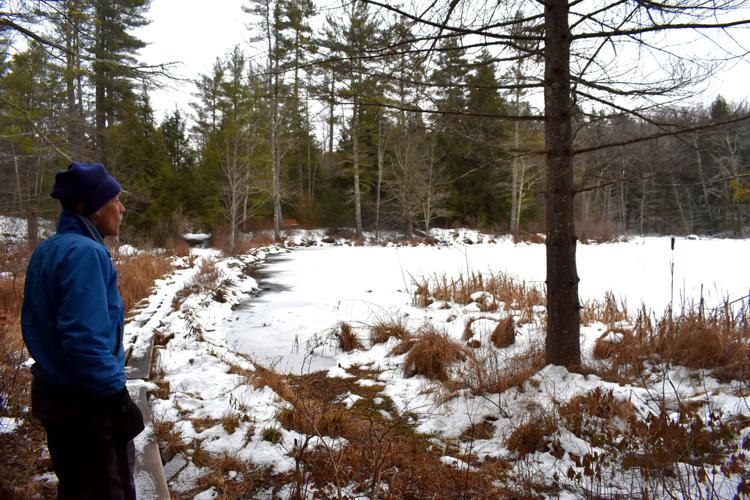
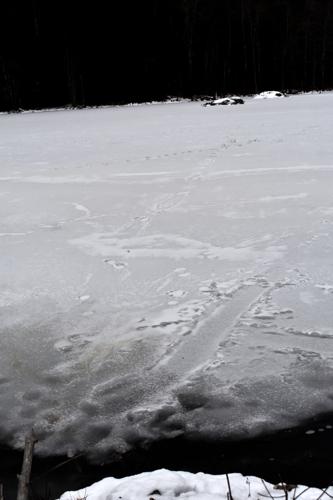
During a hike through Page Pond Forest on a wintry day — when deer tracks were seen criss-crossing footpaths, and markings on the icy surface of a marsh showed where otters had been playing — Powell said the wetlands “filter pollutants and restore the underground aquifers,” noting they benefit all humans who depend on wells or who enjoy a healthy Lakes Region environment.
“Meredith, as a town, has nothing if we don’t have our lakes,” Powell said.
So far, the proposal has enjoyed support, including a unanimous endorsement from the selectboard, and approval at the 2024 Town Meeting for use of Conservation Commission funds toward the effort. Should it succeed, the land would be owned by the Town of Meredith, stewarded by the Conservation Commission and the conservation easement would be held by the Lake Region Conservation Trust.
At least part of that support could be credited to visitation the Town Forest sees from residents, who utilize the 10 miles of trails for walking, running, wildlife watching and cross-country skiing.
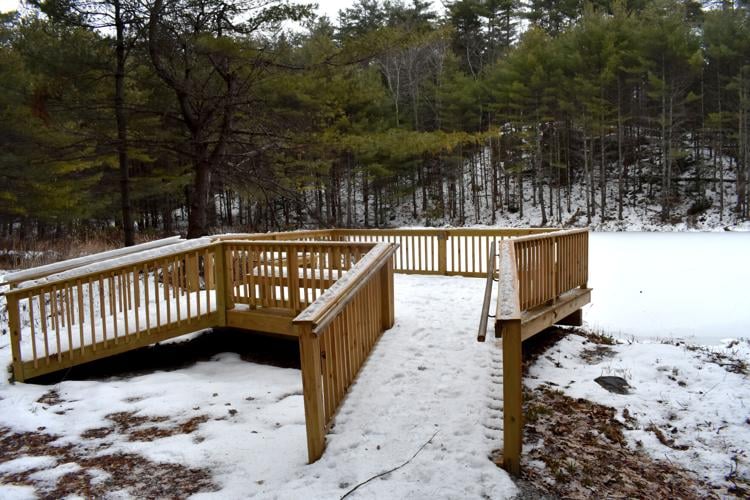
“It gets a lot of use,” Powell said of the Page Pond property, which recently benefitted from an “all-persons road” project that endeavored to put in a wide path welcoming to people who might not be able to traverse a typical hiking trail. Thanks to efforts by the local Rotary Club, that trail leads to an accessible viewing platform overlooking a small pond.
It’s helpful to have so many fans of the property, especially considering the rising cost of conservation. As the calendar has turned, the price of ecological protection has only increased. Conserving this property would cost $347,800, with $320,000 for the cost of the land and appraisal, fees and management planning adding up to the total.
That translates to about $9,200 per acre, Powell said. Compare that to the expansion of Page Pond in 2017, when 198 acres were added. That expansion cost $1.1 million, or $5,500 per acre.
As development continues, and undisturbed lots become scarcer, it’s reasonable to expect conservation will only become more expensive in the future — but, said Powell, the value of protecting these lands continues to exceed the cost.
“These riparian areas, between water and land, are the most diverse. All our shorefronts are turning into houses, and all the otter and mink are getting pushed away,” Powell said, adding when he walks through Page Pond Forest, he sees bear scat and moose scrapes, osprey nests and woodpecker holes.
“All these things that we’re going to keep there by not having houses butt up to it.”
The Conservation Commission’s plan to meet the cost of the project includes a $154,000 grant from the U.S. Forest Service and a $30,000 NH Moose Plate grant. About $90,000 will come from the commission’s budget, which is funded through fees assessed when property is taken out of current use. The balance of the cost, about $73,000, will come from private donations.
Powell said the deal will close sometime next year, regardless of whether or not the campaign for private donations meets its target; falling short would mean there would be less left in the conservation war chest, exceeding the target would give the commission a jump start on the next project.
Following a path that skirts a beaver dam, with the lodge visible poking through an iced-over pond, Powell said, “this is what it’s all about. The birds, the amphibians, the bobcats, the minks. And bringing people out here, so they can look at and touch a beaver dam, that’s really cool.”
For more information, visit meredithnh.org/conservation-commission or send an email to conservation@meredithnh.org.


(0) comments
Welcome to the discussion.
Log In
Keep it Clean. Please avoid obscene, vulgar, lewd, racist or sexually-oriented language.
PLEASE TURN OFF YOUR CAPS LOCK.
Don't Threaten. Threats of harming another person will not be tolerated.
Be Truthful. Don't knowingly lie about anyone or anything.
Be Nice. No racism, sexism or any sort of -ism that is degrading to another person.
Be Proactive. Use the 'Report' link on each comment to let us know of abusive posts.
Share with Us. We'd love to hear eyewitness accounts, the history behind an article.