


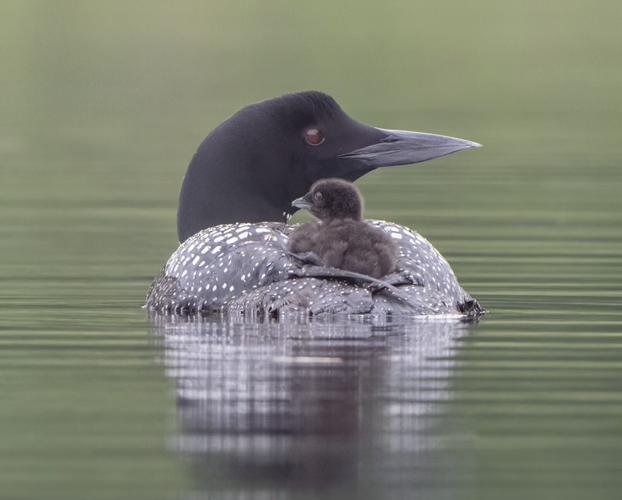
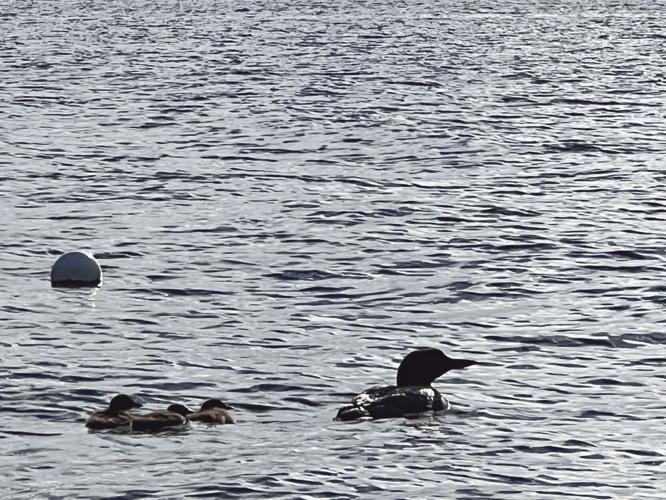
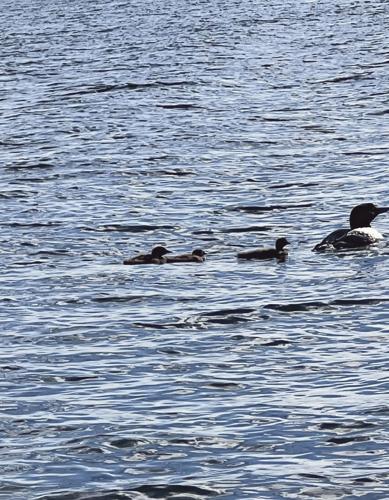
A loon pair was spotted with three chicks, a mile from 20 Mile Bay, in Tuftonboro. The common loon usually hatches no more than two chicks per season, so this phenomenon is not seen very often. Biologist and Outreach Coordinator Caroline Hughes of the Loon Preservation Committee said a loon pair that resides on the beach at 20 Mile Bay had two chicks, and now only has one. She suspects one of the chicks made its way over to the other pair.
“The first pair started out with two chicks and then suddenly only had one, and the second pair started out with two chicks and suddenly had three. And so as far as we can tell, what happened is that the second chick from that first pair broke off and made its way down to the other pair, and they started caring for it,” Hughes said. “That's something that has been documented before. It's rare, but it does happen.”
While loon parents often take proper care of their chicks, Hughes said chicks often pick on each other. A dominant chick can pick on, or attack, its subordinate chick to receive the most care from its parents. She claims this rivalry is natural, and the behavior has evolved to ensure there is enough food for at least one of the chicks to survive.
“It might peck or otherwise attack its sibling to make sure that it gets its fill before it will allow its sibling to eat. And sometimes that can be sufficient to cause the sibling to not survive,” Hughes said. “And in these rare cases, the sibling might realize that it's not going to make it with that particular pair, or might be excluded from the family and just kind of start wandering and find another family and graft itself on, and that's what has happened here.”
To put it in perspective, Hughes said the first chick to hatch has about an 89% chance of survival to the end of the season, but it's only a 57% chance for the second.
“Loons are a species that's known to really care for their chicks well, but not necessarily want other loon’s chicks around,” she said. “And so, the chick from the first family must have been in pretty dire straits in order to decide to make that gamble.”
This past Saturday, the Loon Preservation Committee observed the loon family with their new adopted chick, and the parents were feeding all three equally. The chicks were also not fighting. Hughes believes that so far, “it's going really well for this chick.” The committee will continue to observe the family through August, when the chicks would be old enough to fend for themselves.
Compared to other birds, loons in New Hampshire get a lot of attention. Even more so than the state bird, the purple finch. While their unique breeding plumage is special to the northern United States, they are common. Andrea LaMoreaux, president and policy advocate of NH Lakes, called loons iconic.
“Not all of our lakes have loons. So, the lakes that do have loons, the resident lake associations really take pride in that,” she said.
LaMoreaux also talked about the connotations loons bring to a body of water.
“People associate cleaner and healthier lakes with loons, which is not always necessarily true, but certainly, they do need relatively healthy water and healthy habitat to exist,” she said. “And they need enough area and enough fish in the lake.”
Photographer Mark Schocken, who lives in Tampa, Florida, but resides in campgrounds in Meredith for the summer, spends a lot of his time in the Granite State photographing loons. He claims to have between 20,000 and 30,000 photos of loons alone. He likes coming to New Hampshire to photograph the bird.
“We don't have loons in breeding plumage in Florida, they come for the winter, but they're very drab, and they're not the remarkable, beautiful bird that they are when you see them in the Northeast and other northern parts of the country,” he said.
Schocken describes the loon as a bird with a bright red eye and tuxedo-type plumage, gorgeous in contrast with the water around them. To Schocken, there’s a serenity, a calmness, to being out on the water in his inflatable kayak with his wife, photographing loons from a distance. But another remarkable thing about them is their call.
“It is the most eerie, haunting, beautiful call I personally have ever heard,” he said. “I think that is a major part of what makes them so super special to so many people.”
Schocken has photographed all kinds of animals, and also many birds of prey, owls and other water fowl, but nothing compares to photographing a loon.
The Loon Preservation Committee was founded in 1975 when people noticed the population was on the decline, with less than 100 loon pairs in the state. Last year, they documented 345 pairs. As the loon population continues to grow, Hughes has advice for those who would like to help preserve the growth.
“The big thing is just being careful when you're out on the water. Last year, unfortunately, we did have a loon chick die on Lake Winnipesaukee, down by Long Island after it was hit by a boat.”
Hughes talked about another significant threat to loons.
“The No. 1 threat to loons in the state is lead poisoning from ingested fishing tackle,” she said. “We always encourage people to clean out their tackle box, look through it, make sure that there's not any old lead in there and get rid of it if they do find any.”
The Loon Preservation Committee runs a lead tackle buyback program with several participating local retailers where people can bring old tackle and exchange it for a $10 voucher to one of those stores. Learn more at loon.org.
Hughes believes these actions are important to keep the loon populations safe in New Hampshire.
“The LTC was founded by concerned people, sort of under the principle that if human actions had contributed to that decline, then human actions could also help to reverse it and to bring our loon population back.”


(0) comments
Welcome to the discussion.
Log In
Keep it Clean. Please avoid obscene, vulgar, lewd, racist or sexually-oriented language.
PLEASE TURN OFF YOUR CAPS LOCK.
Don't Threaten. Threats of harming another person will not be tolerated.
Be Truthful. Don't knowingly lie about anyone or anything.
Be Nice. No racism, sexism or any sort of -ism that is degrading to another person.
Be Proactive. Use the 'Report' link on each comment to let us know of abusive posts.
Share with Us. We'd love to hear eyewitness accounts, the history behind an article.