


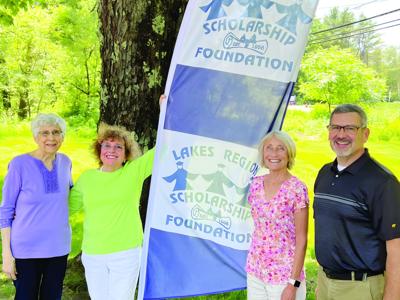
Joan Cormier was the first executive director for the Lakes Region Scholarship Foundation, and she worked — without technology — until she retired in 2018. She had a desk, a pen, and applications submitted on paper.
Computers, a website and social media are among the organization's new tools, but aside from those, not much has changed in the 70 years since its founding.
“If you plopped us back 70 years ago, we’d still look the same,” said Chris Guilmett, current leader for the LRSF. “We’re still the same foundation. Our mission is still the same.”
Even the leadership hasn’t changed much.
The foundation was launched in 1956, and Cormier volunteered as secretary from 1968 to 1985, when she became the first executive director, also unpaid. In 1999, she started bringing home a paycheck for her work.
Paulette Loughlin was the second executive director, coming on board the same year Cormier left, and only two others have served in the role since: Karen Switzer and Guilmett, who has been the leader for two years.
This year, Cormier, Loughlin, Switzer and Guilmett are celebrating the anniversary with pride, and the organization’s achievements with wonder. Since its inception, LRSF has awarded just shy of $12 million in scholarships to 6,800 students in the region, and the number of donors is now at 660.
To mark the occasion, the Lakes Region Scholarship Foundation Legacy Scholarship was created to honor the founders, and two awards were made this year for the first time.
Foundation history
The nonprofit organization was founded by a small group of civic leaders — those in clubs, businesses and individuals. They raised $2,650 and awarded 17 scholarships to students at Laconia-Gilford High School, which was one entity at the time, and Belmont High School.
The mission, then and now, is to promote opportunities for students of all ages in the Lakes Region to access higher education. Recipients are now chosen across the area.
“We can’t thank our donors enough, but it comes down to our trustees and our founders,” Guilmett said. “It’s because of them that we’re where we are today.”
By the numbers, and majors
In 2025, the foundation awarded $899,275 in scholarships to 391 recipients, and this year, 294 donors raised over $1 million, and 401 scholarships were awarded to local students: those in high school, college, and those returning to education.
“When I think back to those eight original donors, I can’t imagine if they could see what it has grown into — this legacy that the Lakes Region Scholarship Foundation has become,” Guilmett said. “We’re just growing by the number of applications, year after year.”
Of this year’s recipients, 146 received a scholarship over $3,000; 92 got $2,000-$2,999; and 139 recipients were awarded between $1,000 to $1,099.
Nearly half of applicants are attending New Hampshire schools, and 16.6% are enrolled in colleges and universities in Massachusetts; 6.9% in Maine; 4.6% in Vermont; 3.6% in Connecticut; 3.2% Rhode Island; and a fraction in 20 other states.
Guilmett said in the early years, recipients chose majors of study which matched the simplicity of the times: teaching, nursing and business, for instance.
During the COVID-19 pandemic, he said many applicants were studying psychology, and other recent focus areas include kinesiology, forensics, technology and medical pursuits.
“Time has changed the majors,” he said. “Now, there is a broader range of what students are studying.”
Awarding scholarships
Many of the foundation’s scholarship funds are set up by families to memorialize a loved one.
“Each memorial tells the story of a person who is no longer with us, but is still helping those they have left behind,” Guilmett said. “Other scholarship funds come from civic groups, individuals and area businesses, to invest in the youth of our local communities.”
“Sometimes families are looking to pay back where they have benefited from LRSF. ‘It’s our turn to give back to the community,’” he added.
Each fund has its own criteria. Students apply, and their applications are screened and sorted by the factors outlined by donors.
During donors week, funders see the applicants who meet their criteria, read student essays and look at each applicant’s history of community service.
Leading the way
The scholarship foundation has a board of trustees with 19 members — only six more officers than the original slate.
In February 1956, 13 people were appointed as temporary officers and directors. That fall, the temporary status was removed, and all 13 became trustees on the board.
“Donors are key, but it all really comes down to the foresight that these trustees have had over those 70 years, that have been driving us to what we are today,” Guilmett said.
No anniversary events have yet been planned, but Guilmett said, after dispersing this year’s awards, there is time now to organize a celebration.
Check lrscholarship.org for updates.


(0) comments
Welcome to the discussion.
Log In
Keep it Clean. Please avoid obscene, vulgar, lewd, racist or sexually-oriented language.
PLEASE TURN OFF YOUR CAPS LOCK.
Don't Threaten. Threats of harming another person will not be tolerated.
Be Truthful. Don't knowingly lie about anyone or anything.
Be Nice. No racism, sexism or any sort of -ism that is degrading to another person.
Be Proactive. Use the 'Report' link on each comment to let us know of abusive posts.
Share with Us. We'd love to hear eyewitness accounts, the history behind an article.