


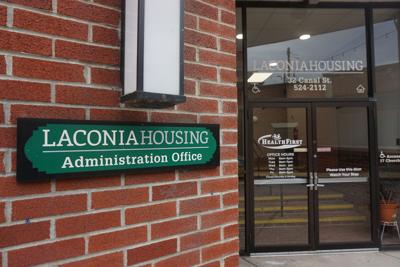
LACONIA — Facing a budget shortfall in housing assistance, representatives of the Laconia Housing Authority told councilors on Monday night the program — already stretched thin — may be forced to reduce its number of vouchers, potentially impacting between 42 and 79 households.
Executive Director Catherine Bowler told councilors the housing agency is short $146,000 in its Housing Choice Voucher Program, colloquially known as “Section 8”. Last year marked the first time the housing authority experienced a budget shortfall in its history.
“To our knowledge, we’ve never been in a shortfall status,” Bowler said. “What shortfall means is you don’t have enough money to pay your current listing of landlords and vouchers out on the street through the end of a calendar year, which is Dec. 31. You fall into a shortfall if you cannot do that — last year was Laconia Housing’s first time that we went into a shortfall status.”
Depending on the funding secured at the federal level — a proposal in the U.S. Senate would fund the program at 97.5% of previous funding while another in the House would fund it at 88.59% — Laconia Housing Authority may be forced to offer between 42 and 79 fewer housing vouchers to eligible households.
Many of those included in this specific program and who could be affected by the shortfall are either elderly or disabled, Bowler explained. Those conditions could exacerbate an already difficult situation, as the waiting list for the program is at 821 applications and growing: the agency received 24 applications since Jan. 1. The waitlist can be about three years long.
“So are you saying that, based on current funding in the House and the Senate, the people that will be impacted most are going to be seniors, disabled, veterans?” Mayor Andrew Hosmer asked.
“They could be veterans, if a veteran is in a unit, yes,” Bowler said.
The problem is not isolated to Laconia Housing Authority. Nationally, if funded at the level proposed in the Senate, the housing assistance payment program would require an additional $790 million to reach full funding, reducing the number of families who’d receive assistance by up to 64,000. If the House bill is implemented, that number could skyrocket to 286,000 fewer families and Laconia Housing Authority would potentially serve 79 fewer households as compared to the period prior to the shortfall.
“If the Senate, 97.5%, it’ll be 42 people who lose vouchers, if it’s [U.S. House of Representatives] it’s 79 people who will lose housing,” Bowler said. “We are taking in people on our waitlist and applications, but here are the ramifications of what’s happening: we are not allowed to issue a voucher out on the street. If we did, we would be in noncompliance with [U.S. Department of Housing and Urban Development] and we would be in serious jeopardy, they may force us to pull back vouchers from somebody in the community.”
In New Hampshire, in addition to Laconia, housing authorities in Concord and Rochester as well as New Hampshire Housing are also in shortfall, and still others are near shortfall, Bowler said. Without adequate funding, housing authorities may be required to suspend issuing new vouchers.
Overall, Laconia Housing operates with a budget of about $14.2 million for all programs and properties. They offer the city and city landlords access to housing assistance payments through the housing choice voucher program with $4.3 million of awards subsidized federally. The Section 8 program was established in 1974, and evolved into the Housing Choice Voucher Program in 1983. It’s the largest rental assistance program in the country, serving over 2.3 million households through its subsidies.
These vouchers are administered locally by agencies like Laconia Housing. They determine tenant income eligibility and inspect units to ensure they meet standards set by the U.S. Department of Housing and Urban Development, then negotiate reasonable rents which reflect the local market.
Tenants pay roughly 30% of their income toward their rent, and the local housing authority pays the remainder directly to the landlord, up to the federal limit. Most recently, that figure was $1,300 each month. Tenants are required to regularly verify their income and composition of their household to maintain eligibility for the program.
It’s seen as mutually beneficial by proponents, guaranteeing landlords will receive their rent, and for families, promoting economic self-sufficiency by reducing financial burdens and increasing housing mobility by allowing them choice in where they live.
“We used to be at an average subsidy, in 2018, at $575. Today, at the end of 2024 ... our average subsidy was $833 in order for that person to only pay their 30%,” Bowler said.
The average monthly subsidy has increased in recent years, rising from $548 in 2019, to $833 in 2024. The average monthly rate per bedroom has generally increased as well, to $1,163 in 2024, though it was higher in 2023, at $1,218.
In 2024, HUD funded the program in Laconia at $4.1 million, but the local housing authority paid out $4.3 million in housing assistance. Depending on the level of funding earmarked at the federal level, the local shortfall could increase from about $146,000 to between $343,831 and $731,154.
“If the federal funding doesn’t keep up with the dynamics of the market, that’s where the delta gets bigger, correct?” Hosmer asked.
"That's exactly where we’re at,” Bowler said.
The award received by Laconia Housing in recent years has not kept pace with market inflation, they say, and their shortfall status contributed to their ability to serve 12 fewer households in 2024 compared to 2023. They were fully funded in 2023.
“We started out with $82,000 leftover from 2023, so they allow you to keep so much of your money in reserve. We used up all of the reserve plus our award, the $4.118 million, and we spent $4.387 million in 2024,” Bowler said. “We came up with a $146,000 shortfall.”
In order to be fully utilized at $833 and issue 509 vouchers, Laconia Housing would need $5.222 million. Last year, they issued 445 of 509 maximum vouchers available.
“We are nowhere near what we should be getting,” Bowler said.
Laconia Housing itself owns and manages 10 properties in the Lakes Region, and provides 351 affordable units. The Housing Choice Voucher Program uses 443 of the 509 vouchers awarded across their properties and others in the region, and has a current waitlist of 821 unique applicants. The number of vouchers used varies across their properties.
“This blows a hole in the housing continuum, doesn’t it,” Hosmer said.
Bowler said the local housing authority is experiencing pressure from HUD to reduce their number of total vouchers.
“Basically what HUD wants us to do is to get down to, like, 423 vouchers, or 420 vouchers,” Bowler said.


(1) comment
I would like to know why, if they are in such financial distress, did they just spend thousands and thousands of dollars to replace perfectly good water heaters with on demand units in all of the apartments at the Orchard Hill complex.
Welcome to the discussion.
Log In
Keep it Clean. Please avoid obscene, vulgar, lewd, racist or sexually-oriented language.
PLEASE TURN OFF YOUR CAPS LOCK.
Don't Threaten. Threats of harming another person will not be tolerated.
Be Truthful. Don't knowingly lie about anyone or anything.
Be Nice. No racism, sexism or any sort of -ism that is degrading to another person.
Be Proactive. Use the 'Report' link on each comment to let us know of abusive posts.
Share with Us. We'd love to hear eyewitness accounts, the history behind an article.