


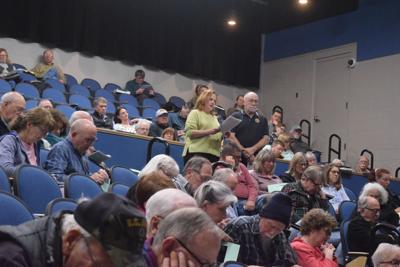
MEREDITH — Town Meeting lasted for about 4.5 hours Wednesday, and while the majority of time was spent on the budget and related seven warrant articles, there was plenty on the warrant for spirited discussion among the roughly 250 audience members.
Keno ban passes by 3
The closest vote of the night was opting out of Keno in Article 20, which passed 99-96 by secret ballot vote following comments from supporters of the game of chance in town, as well residents against it.
A “yes” vote in this case prohibited the operation of Keno games within the town. Keno was not allowed in Meredith bars leading up to the vote, but House Bill 737 required municipalities to bring the decision to the voters by June 1, 2027, or it would be automatically permitted.
Members of American Legion Post 33 were in favor of Keno, and members Melissa Dever and John Dever spoke at the Feb. 23 public hearing, as well as at Town Meeting. Melissa, at Town Meeting, noted the positives of having Keno in town, referring to a VFW post in Laconia showing they had $62,000 in annual income in one recent filing year. As the Post 33 finance officer, she said this keeps revenue in town.
“Meredith supporting Meredith.”
She has said Keno helps organizations like American Legion Post 33, as funds would help support the mission to assist local veterans, as well as maintain the facility as a safe and welcoming community gathering location.
At the public hearing, she said Post 33 is committed to be in full compliance with state and local laws, and would ensure all Keno activity remain well managed, transparent and community focused.
Bob Manley owns Hermit Woods Winery & Eatery, and said there is evidence over the years that suggests gambling has helped business, and much of what Melissa Dever said leads to great outcomes. However, he always fears much of the funding from gambling comes from people with an addiction.
Tyler Willey runs Frog Rock Tavern with his father, and spoke in favor of Keno. He said with The Mug right down the road, in Center Harbor, and High Octane Saloon and The Looney Bin, at the Weirs, not much further, people who want to gamble can take their business to those locations.
“If I was a newcomer, I wouldn’t choose Meredith, because of these reasons,” Willey said.
Willey also said the state has approved gambling, and he can sit at a bar and bet $10,000 on Draft Kings, or drive over to Cumberland Farms to get a scratch ticket.
“No municipality or resident should decide what I can and cannot do in the four walls of my business,” Willey said.
Steve Conkling said there was no reason to keep Keno out of town, and it should be up to the individual to decide whether they play, or not.
“They tried prohibition in the teens and ‘20s, and that didn’t work out that well,” he said.
Cookie Boulanger said, at 80 years old, she enjoys her bingo, and most people are just playing, and aren’t causing trouble.
“I have no problem with having Keno in the town of Meredith,” Boulanger said.
Brad Rohdenburg, a retired U.S. Marine, said Keno has nothing to do with veterans, and he doesn’t think it should be tied to them.
“You can find stupid ways to lose money online, but that doesn’t mean our town should be facilitating it,” he said.
Despite most of the discussion coming from people in favor of Keno, the decision came down to a 3-vote margin to prohibit the game.
Other articles
Article 9 kicked off the meeting, and preceded most of the fireworks stemming from Articles 10 through 17, involving the budget and associated projects.
By passing a ballot vote of 203-24, the town approved using $900,000 for Water Treatment Plant filter upgrades.
The four filters are at the end of their useful life, and the repairs will involve removing and replacing the existing filter media. They will also be sandblasted and recoated with epoxy coating. The project is expected to last through next year.
About three hours later came the passage of Article 18, which asked voters to modify provisions for an optional veterans tax credit to $4,500, which was an increase of $500 from the amount set at 2020 Town Meeting.
Thirty-one Meredith property owners receive the credit, and recent state legislation removed the requirement for communities to combine the $500 Optional Veterans Tax Credit with the Service-Connected Total and Permanent Disabled Veterans Tax Credit. Adding the $500 makes up for the loss of the Optional Veterans Tax Credit for disabled veterans.
Article 19 was to see if the town would vote to designate a parcel of town-owned land as Town Forest, and passed by card vote.
The 37-acre parcel is located off Meredith Neck Road, and is to be included as part of Page Pond Town Forest. One resident made an amendment to have an environmental impact assessment done, saying while it is a nice addition, it is like a highway of trails out there. He wondered about what it means for wildlife in the area.
Conservation Commission Chair Scott Powell said the purpose is to bring it under their stewardship and protect it. It will include the same rights and privileges allowing for hunting, fishing, and recreational trails.
Attorney Timothy Sullivan said since the amendment updated the subject matter, it would be illegal, so the resident withdrew the amendment, and the article passed by card vote.
Articles 20 and 21 were petitioned, by Rick DeMark, and passed by card votes.
Article 21 called on the state Legislature to protect local taxpayers by ensuring adequate state revenues for essential services, as well as avoiding polices that shift cost to local taxpayers.
According to material distributed about the article, it was brought forth because state budgets have cut or eliminated revenue sources, which leads to property taxes increasing.
Proponents of the article said voting “yes” sends a clear message the town expects the state to pay its fair share, noting a more fair state budget leads to stronger communities.
Article 22 asked voters if they believe school budget decisions should remain with local voters, instead of being restricted by statewide, one-size-fits-all spending caps.
Information about the article was distributed by petitioners before the meeting, saying it intended to protect local control of school budgets.
The petitioners’ material stated it matters now because of proposed legislation that would impose state-mandated spending caps on school budgets. While the state pays less than 30% of education costs, the cap would apply to all district budgets. Proponents of the article say this would reduce flexibility to respond to enrollment changes, facility and staffing needs, and costs for health insurances, transportation, and special education.
They said a “yes” vote protects local voter control over school budgets, prevents the one-size mandate, preserves flexibility to meet real-world costs, and defends educational quality, local accountability, and home values.
DeMark noted House Bill 1300 was being voted on the following day, and if it passed there would be a vote every two years for a local tax cap. The bill passed in the House 177-160.





(0) comments
Welcome to the discussion.
Log In
Keep it Clean. Please avoid obscene, vulgar, lewd, racist or sexually-oriented language.
PLEASE TURN OFF YOUR CAPS LOCK.
Don't Threaten. Threats of harming another person will not be tolerated.
Be Truthful. Don't knowingly lie about anyone or anything.
Be Nice. No racism, sexism or any sort of -ism that is degrading to another person.
Be Proactive. Use the 'Report' link on each comment to let us know of abusive posts.
Share with Us. We'd love to hear eyewitness accounts, the history behind an article.