


For the first time in a decade, a large coordinated effort to conduct water quality testing across Lake Winnipesaukee immediately following ice-out started Monday morning.
Ice-out was declared by Dave Emerson of Emerson Aviation just after 7 a.m. on April 16. The sort of official-unofficial declaration denotes the date and time when the M/S Mount Washington is able to reach all of its ports of call across Lake Winnipesaukee each year.
Working in eight teams, environmental conservation groups and volunteers, marine recreation companies, state scientists and staffers from the University of New Hampshire worked to gather samples for testing of numerous variables across 12 deepwater sites around the Big Lake.
Volunteers with Irwin Marine, Freedom Boat Club, Meredith Rotary Club, the Laconia Conservation Commission, New Hampshire Fish and Game, the state Department of Environmental Services and UNH contributed to the effort.
Striking a different chord as compared to routine summer sampling conducted each year, which measures conditions in the upper layers of the lake, organizers and volunteers on Monday sought to gather information about conditions throughout the entire water column.
Last year, the lake and its residents experienced several significant cyanobacteria blooms, contributing to warnings across all areas of the lake. Those conditions may have contributed to a heightened awareness and thus increased interest among the public in safeguarding Lake Winnipesaukee.
Cyanobacteria is a naturally occurring aspect of the ecosystem, but its effects — some negative — on humans are not well understood.
“It’s been around forever, but as humans we haven’t had to deal with the side effects for very long,” Lake Winnipesaukee Alliance Conservation Program Manager Bree Rossiter said Monday.
Fertilizers, which often contain phosphorus among their components, are a significant contributor to cyanobacteria growth. Luckily, phosphate-free fertilizers are available, albeit there isn’t legal enforcement dictating their use.
“It’s significant,” Rossiter.
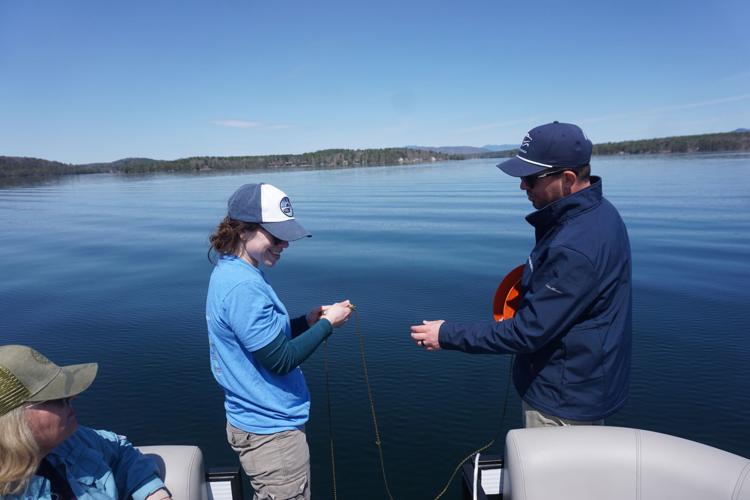
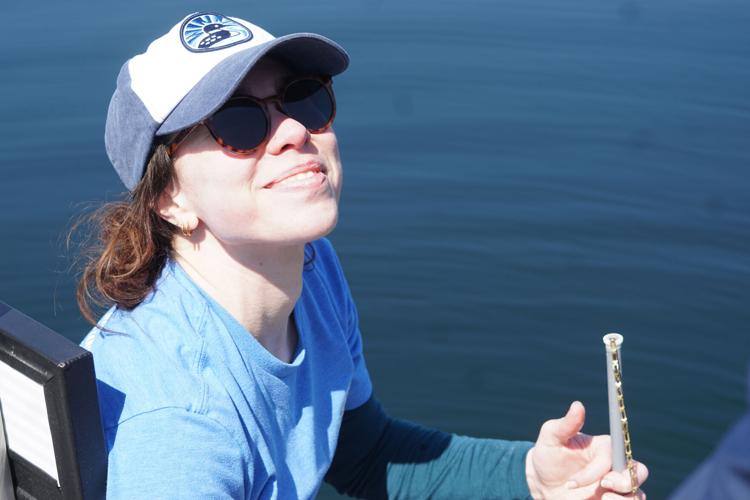
Team four, comprising members of the Lake Winnipesaukee Alliance in collaboration with Freedom Boat Club, worked to record vital statistics and collect samples for further analysis at one deepwater site near Governor’s Island.
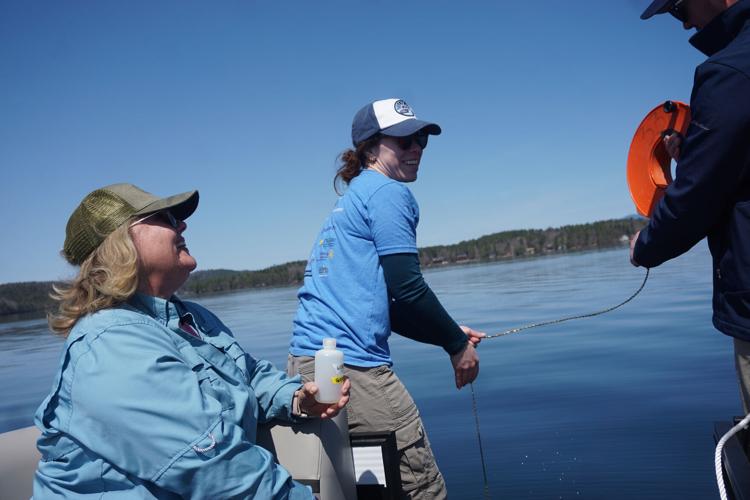
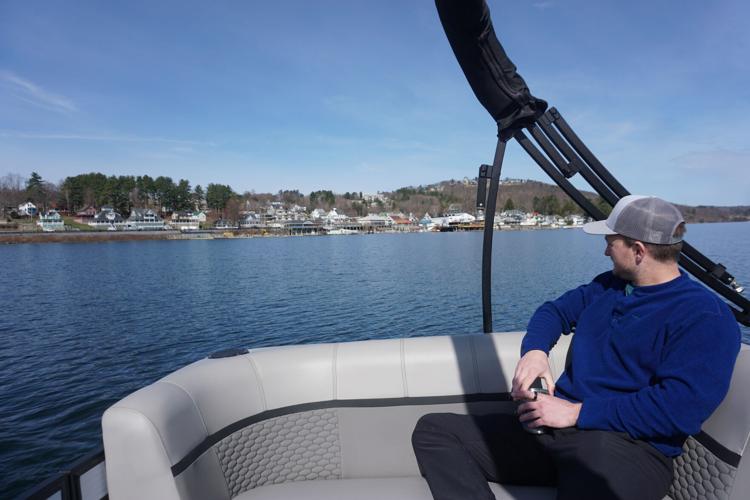
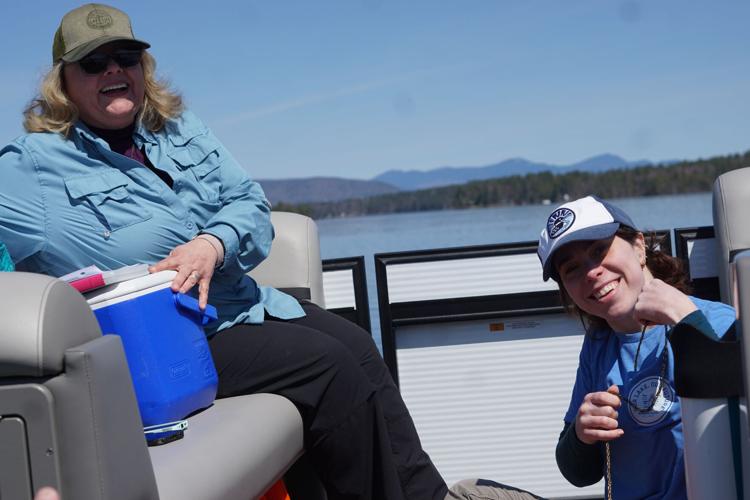
Boarding a large pontoon boat on the Weirs Channel at North Water Marine on Monday morning, Freedom Boat Club franchise owner Kyle Gassman navigated Rossiter, Joanne Haight, LWA director of outreach and development, The Laconia Daily Sun and filmmaker Gunner Found of CineTrek Media toward Governor’s Island and the group's designated deepsite.
“The whole purpose of this is to establish a baseline of what’s happening,” Rossiter said Monday morning.
With minimal boat traffic on the lake, conditions were pristine, and the waters were cold.
Initial observations appeared positive.
Ice-out sampling is important. After the surface ice is gone from Lake Winnipesaukee, the lake experiences a natural mixing process known as “spring turnover”, when the surface water warms up to about 39 degrees Fahrenheit and closely matches temperatures of deeper waters down below. Uniform temperatures facilitate the mixing of the water column, which redistributes oxygen and nutrients throughout the lake, replenishing oxygen levels and supporting aquatic life.
Typically and ideally, during and coming out of winter, the lake is essentially uniform in temperature. Through summer, the sun penetrates the water column and heats it up, trapping nutrients in the sediments at the bottom. Ice coverage helps keep the sun from penetrating and delays stratification.
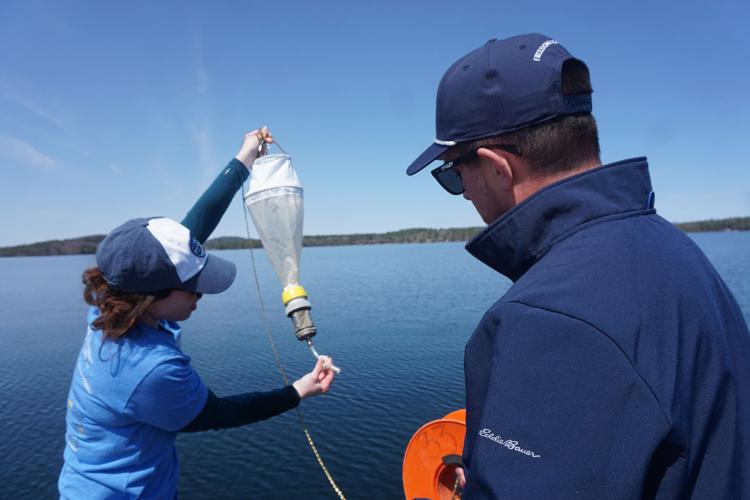
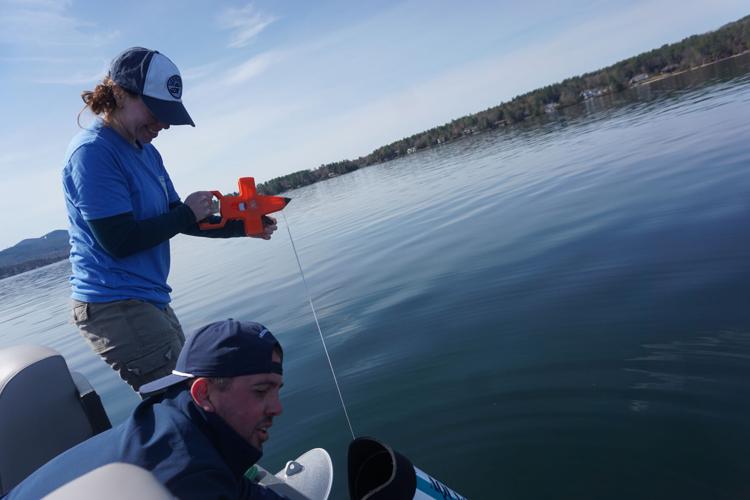
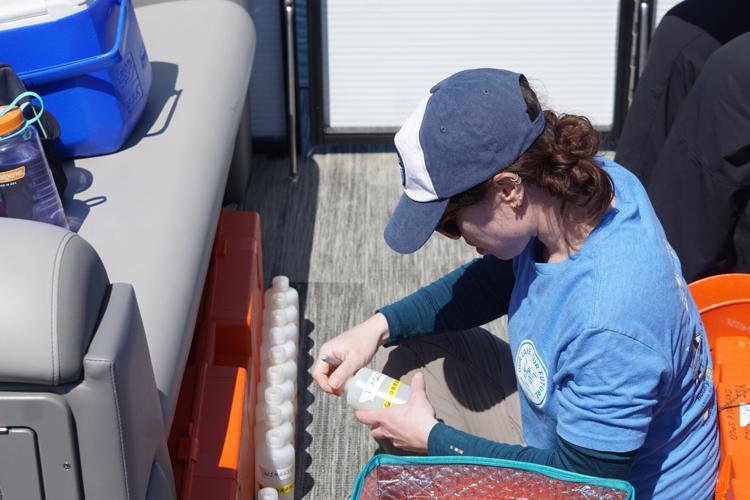
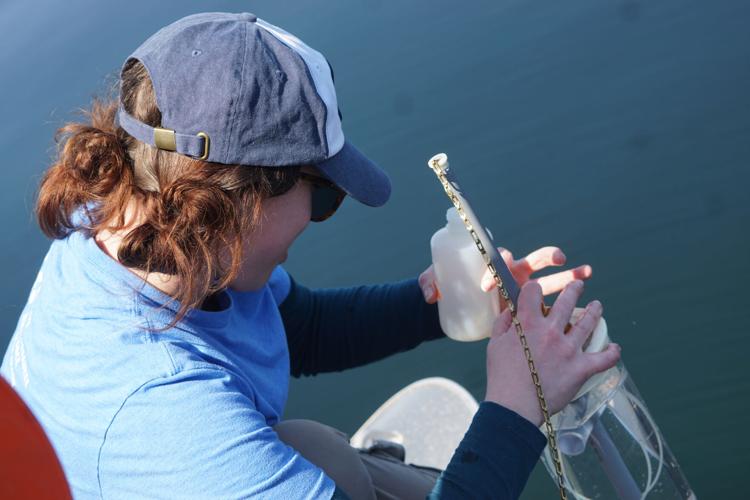
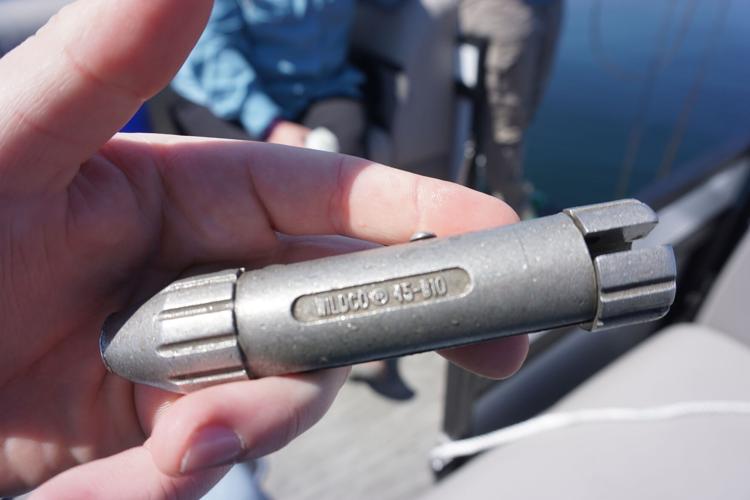
Scientists were also tracking the relative levels of phosphorus — one of the major contributors to cyanobacteria blooms in the lake — within the water column. At the deepsite near Governor’s Island, Rossiter, Haight and Gassman worked with Kemmerer bottles to collect water samples every three meters, tracking nutrient distribution throughout the water column.
“We’ll do that all the way down to the bottom,” Rossiter said while underway.
Internal loading is the release of phosphorus and other nutrients from sediment at the bottom of the lake back up into the water column, which can contribute to or exacerbate cyanobacteria blooms, Rossiter explained. That dynamic can still be at play even if external contributors — like stormwater runoff, failing septic systems near the lake or fertilizer input — are minimal.
Springtime can be somewhat precarious, in terms of the health of the lake. Runoff from rain can wash nutrients from the land into the waters, especially after a winter of heavy municipal use of salt and sand.
Teams taking part in the effort also monitored temperature and oxygen levels throughout the lake, from the surface down to the bottom. If deeper parts of the lake are anoxic — meaning under conditions of low-oxygen — at the beginning of the season, it can bode ominous for cold-water species like trout, which depend on a cold and oxygen-rich environment.
“Having a good amount of oxygen throughout the water column is a good sign,” Rossiter said.
Monday morning, water temperatures at the site near Governor’s Island fluctuated by just 1 degree celsius, from the surface down over 100 feet to the bottom, and the relative level of oxygen was quite high to the bottom, too.
Bob Craycraft, a cooperative extension program manager, said Tuesday the sites his group monitored — near Alton, Center Harbor and around Bear Island in Meredith — garnered similar results.
“The water temperatures were pretty uniform to the bottom,” he said, noting there were some fluctuations in clarity between locations. “That’s kind of the nature in Winnipesaukee in general.”
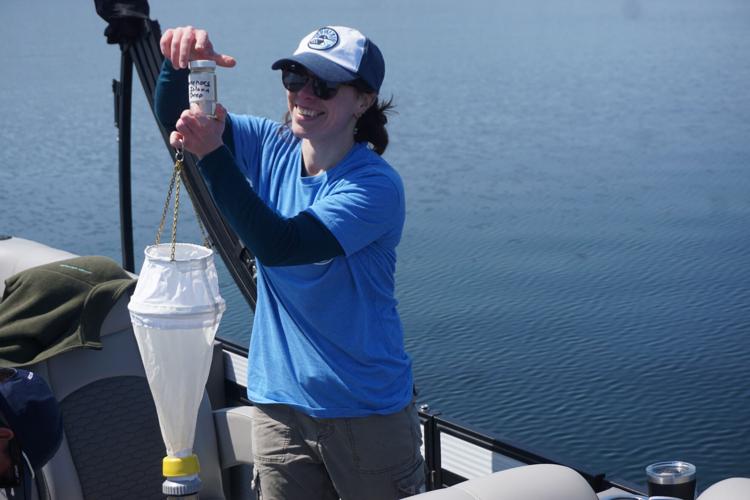
Researchers and volunteers also collected microscopic organisms like phytoplankton — which perform photosynthesis — and small aquatic animals called zooplankton using a plankton tow net. Those tiny creatures are the base of the lake’s food chain and by sampling them, scientists can catch early warning signs of cyanobacteria development in our waters and form an overall better understanding of the lakes’ ecology.
“The plankton, it tells you a little bit about what’s going on in the food web, kind of way down at the lowest level,” Rossiter said.
Craycraft’s group didn’t notice any larger plankton visually, like an invasive creature called the spiny water flea, though testing by DES is set to be completed at a later date. Staff at UNH will be starting Thursday an analysis of the nutrient profiles gathered, paying particular attention to phosphorus levels.
As part of the monitoring effort, those involved also used Secchi disks to gauge the relative clarity of the water over the 12 deepsites monitored on Monday. Near Governor’s Island, the water was clear through nine meters, which was a positive result, Rossiter said while on the boat.
“It’s great,” she said. “We ideally want it to be somewhere between eight and 10" feet.
"That's definitely exceptional," Amy Smagula, chief aquatic biologist at DES said Tuesday.
Smagula said the coordinated testing effort went well, and they're working to analyze plankton samples now. That process will likely take a few weeks before results are summarized, and referred members of the public to LWA for results when available.
The effort was important, Smagula said, because they'll be able to compare their results to the only two other ice-out datasets they have: one from April 2010 and another from May 2015.
"The oxygen concentrations were really good throughout the water column," she said.
Limited water quality testing is performed by a team of about 50 volunteers with LWA each year.
“We’re always looking for more people to be involved,” Haight said Monday.
“We have this fabulous resource here — we can’t take it for granted.”


(0) comments
Welcome to the discussion.
Log In
Keep it Clean. Please avoid obscene, vulgar, lewd, racist or sexually-oriented language.
PLEASE TURN OFF YOUR CAPS LOCK.
Don't Threaten. Threats of harming another person will not be tolerated.
Be Truthful. Don't knowingly lie about anyone or anything.
Be Nice. No racism, sexism or any sort of -ism that is degrading to another person.
Be Proactive. Use the 'Report' link on each comment to let us know of abusive posts.
Share with Us. We'd love to hear eyewitness accounts, the history behind an article.