


With all of the tumult in recent school years due to the pandemic, it’s been easy to miss what would otherwise have been a huge change: federal funding has been available to make school meals free for every student.
The change has resulted in some expected, and some unexpected, outcomes.
The least surprising outcome has been that students are eating the breakfasts and lunches served by their public school more than ever.
Statewide data, provided by a spokesperson for the New Hampshire Department of Education, show the rates for the 2021-2022 school year on pace to easily exceed participation in the 2018-2019 school year, the last one unaffected by COVID. Most significant is the breakfast participation rate, which by the end of December of this school year had already eclipsed the pre-pandemic yearlong figure.
Local food service managers, at districts that are taking advantage of the funding, reported similar results.
Robert Cohen, food service director for Winnisquam Regional School District, said, “Participation for food service has been incredible. This year the children are scoffing down breakfast and lunch in record numbers. We like to think it’s because our homemade food is excellent but we also know that it’s free and that helps."
In Laconia, participation rates were in the mid-60s, by percentage of students who ate meals prepared by the school. Now that rate exceeds 80% at some schools, said Tim Goossens, food service director.
Arlene Green, at Gilmanton School District, said she has also noted an increase.
Free and reduced lunches have always been available to those students whose families qualify, based on income level, but that has required the parents to fill out necessary paperwork. By making all lunches free, it means that there are likely students eating who wouldn’t have before, because the adults at home wouldn’t have requested assistance, for one reason or another.
The universally free meals have also alleviated what had previously been a perennial problem for food service departments: chasing families who carried significant debt. As most food service programs aim to be self-sustaining, having a handful of families that owe several hundred dollars can put food service directors in uncomfortable situations.
“Having free student meals eliminated one of the toughest parts of my job, which is to collect negative student debt from families who struggle to pay for their children’s meals,” said Cohen.
In Laconia, Goossens said his staff serves five meals a day: Breakfast, fresh fruit and vegetable snack, lunch, and then for kids in afternoon programs, an after-school snack and then a supper.
Adults who remember school lunches they ate decades ago might be surprised by the quality of food served in today’s public schools, said Goossens. Federal rules require whole grains, lots of vegetables, and limits to sodium and fat.
“It’s difficult to come into any school and find a meal that is not healthy,” Goossens said. Prior to the pandemic, each Laconia school, even the elementary schools, had a salad bar, he added.
Having more meals to serve can also translate into better choices, he said. In any food service operation, greater volume makes possible more options, what Goossens called “more vibrancy.”
Yet the change has come with its own complications. With more meals to serve, the supply chain disruptions wrought by the pandemic have been magnified in their impact.
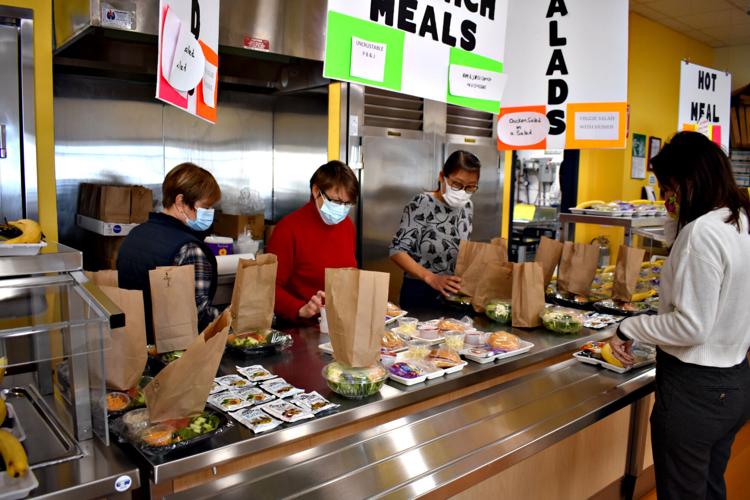
Gone, for now, are the days when cafeteria workers serve by scooping food out of steam trays and directly onto a student’s plate. Now, all meals are pre-packaged onto trays so as to minimize interaction – and possible virus transmission – between students and staff. That requires a wide array of paper and plastic containers and their appropriate lids. Those materials have been inconsistently available, and when they can be ordered, the price one week might be greatly increased over the previous week. That leads directors to stockpile materials, even though they know that only exacerbates supply chain issues for other consumers.
And the cafeteria workers can’t rely on the availability of the food that they put in those containers. Goossens said it used to be that out of every 100 items he ordered, 98 of them would actually be delivered. Now it’s more like 60 to 65 out of 100, which is a headache when menus are planned out weeks in advance. And, like containers, food prices can jump without warning.
“It’s harder to get food, and it’s harder to get stuff, than ever before,” Goossens said. Once he gets it, budgeting is another fiasco. The cost of chicken breast, for example, has doubled this year, and the cost of sanitary gloves for his workers has quadrupled.
If he’s unsure of what’s going to happen next month, next year is an even bigger question mark. But it’s one that food directors can’t ignore, either. Goossens said that he is currently building his budget for next year, and it’s still unknown whether or not the federal funding will continue to be available for free food for all. Should he budget for 60% participation rates or 80%? Anyone who can predict the actions of Congress is invited to give him a call.
At least one local district chose to let the headaches and confusion of the free lunches pass them by. Gilford School District voted unanimously in August to turn down the federal funding and continue with the conventional food service model, said Gretchen Gandini, Gilford School Board chair.
“It was our understanding that the current model was meeting the needs of our community and students,” Gandini said. The board concluded that making lunch free might translate to greater food waste, and that the cafeteria staff and administrators were able to reach out to struggling families to get them signed up for the free and reduced meal program. “The current model seems to be sufficient,” Gandini said.
Running a school food service program over the past two years has been an exercise in adaptation and resilience. Goossens said he hopes that any future changes include at least one return to normalcy.
“When this whole thing first started in March 2020, people thought the world was coming to an end. And for some people it did.” Goossens recalled how his kitchens became food depots for distribution to families suddenly stuck at home. Then it was figuring out how to serve meals in a constantly shifting environment, such as when students attended school on a hybrid remote schedule.
“I think people were satisfied to be able to pull that off and then to move on to the next phase,” Goossens said. “Everybody’s going to be so happy to be seeing those kids come through the line without their masks on and make their choices.”


(0) comments
Welcome to the discussion.
Log In
Keep it Clean. Please avoid obscene, vulgar, lewd, racist or sexually-oriented language.
PLEASE TURN OFF YOUR CAPS LOCK.
Don't Threaten. Threats of harming another person will not be tolerated.
Be Truthful. Don't knowingly lie about anyone or anything.
Be Nice. No racism, sexism or any sort of -ism that is degrading to another person.
Be Proactive. Use the 'Report' link on each comment to let us know of abusive posts.
Share with Us. We'd love to hear eyewitness accounts, the history behind an article.