


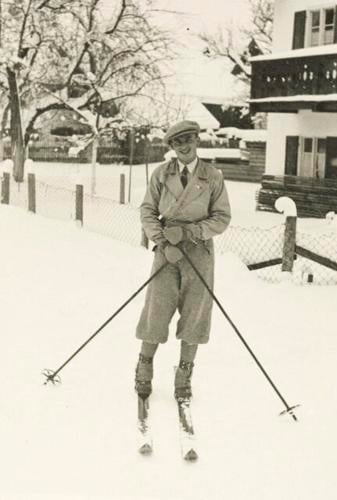
WOLFEBORO — A young skier, enamored of the sport, purchases the best pair of skis, with the latest and fastest design, that they can afford. It’s a story that has happened countless times over the history of the sport, but this skier’s purchase took place nearly a century ago, and an ocean away.
Next month, though, the skis will traverse time and space to take up their home for the foreseeable future at the Abenaki Ski Lodge.
The skis are 1929 Allgäu skis of mostly wooden construction — as skis had been made for millennia before — but these featured two strips of metal along the bottom edges of both skis (a construction technique universally employed today) which allowed skiers to take corners faster and sharper, and with more control.
In 1929, when a young Hermann Schütze bought his pair, the steel edges had only been on the market for three years, patented in 1926 by Bavarian ski maker Rudolf Lettner.
When Schütze bought those skis, he was likely looking ahead to a promising future. He was a medical student and planned to take over his father's established and respected medical practice. And he was an enthusiastic skier at a time when the sport skiing industry was burgeoning.
Yet, within a few years, the future Schütze had envisioned for himself was but a young man’s fantasy, as the raging winds of history swept his life — and the lives of so many millions around the world — of course.
Schütze is believed to have died during World War II, but his beloved skis survived. Their survival was first a story of hope, then became more about love and the endurance of the human spirit, even through times of anguish. Through another twist of fate, the skis became entrusted to an American, who spent years searching for the proper place to honor the skis, and all they represent. He said he knew he finally found the right place when he first walked through the doors of the Abenaki Ski Lodge.
The Dr. Hermann Schütze skis will be formally accepted by the Town of Wolfeboro, which operates the Abenaki Ski Club, at 2 p.m. on Saturday, Dec. 2, at the Kingswood Arts Center. The program includes officers from both the German and American military, local and state dignitaries, as well as a recorded message from one of Schütze’s children.
Compulsory service
Even as the storm of Nazism was building, Schütze’s life was continuing according to plan, at least for a few years. He graduated with honors from medical school, married the love of his life Ehefrau Wiltrud in 1938, and the following year, with a growing family, joined his parents’ medical practice in the peaceful town of Bad Kissingen, located between Frankfurt and Nuremberg.
The next year, the events he was attempting to stay apart from came knocking on his door. In 1940, Schütze was compelled to leave his practice and join the Luftwaffe — Nazi Germany’s Air Force — as a physician.
Schütze and his family had neither been members nor supporters of the National Socialist Party. In fact, they had been quietly subversive. Schütze’s father had developed a hobby of building radios out of old cigar boxes, and distributed them to trusted friends so they could hear actual news, not just the propaganda distributed by the government.
Schütze was first given a comfortable assignment in France. However, he was perhaps too eager to share his disagreements with the party ideology — and the Nazi’s secret police had many ears — and found himself reassigned to less hospitable locales. His last station was along the Russian front, and the last known sighting of him, according to a letter another soldier sent to the family, was on Aug. 20, 1944, when Schütze and a group of other soldiers entered a wooded area near the city now known as Vilnius, Lithuania.
Less than a year later — in May 1945 — the Allied Forces had defeated Nazi Germany and the U.S. Army took over the Schütze family home. Ehefrau had died two years earlier, and the remaining members of the family — Schütze’s mother and his two children — were turned out into the street.
The Schütze family, like the rest of the country, was destitute at the end of the war. They were burning furniture to keep warm, and Schütze’s leather ski boots, which the children Hilla and Manfred used to put on to see how big their father’s feet were, had been traded to a neighbor for a few bites of food. But never once did the family consider burning the skis as fuel, or trading them for some material need. When the family lived at home, they held the skis up to show the children how tall their father was. After he stopped sending letters home, they kept the skis on an enduring hope he would return, pleased to find they kept his beloved skis.
The years immediately afterward were a struggle for survival. Manfred and Hilla were looked after by their grandmother, who had survived two world wars, and found shelter for the children in a neighbor’s cold basement. In 1956, the American government relinquished the home back to the Schütze family, who found that items they had hidden in the attic, including the skis and poles, were still there.
The American skier
Manfred and Hilla never married but instead looked after one another through their adult lives. The family clinic never reopened and was turned into apartments.
In 1990, Steven Reinfurt and his family rented one of the apartments. Steven was contracted to work as an educator with the Department of Defense. They lived in the Schütze home for 13 years.
Over those years, Reinfurt and Hilla connected over the strange ways their nation’s histories, and family histories, entwined.
Reinfurt’s family was also shaped by World War II. Both of his parents served, his mother as an Army nurse and his father in the First Infantry Division that was part of the invasion of Normandy. His parents married in Frankfurt after the war ended, but before they returned home to New York state.
Hilla noted that, although the American military had made them homeless for a time, their home was eventually returned. On the other hand, Reinfurt recalled her saying, “My country took our father because he would not submit to a political ideology he did not believe in and never gave him back. He was an exceptional man, son, husband, father and physician who we shall never forget.”
Manfred and Hilla weren’t skiers, but Reinfurt has a lifelong passion for the sport, both alpine and telemark. He is also credentialed for mountain rescue. Manfred died in 2004, which left Hilla the last member of the family, and the skis weighed on her mind. She explained their history to Reinfurt, and asked him to find a suitable home for them.
That was in 2008. He accepted her request, and began looking at every ski lodge he visited differently. At some, he asked if they would accept such a donation, but knew it wasn’t the right place when he would get an answer like, “those would look great in our bar.” They would also lose their story, their historical significance as just another bit of kitsch to amuse the apres crowd.
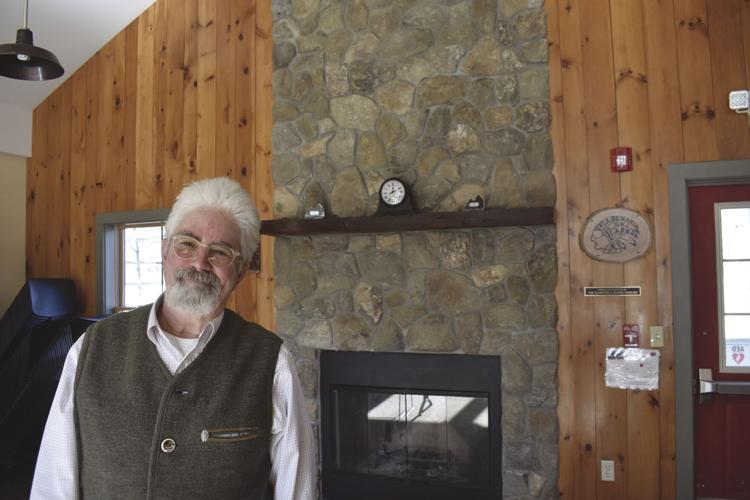
In 2018, Reinfurt walked through the doors of the Abenaki Ski Lodge for the first time, and sensed immediately that his search was over. There, posted on the wall at the entrance, was a poster detailing the history of the ski hill, which had been community-run since its founding in 1936 — a year when Schütze was still hoping to spend his life practicing medicine, raising his children and skiing. On the slope outside, a tow rope carried multiple generations of skiers up the hill for run after run. And above the lodge’s broad, fieldstone mantle was a space practically calling out for something to adorn it.
But Reinfurt was an outsider five years ago, a stranger on a strange quest. To take the next step, he had to become part of the community. He joined the volunteer ski patrol team, and got to know the people and families who keep the ski area running. He witnessed the beauty at work — where parents joke that they drop kids off when they’re 5 and pick them up when they’re 17, where the people selling hot dogs and cocoa know each kid by their first name, and where a small hill can shine brighter than the largest, fanciest resorts in the Rockies or the Alps.
When he felt the time was right, Reinfurt brought the idea to the Friends of Abenaki Ski Area, and then to the town’s selectboard, both of which offered enthusiastic support.
By finding a place of honor for the skis, Reinfurt said he feels that Schütze is finally getting the honor he deserves. And, he said, he has been taught a lesson through the process: The divide between past and present, between this life and the next, is not nearly as wide as one might think.
“The veil is so close,” Reinfurt said. “These skis, you can feel the spirit of many through this genuine heartfelt experience: Do for one and you’ve done for many. This is very healing. Love is stronger than death.”
“Somebody I never met, his skis became my teacher,” Reinfurt continued. “We have things behind us, things before us, but the things inside of us are the greatest things of all.”
•••
The Sunshine Effect is a new series in The Laconia Daily Sun highlighting the people and organizations working to improve our communities through volunteering and fundraising. We believe that telling their stories will encourage others to support their work, and launch new charitable efforts of their own. Have a suggestion for someone making a difference we should feature? Share it with us at laconiadailysun.com/sunshineeffecttip.


(0) comments
Welcome to the discussion.
Log In
Keep it Clean. Please avoid obscene, vulgar, lewd, racist or sexually-oriented language.
PLEASE TURN OFF YOUR CAPS LOCK.
Don't Threaten. Threats of harming another person will not be tolerated.
Be Truthful. Don't knowingly lie about anyone or anything.
Be Nice. No racism, sexism or any sort of -ism that is degrading to another person.
Be Proactive. Use the 'Report' link on each comment to let us know of abusive posts.
Share with Us. We'd love to hear eyewitness accounts, the history behind an article.