


MEREDITH — When she came to the U.S. in 1972 as the 26-year-old wife of an American engineer working in Japan, Kazuko Okubo shared her mother’s gilded vision: America was a land paved with endless opportunity – where daily life was laced with comfort.
“Before I came, America was a wonderful dream country. My mother said the sidewalks are all gold, and husband and wife go dancing,” Okubo said. “Now I know what is abuse. I know how to get over people.”
The circumstances awaiting Okubo here were far from her mother’s hope-fueled fantasy. Okubo’s husband brought her to south Florida, ostensibly for a month-long honeymoon. After they arrived, he announced they would be staying.
She left her business as a designer and dressmaker in Osaka, and her Samurai family, for a life that morphed into servitude and denigration by her husband’s relatives. Okubo was tasked with caring for his three children from a previous marriage, whom she didn’t know existed. Her husband often spent time with a girlfriend.
“Anything I do, I’m wrong, including feeding them vegetables instead of meat and potatoes,” said Okubo. “When in Japan, he was a good man, until he came to this country. I thought, if I stay in this home, I’m going to kill myself.”
She said she was treated three times in hospitals for attempted suicide. A critical barrier was not being able to speak English well enough to communicate to people who would listen.
When she ran away with her newborn child, police returned her to the situation she wanted to flee. Okubo and her husband later divorced. She became an immigrant and single mother without family ties, essentially a vagabond without a home country. In Japan, she was looked down upon as an unwed mother, and effectively disowned, she said.
After a subsequent abusive marriage dissolved, Okubo relocated to New Hampshire with her two young children. She slept outside in winter on the porch of an unoccupied summer house. Neighbors offered to care for her kids, including a toddler, while she looked for a full-time job. Okubo waitressed and worked at Walmart, and eventually earned enough to rent an apartment while caring for her daughter and son. She gained language fluency and independence.
“I think the U.S. is a wonderful country,” said Okubo, now 75. “People should realize how lucky they are. The U.S. is a very good country. Women have rights.”
Today she lives in an apartment adjacent to her daughter, son-in-law and grandson’s home in Meredith, and creates visual art that’s a metaphor for assembling a rewarding life from shattered pieces.
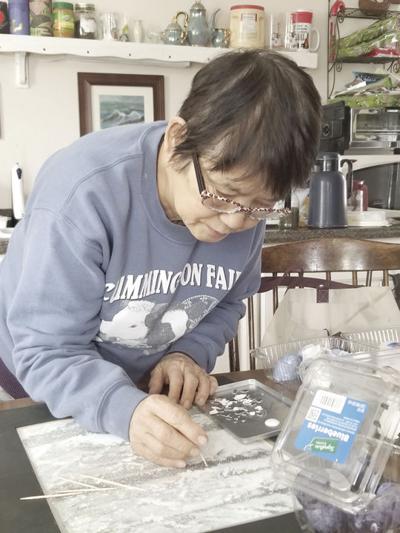
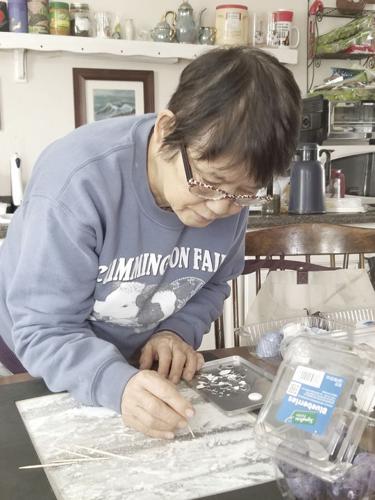
Okubo collects broken eggshells, carefully washes and dries them, paints them colors pale or deep, then smashes them with a hammer. Bit by bit, with a glue-dipped toothpick, she places the fragments on a drawing until they form a mosaic in miniature – a still-life of flowers inspired by a calendar illustration, a landscape of a single lighthouse facing a white-capped sea.
Her apartment is lined with her drawings, paintings, block prints, and eggshell images, the bulk of which are colorful and inspiring. In 2010, she wrote and self-published a book, “Japanese Wife,” chronicling her journey to safety and wholeness in a foreign country.
“My son said, I can’t touch it. My daughter said, I’m sorry I can’t read it because I will cry. ”
Today she is grateful and forward-looking. “Life is what you want to do,” she said. “I’m glad.”
She’s writing a screenplay based on “Japanese Wife” and a book about her experiences with the U.S. justice system and the prejudice she faced as an immigrant who spoke little English. She is optimistic about contributing her wisdom of years and inspiring young people.
She eagerly gives copies of the art she has made – and shelter to a homeless woman she took in this past November. Okubo's guest has been sleeping in her yellow studio upstairs.
“I was homeless and was cold outside in the winter. People took my kids to their house, but not me. I ended up sleeping on the streets,” Okubo said. “I try to help her out. I cannot do nothing. Whatever I have, I share.”


(0) comments
Welcome to the discussion.
Log In
Keep it Clean. Please avoid obscene, vulgar, lewd, racist or sexually-oriented language.
PLEASE TURN OFF YOUR CAPS LOCK.
Don't Threaten. Threats of harming another person will not be tolerated.
Be Truthful. Don't knowingly lie about anyone or anything.
Be Nice. No racism, sexism or any sort of -ism that is degrading to another person.
Be Proactive. Use the 'Report' link on each comment to let us know of abusive posts.
Share with Us. We'd love to hear eyewitness accounts, the history behind an article.